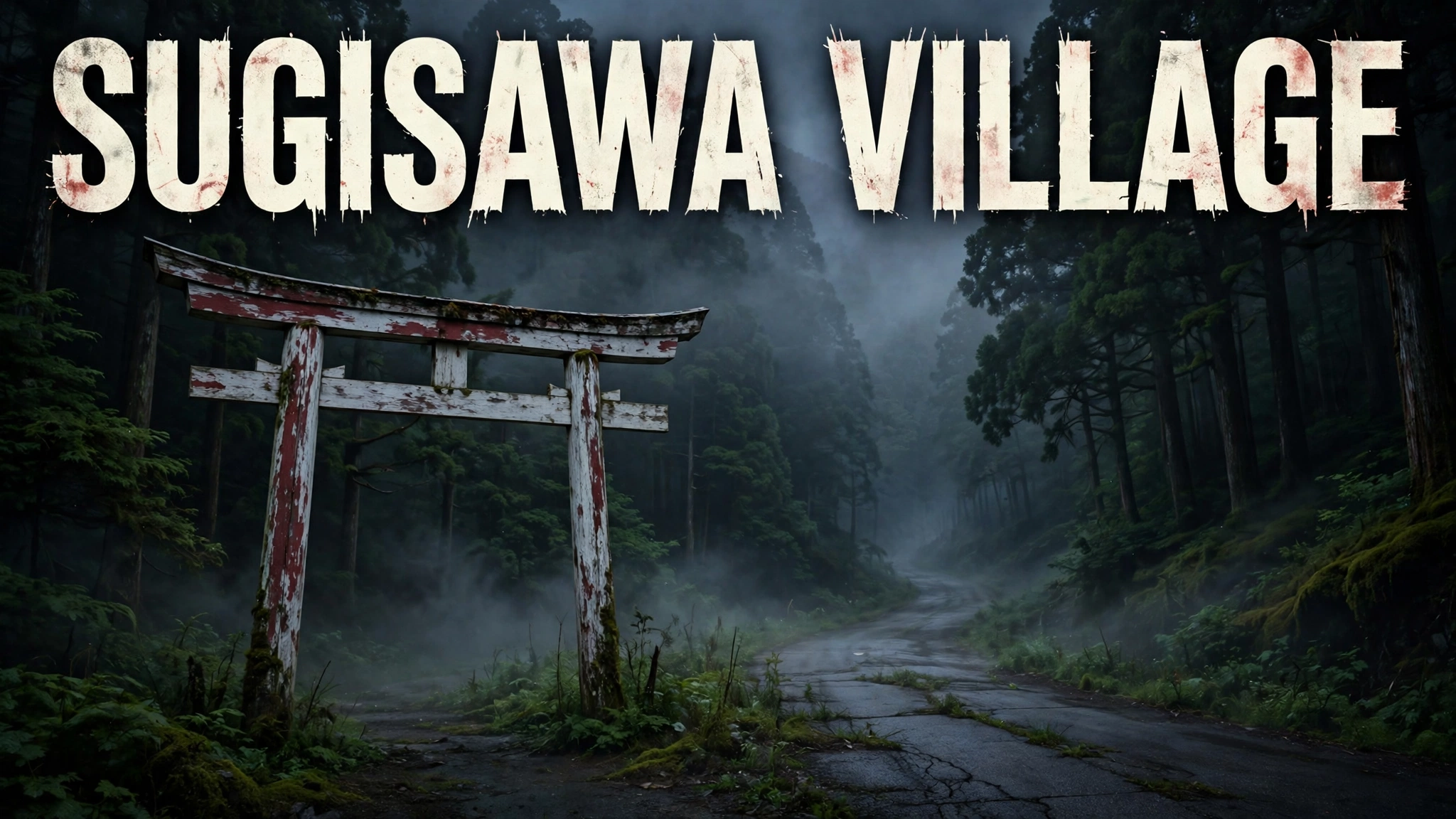
South of the city of Aomori in Aomori Prefecture, very close to Aomori Airport, a plain wooden torii gate stands between two cedar trees beside a paved road. The place is Obatazawa-Kosugi, Aomori City. This unremarkable gate has long been rumored to be the entrance to Sugisawa Village, a village where one villager is said to have lost control and murdered every other resident, after which the authorities erased the existence of the village and removed the name from the map as well.
At the entrance stands a red torii gate stained with blood, and beneath the gate rests a strange stone in the shape of a skull. From the 1990s into the early 2000s, the legend was featured on the variety programs Tokumei Research 200X and Kiseki Taiken! Unbelievaboo, and for a time grew into a social phenomenon.This article preserves the fragments of rumor that have circulated, while following the record that can actually be confirmed and the parts that remain unresolved as separate threads.
A village erased from the map. Strangely, however, a search for Sugisawa Village in Google Maps today brings up this very place. A village that should have vanished has returned to the map. Erasure and revival. That paradox is the most modern fragment of the Sugisawa Village legend.
- Observing the Area Around the Red Torii Gate on Google Maps
- The Structure of the Legend — A Story of Massacre and Erasure
- A Real Clue — The Plain Wood Torii Gate at Obatazawa-Kosugi
- Television Carried Sugisawa Village — Tokumei Research 200X and Unbelievaboo
- The Tsuyama Incident and Yatsuhaka Village — The Bloodline of the Rumor
- Until the Village That Had Vanished from the Map Appeared on the Map
- Our Reading — Not a Village That Vanished, but a Village That Was Erased
- In the Area
- What to Eat
- From Aomori Airport — The Road to the Red Torii Gate
- Fragments Assembled
- Sources & Further Reading
Observing the Area Around the Red Torii Gate on Google Maps
Open the satellite imagery at the observation point and look west of Aomori Airport. Only a few kilometers away, the view shows dense green, a well-maintained road, and a golf course. The landscape differs greatly from the image of an abandoned village deep in the mountains that the legend describes. After a sludge and sewage treatment facility was built in the area in 2007, the land is said to have opened up and development advanced.
In the satellite imagery, neither the torii gate, nor the skull stone, nor an abandoned village can be seen. The view shows only the quiet outskirts of Aomori. When the place that a rumor points to overlaps with a real landscape, however, the legend gains a vivid quality. A story may take root precisely in a place where nothing stands.
The Structure of the Legend — A Story of Massacre and Erasure
The skeleton of the Sugisawa Village legend closely resembles the legend of Inunaki Village. Long ago in this village, a young man, as if possessed by something, took up an axe and attacked the villagers, and the village was wiped out except for the young man. The young man then took his own life. The village, left without residents, had the existence of the village erased by the authorities and disappeared from the map as well.
The route to the village is said to carry clear signs. Along the mountain path appear an old signboard that should not exist and houses on the verge of collapse. The decisive marker is the bloodstained red torii gate, standing as if to repel intruders. At the foot of the gate, a stone with an eerie form that looks like the skull of a person or an animal is said to rest. A short distance beyond the gate stands a notice board with words to the effect that no guarantee of safety exists beyond that point, and deeper inside remain ruins stained with traces of blood, according to the account.
A torii gate at the entrance of the village, red as if stained with blood. The unnatural fact that a torii gate stands alone with no shrine has become the core of the rumor.
A rock at the foot of the torii gate that looks like the shape of a skull. Whether the rock truly looks that way is left to the imagination of each person who visits.
A sign bearing words to the effect that no guarantee of life is given to anyone who enters beyond this point. The sign forms a pair with the sign of Inunaki Village that voided the Constitution, as a marker of a boundary line.
Let the distinction be stated. These are rumors that have in fact circulated, and are not confirmed facts. No record has been confirmed of an administrative place name called Sugisawa Village, and no record of a mass killing of the kind described in the legend has been confirmed either. To savor a rumor as a rumor and to treat a rumor as fact are different matters.
A Real Clue — The Plain Wood Torii Gate at Obatazawa-Kosugi
Let us now look at the real place that the rumor points to. According to a report by Itsuki Asari, a researcher of strange phenomena, published in Web Mu, the place regarded as the entrance to Sugisawa Village is Obatazawa-Kosugi in the city of Aomori, very close to Aomori Airport. Contrary to the image of a remote mountain interior, the torii gate stands right beside a paved road and can be reached with ease. A golf course stands nearby, and a visit in daylight reportedly carries little sense of dread.
Beyond the torii gate stand monuments including a stone monument inscribed with the name Sarutahiko Okami, but no rock in the shape of a skull of the kind told in the legend was found, and no sign bearing the warning about no guarantee of life, and no ruins stained with traces of blood. Naturally, no abandoned village exists either. In the 1990s, the roads in the neighborhood had not yet been developed, but after a sludge and sewage treatment facility was built in 2007, the land opened up and development advanced, as Yuki Yoshida records in Kinsokuchi Junrei.
Most symbolic of all is the fact that a search for Sugisawa Village in Google Maps today brings up this place. Far from a village erased from the map, the village has newly been registered on the map. The legend has achieved a paradoxical triumph on the map.
Television Carried Sugisawa Village — Tokumei Research 200X and Unbelievaboo
The force that made the Sugisawa Village legend known across the country was television. Around 1999, the variety program Tokumei Research 200X featured the legend, and on August 24, 2000, the two-hour horror special of Kiseki Taiken! Unbelievaboo featured the legend as well, and for a time the story grew into a social phenomenon.
On the programs, staff members interviewed local people, and keywords such as the torii gate, the skull stone, the ruins, and the massacre were introduced as spoken accounts. Because a rumor told offline was put into text on networks, however, the natural reading is that the rumor spread while retaining detail. Even if a program concluded that the rumor was true, that conclusion confirms the existence of the rumor, and does not confirm the fact of a massacre.
Through the amplifier of television, Sugisawa Village changed from a local ghost story of Aomori into a haunted place known across Japan. A rumor, once given media, overwrites the real landscape.
After the broadcasts, people from across the country began to visit the area around Obatazawa-Kosugi to check the story in person. Visits late at night, noise, and litter left behind. For local residents, the situation was nothing but a nuisance. The effect that a ghost story has on real land is no laughing matter. As Yuki Yoshida records in Kinsokuchi Junrei, development after 2007 turned the area into open land, and the landscape keeps changing. The rumor, however, does not follow the change in the landscape and continues to be told in the old image. The gap between reality and rumor may in fact be widening.
The Tsuyama Incident and Yatsuhaka Village — The Bloodline of the Rumor
The skeleton of the Sugisawa Village legend, in which one man murders every villager, has a clear predecessor. The predecessor is the Tsuyama Incident of 1938, also known as the Tsuyama Thirty Murders. In that case, one young man killed 30 villagers in a single night, in an incident that remains in the history of crime in Japan.
The outline of the case is as follows. In the early hours of May 21, 1938, in the village of Nishikamo, Tomata District, Okayama Prefecture, in present-day Tsuyama City, a young man of 21 took up a hunting gun and a Japanese sword and attacked the settlement, killing 30 people including his grandmother, and then took his own life. Various accounts exist about the motive, and resentment over ostracism connected with tuberculosis has been pointed to among other factors. The case brought into relief the closed nature and the discrimination held within rural villages of Japan before the war, and the story has been retold for a long time since.
Then comes Yatsuhaka Village by Seishi Yokomizo. Serialization of this celebrated work began in magazines in 1949, and the story of a village killed by a curse, modeled on the Tsuyama Incident, fixed the image of the closed village in postwar Japan. The motifs of the closed settlement, the curse, and mass murder took deep root in mystery fiction and ghost stories in postwar Japan. The Sugisawa Village legend is modern folklore that inherits the bloodline of such stories.
In other words, Sugisawa Village did not invent the story pattern of the village where every villager is murdered. A real massacre, the Tsuyama Incident, came first. Seishi Yokomizo turned that case into a story, the story soaked into the collective imagination of the people of Japan over half a century, and in time the imagination joined with a local ghost story of Aomori and became Sugisawa Village. A rumor always has a bloodline.
Of interest is the fact that one of the oldest records of the legend appears in a paper from 1995. The paper, titled Sekenbanashi to Densho, or Everyday Talk and Tradition, by Junichi Koike, was included in Kyoukai to Communication, or Boundaries and Communication, published by Hirosaki University. When students of Hirosaki University were asked to report ghost stories that they knew, Sugisawa Village was raised as a famous place for ghost stories in Aomori Prefecture. The paper records a village where every resident was murdered by one man, where spirits that cannot rest draw visitors onto a path of death, and where the place is no longer a village but a burial ground.
In short, Sugisawa Village was a story told locally in Aomori before the internet was born. The internet did not create the rumor. The internet carried a local rumor to the whole country.
Until the Village That Had Vanished from the Map Appeared on the Map
The most ironic and most interesting development of the Sugisawa Village legend lies in the ending of the legend. According to the legend, the authorities erased the existence of Sugisawa Village and removed the village from the map. In reality, the opposite occurred. As the rumor spread on the internet, people began to search for Sugisawa Village in Google Maps, and in time a spot named Sugisawa Village was registered on map applications.
A village that should have been erased from the map now appears on the map. A place name that should have been deleted has revived on digital maps. Can this outcome be called a victory for the rumor? Or does the outcome mean that the character of the map as an official record has been overwritten by collective imagination?
In the past, the map was a tool with which the state and local authorities recorded reality. Today, however, the map has become a living medium updated by searches and posts from users. Sugisawa Village may be one of the first cases that symbolize that change. A rumor rewrote a real map. Folklore in the 21st century is carved not on paper but on satellite imagery.
When this paradox is enjoyed, however, one point must not be forgotten. Among the people who visit the Sugisawa Village shown on the map are people who make noise late at night, leave litter behind, and cause trouble for residents. Behind the digital triumph, the real land quietly bears the confusion.
Our Reading — Not a Village That Vanished, but a Village That Was Erased
The core of the Sugisawa Village legend lies in the single phrase erased from the map. The village did not fade away naturally. The existence of the village was deleted by the will of someone. That setting gives the rumor a political unease.
In the real Obatazawa-Kosugi, no abandoned village, no traces of blood, and no sign about no guarantee of life exist. What exists is only a plain wooden torii gate, a stone monument to Sarutahiko Okami, and a quiet suburban landscape. People, however, saw Sugisawa Village in that place. Google Maps confirmed that view after the fact and placed the place name Sugisawa Village on the map.
A village that should have been erased has revived on the map through the power of rumor. This story is no longer a ghost story. The story is a tale of the birth of a modern place name, in which collective imagination rewrote a real map.
Considered in this light, the setting of erasure from the map itself reflects the anxiety of modern people. A settlement whose existence is deleted for administrative convenience. A marginal village where people disappear through depopulation until only the place name remains. Through the form of fiction, the story of Sugisawa Village may be telling the fear of disappearance that real rural villages in Japan now face. Beyond the red torii gate lies not an abandoned village but a landscape of our own future.
What lies beyond the red torii gate? No need exists to go and check. Stand on this side of the gate and consider why people saw an erased village in this unremarkable place. That act of imagination makes a far richer journey.
One boundary line, however, must be observed. The surrounding area includes private land, and wandering at night becomes a nuisance for local residents. Enjoy a rumor on the map, and observe the rules in person. That is the correct way to keep company with Collected Rumors.
In the Area
The place regarded as Sugisawa Village is not itself a sightseeing facility. The base city of Aomori, however, offers places where the history and culture of the northern land can be experienced in safety. On an actual trip, a plan centered on facilities open to the public is the sound course.
A large settlement site from the Jomon period. Restorations of a huge building with raised pillars stand in a row, and visitors can encounter the daily life of people from more than five thousand years ago. The site is a historic landmark representative of Aomori.
A museum adjacent to the Sannai-Maruyama Site. The collection holds works by artists connected with Aomori, including Yoshitomo Nara and Shiko Munakata. The architecture itself is also a highlight.
A facility where the history and force of the Aomori Nebuta Festival can be experienced throughout the year. Huge Nebuta floats are on display, and the heat of the festival can be felt at close range.
A group of mountains rising south of the urban area of Aomori. A ropeway offers easy access to high mountain scenery, and the mountains show expressions that change with each season. For mountain climbing, equipment and a check of the weather must not be forgotten.
These sightseeing places and the place regarded as Sugisawa Village are connected within the same wide region of Aomori City, and are not neighboring facilities within walking distance. A visit around the torii gate and a visit to a sightseeing place should be planned as separate matters.
What to Eat
A visit to Aomori is also a chance to encounter the food culture of the northern land. The home cooking of Tsugaru should calm the stir of a ghost story. The memory of a local table remains, bound to the memory of a journey.
A local dish of Aomori in which a scallop shell serves as the pot and the dish is finished with miso and egg. The scent of the shore and the richness of miso overlap in this feast of the north.
A vegetarian dish of Tsugaru in which daikon radish, carrots, frozen tofu, and other ingredients are cut fine and simmered. A plain and deeply flavored bowl that uses the bounty of the mountains without waste.
Clear ramen of Tsugaru in a broth of dried sardines, and the apples of Aomori, known to all. For a small hunger in the middle of a journey, enjoy the taste of the land.
Business conditions, prices, and menus of shops change over time. For that reason, shop names and business hours that cannot be confirmed as real are not listed here.
From Aomori Airport — The Road to the Red Torii Gate
The place regarded as Sugisawa Village lies within sight of Aomori Airport. A place that can be reached and a place where entry is permitted are different matters, however. The area around the torii gate includes private land, and visits at night must be strictly avoided.
The journey begins at the air gateway at the northern end of Honshu. Secure a rental car here. In the snow season, winter tires are essential.
Only a few kilometers from the airport. Along the paved road, the plain wooden torii gate between two cedar trees comes into view. Aim for a visit in daylight.
The land beyond the torii gate includes private land. Entry into the grounds, wandering at night, and noise are strictly prohibited. View the site quietly from the public road.
Carry the afterglow of the legend and head to the Sannai-Maruyama Site or to WA-RASSE. To savor both rumor and reality is the correct way to travel to these coordinates. Keep the memory of the red torii gate close and continue the journey across the northern land.
The area around the torii gate includes private land. Do not enter land without permission, visit at night, fly a drone, or act in ways that trouble residents. Keep any viewing short and from the public road.
Aomori in winter is a region of heavy snow. A rental car requires winter tires, and sunset comes early. In mountain areas, sections exist where mobile phone signals are hard to receive.
About 10 minutes by car from Aomori Airport. The most famous erased village in Japan stands within a strikingly ordinary landscape. The distance that can be approached and the places that can be entered do not coincide. That gap may be what keeps Sugisawa Village strange forever. To stand on this side of the torii gate and imagine the far side of the rumor. That is the correct way to keep company with this place.
Fragments Assembled
The true form of the Sugisawa Village legend is highly likely to be neither a settlement erased from the map nor an abandoned village beyond a red torii gate. What can be confirmed is the plain wooden torii gate and the stone monument to Sarutahiko Okami at Obatazawa-Kosugi in Aomori City, a local ghost story preserved in a paper from 1995, and the amplification of the rumor that television carried to the whole country. That is the answer reached through investigation.
After that answer has been learned, however, open the satellite imagery once more. Within the green near the airport stands the place of the torii gate. In an unremarkable landscape, people saw an erased village. Is that fact alone not fantastic enough?
On the map, the place of the torii gate can still be read. Long ago, people told rumors of a village in the mountains, and television carried those rumors to the whole country. Now a satellite looks down on that torii gate, and a map application displays the name Sugisawa Village. To learn a true form is not to lose a mystery. The form of the mystery changes.
Sources & Further Reading
- The Mystery of Sugisawa Village: The Reality of a Strange Tale Told as the Village Erased from the Map — Web Mu (Itsuki Asari) — A field report on Obatazawa-Kosugi, the paper from 1995, and quotations from Kinsokuchi Junrei
- An Examination: What Was Foolish in the Kiseki Taiken! Unbelievaboo Two-Hour Horror Special (Broadcast August 24, 2000)? — A verification and critical examination of the content of the special broadcast in 2000