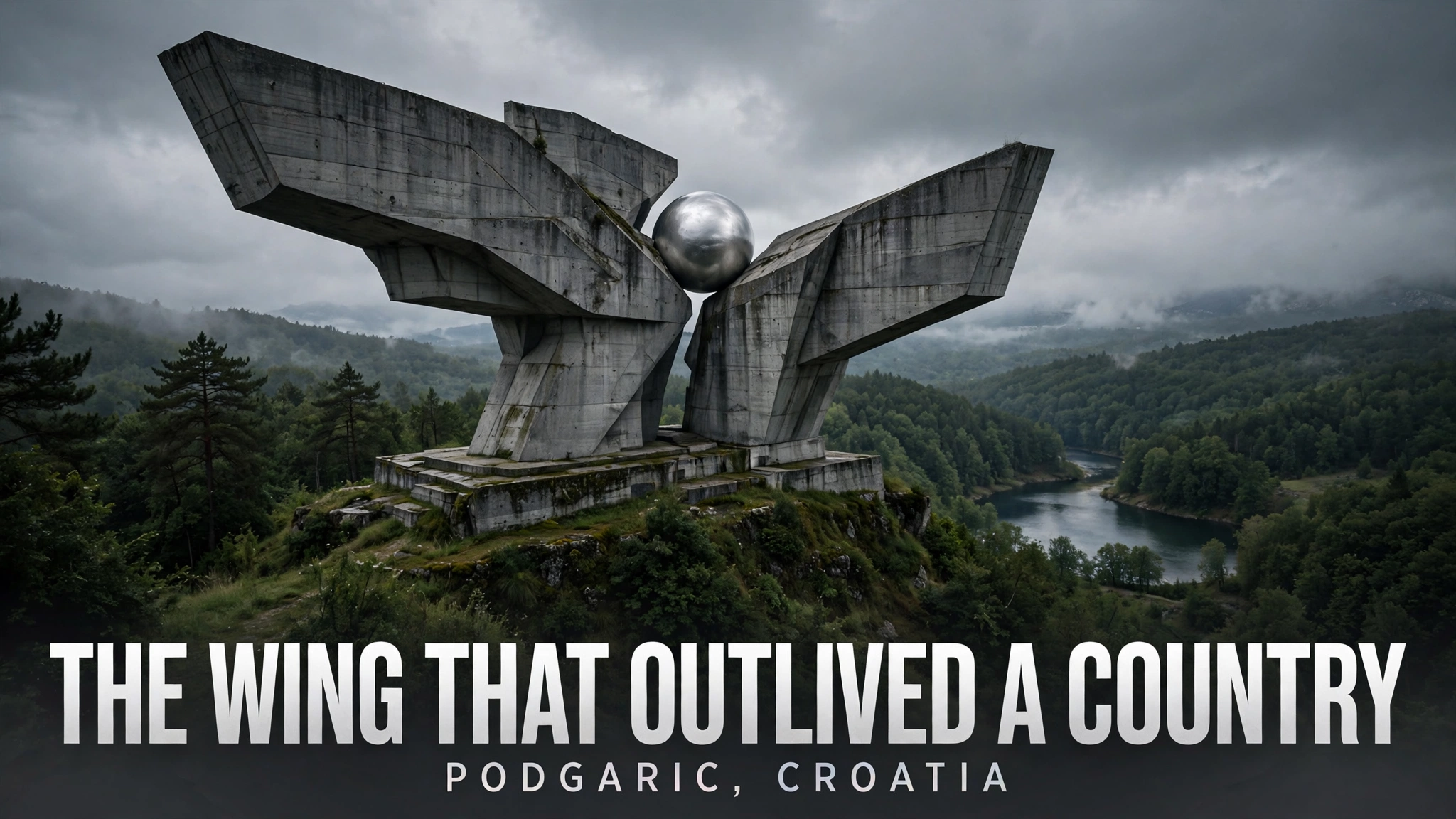
Drive east from Zagreb, the capital of Croatia, pass through the deep forest of the Moslavina region, and on a hill beyond the trees the form appears without warning. Exposed concrete spreads into huge wings to left and right, and at the center the wings hold a sphere faced with polished aluminum plates, an eye. The monument stands about 10 meters high and 20 meters wide. Officially called the Monument to the Revolution of the People of Moslavina, the work is a leading example of the spomenik, the memorial monuments of former Yugoslavia.
Completed in 1967, these wings were built to hold the memory of the people who fought and died in this place during the Second World War. Beneath the concrete, the remains of about 900 soldiers still sleep. Behind the beauty of the form stands a plain reality. The monument is also a huge grave marker.
The monument has also lived through a second death. The state that built the monument, the Socialist Federal Republic of Yugoslavia, itself collapsed in the 1990s. Wings built to celebrate victory, and completed by the collapse of a state. A vessel of memory that belongs to no one now lies quietly in the hills of Croatia.
Look down on this place in satellite imagery, and the feeling reverses. The eye of the giant seems to look back. This article follows the record that can be confirmed, and traces the shape of the wings and the history that sleeps beneath the wings.
- Observing the Wings of Victory on Google Maps
- The Shape of the Wings — Victory Carved by Džamonja
- The Forest of Moslavina — Field Hospitals and a Base of Resistance
- The Hill Where 900 Sleep — Burial Mounds and a Bronze Plaque
- An Afterimage of the Future — The Spomenik Phenomenon
- Wings After the State — From the 1990s Onward
- Our Reading — The Wing as a Vessel for Memory
- In the Area
- What to Eat
- From Zagreb Airport — A Journey to Observe a Lost Future
- Fragments Assembled
- Sources & Further Reading
Observing the Wings of Victory on Google Maps
View the hill of Podgaric in satellite imagery, and the geometric shadow of the monument stands out sharply against the green of the surrounding forest. Asymmetric wings and a round core at the center. The shape of that shadow may speak more clearly from above than from the ground. Below the monument spreads an artificial lake created at the time of construction, and the landscape was once designed as a single scene together with a resort hotel.
Zoom in, and the asymmetric outline of the wings can be read. One wing has two edges, and the other wing has three edges. That offset is the source of the dynamic life of the sculpture.
The Shape of the Wings — Victory Carved by Džamonja
The monument was designed by the sculptor Dušan Džamonja (1928–2009). Of Croatian and Macedonian background, Džamonja was a leading memorial artist of former Yugoslavia. The Serbian artist and architect Vladimir Veličković cooperated on the design of the landscape.
In the words of Džamonja himself, the theme of the sculpture is wings of victory that overcome death and defeat. The form holds the Partisan victory over the invading Axis powers in the single instant of a bird in flight. The wings are deliberately asymmetric, with two edges on one side and three edges on the other side. That imbalance gives the sculpture a dynamic impression, as if the wings were about to take off at this very moment. According to testimony by Fyodor, the son of Džamonja, the five edges symbolized the five republics of Yugoslavia.
The sphere at the center is an eye faced with polished aluminum plates. Within the inorganic gray of the exposed concrete, that point alone reflects light and glints. A Belgrade architecture journal of 1969 described the metal core as a poetic displacement of firmness and unity. If the wings are motion, the eye is stillness. That contrast creates the tension of the monument.
Monument to the Revolution of the People of Moslavina (Spomenik Revolucije Naroda Moslavine).
Sculptor Dušan Džamonja, with landscape design by Vladimir Veličković. Completed in 1967 after a construction period of about two years. President Josip Broz Tito and his wife attended the unveiling ceremony on September 7 of that year, together with several hundred people.
About 10 meters high and about 20 meters wide. Exposed concrete, reinforcing steel, and aluminum plates.
Wings of victory that overcome death and defeat. Asymmetric wings (two edges and three edges) and a central sphere faced with aluminum, the eye. Testimony also holds that the five edges of the wings symbolized the five republics.
Tito took a liking to the monument at the unveiling, and later placed a model of the monument at Villa Zagorje, his residence in Zagreb, and invited Džamonja to convey his thanks. Wings loved so deeply that the supreme leader of the state placed a model at his own residence. No one among the people gathered in 1967 could have imagined that those wings would outlive the disappearance of the state itself.
The Forest of Moslavina — Field Hospitals and a Base of Resistance
The reason for the monument lies in the memory of the Second World War carved into the forest of Moslavina. In April 1941, the army of the Kingdom of Yugoslavia fell to the Axis invasion, and the region that is now Croatia was absorbed into the Independent State of Croatia (NDH), a puppet state of the Axis powers. The practical work of rule was carried out by the Ustaše, a movement that raised the banner of ethnic cleansing. Serbs, Jews, Roma, and Croatian opponents of the regime were targeted, and the people of Moslavina rose in revolt.
From the winter of 1941 to the end of the war, the area around the village of Podgaric became an important Partisan base. In the deep forest above the village, a group of field hospitals was built, known as Stara Konspiracija (Old Conspiracy) and Novo Konspiracija (New Conspiracy). The hospitals received wounded soldiers of the 10th Zagreb Partisan Corps, a force of about 6,000 soldiers, and treatment began on January 27, 1942. At the peak, the hospitals could hold more than 700 wounded people at the same time.
The hospital group was no simple field hospital. The complex held a bakery, a theater, a school, and even a shoe repair workshop, and the Communist Partisan leadership of northern Croatia held political and operational meetings here. The small village of Podgaric became the cultural, political, and military center of the resistance movement in Moslavina. Axis mopping-up operations were also carried out several times, and several hundred Partisan soldiers lost their lives in this land.
The Hill Where 900 Sleep — Burial Mounds and a Bronze Plaque
On both sides of the approach to the monument stand burial mounds of heaped earth. Inside the mounds sleep the remains of about 900 Partisans who lost their lives in the hospitals of this land. At the entrance of the concrete arch that runs through the center of the mounds, a weathered bronze plaque is mounted, inscribed with the following words.
“Here are buried 900 soldiers from the wider area of Moslavina who sacrificed their lives for the freedom and independence of our nation during the National Liberation Struggle from 1941 to 1945.”
The inscription records that 900 soldiers from the wider area of Moslavina, who gave their lives for the freedom and independence of the nation during the National Liberation Struggle from 1941 to 1945, are buried here.
The beautiful concrete wings are, in truth, nothing other than the lid of a huge grave marker. The abstract quality of the form draws the eye, but the essence of the monument is a house of the dead. A plan once existed to mount metal plates inscribed with the names of the war dead on the inner walls of the arch, but the plan was never realized. Above the sleep of 900 people without names, wings without a name spread wide. Nameless dead and a nameless victory. This hill is what joins the two.
An Afterimage of the Future — The Spomenik Phenomenon
The wings of Podgaric are one of the leading works among the spomenik, the group of abstract memorials built across former Yugoslavia from the 1960s to the 1980s. Yugoslavia in the era of Tito built avant-garde concrete monuments at battle sites across the land, and sought to carry the memory of victory into the future through abstract form. The style excluded any specific religious color and carried a transcendent dignity that could be called cosmic. The style also looks like an attempt by a society without God to draw a new sacred quality out of concrete.
The monument of Podgaric was a symbol of Yugoslavia in that era. The monument graced the cover of Yugoslavia: Monuments of the Revolution, a book by Miloš Bajić published in 1968, and the image was printed on postcards, stamps, and tourist brochures and circulated at home and abroad. For children who visited on school excursions, the concrete wings were a symbol of a shining future.
After the collapse of the state, the spomenik were rediscovered. Spomenik (2010), a book of photographs by the Belgian photographer Jan Kempenaers, who traveled across former Yugoslavia from 2006 to 2009, drew international attention, and the Spomenik Database by the American researcher Donald Niebyl built a detailed archive. In 2013, Los Carpinteros, a collective of artists from Cuba, presented Podgarić Toy, a work that reproduced this monument at a scale of 3 meters in Lego blocks, and the work was exhibited in galleries in Houston and New York. Wings that should have been forgotten came back to life as an afterimage of the future in the age of the internet.
Wings After the State — From the 1990s Onward
Through the collapse of Yugoslavia and the Croatian War of Independence in the 1990s, many spomenik were destroyed as debts of the past. The wings of Podgaric escaped demolition, almost by miracle, perhaps because of the overwhelming beauty of the form. In the moment when the backing of the state was lost, however, the meaning of the monument changed. From a symbol of a shining future to an eerie relic of the past. Visitors fell sharply, and according to the record of the Spomenik Database, visitors today remain very few.
Even so, the wings have not been abandoned completely. A commemorative and memorial ceremony is still held in this place once a year, and occasional maintenance keeps the condition of the structure recorded as good. Lichens creep across the surface of the concrete and fine cracks have formed, but those marks only deepen the sense of accumulated time. The noise of the festivals of the past has vanished, and now only the voices of birds and the sound of wind rule the hill.
The artificial lake created at the same time as the monument, formed by damming the Kamenjača River, and Villa Garić, the resort hotel on the shore of the lake, are traces of a past dream of tourism development. Much of the grand plan was never realized, but the lake still holds quiet water below the wings today.
Our Reading — The Wing as a Vessel for Memory
To read this monument only as a political monument would be a waste. In this archive, the wings are considered here as a yorishiro, a vessel made to hold the tragedy of the land. The memory of the deaths of 900 people is too heavy and too raw, and the memory was wrapped in a strange form that seems to belong to another world. That act may have been a ritual on the scale of a state, performed to convert the existence of the dead into a story called victory.
The interesting point is that the effect of that ritual continues even after the disappearance of the state. Neither Tito nor Yugoslavia exists now. The wings still stand on the hill, people still gather once a year, and flowers are still offered. The function as a vessel barely lives on, even after the party that made the vessel has vanished.
Beyond the gaze of the eye at the center spreads the forest of the former battlefield. That gaze faces no specific enemy. The eye seems to stare at the emptiness of the land itself, an emptiness that time does not heal. Peer at the place by satellite, and the realization arrives in reverse. The eye is looking back.
Built to celebrate victory, and completed by the collapse of a state. That paradox is what makes the wings of Podgaric more than a simple monument. The wings accept the fate of being forgotten, and still the wings stand. That figure looks like a portrait of memory itself.
Brutalist concrete is cold. Beneath that cold, however, the warmth of human hands certainly remains. People climb the hill to touch the quiet of the wings that wrap the sleep of 900 people.
In the Area
The monument of Podgaric stands in a place that can still be visited in person today. Development as a sightseeing destination is minimal, but photographers and lovers of architecture visit from around the world to experience the overwhelming presence of the monument. This place is no amusement park, however. A visit needs the awareness that the visitor stands above burial mounds.
The remains of a fortress from the 13th century on a hill near Podgaric. The site is known as a historic place to visit together with the monument, and the ruins convey the history of medieval Moslavina.
An artificial lake created by damming the Kamenjača River at the same time as the construction of the monument. The lake was planned as landscape design, and Villa Garić, a resort hotel, was built on the shore. A walk along the water with a view of the wings can be enjoyed here.
A town in the Moslavina region that serves as a transit point toward the monument. The town can be used as a base for lodging and meals.
The capital of Croatia. Cobblestones in the old town, St. Mark Church, and streets where history from the medieval era to the modern era overlaps can be enjoyed here.
These sightseeing places and the monument are connected within the same broad region of Moslavina, but the sightseeing places are not adjoining facilities within walking distance. A visit to the monument and a tour of sightseeing places need to be planned as separate matters.
What to Eat
The village of Podgaric itself is small, and restaurants are limited. Planning meals in Kutina or Zagreb, points along the route, is realistic, but knowledge of the food culture of the Moslavina region deepens the memory of a journey.
The Moslavina region is known as one of the wine regions of Croatia. Local wines made from grapes grown in fields on the hills are tied closely to the dining tables of the region.
A representative meat dish of the Balkan Peninsula, made by shaping minced meat into small rolls and grilling the rolls. The standard way to eat ćevapi is with lepinja (flat bread) and kajmak (a dairy spread).
A traditional dish of the Dalmatia region, in which meat and vegetables are placed in an iron pan, covered with a bell-shaped lid, and roasted slowly over charcoal. Preparation takes time after an order, so advance reservation is common.
Business conditions, prices, and menus of shops change over time. For that reason, shop names and business hours that cannot be confirmed as real are not listed here. Expect no meal in the village of Podgaric, and plan a day trip with fuel and water prepared.
From Zagreb Airport — A Journey to Observe a Lost Future
The monument of Podgaric stands in a place that can be visited. Arrival by public transportation, however, is extremely inconvenient, and a car is essential in practice. A journey to see the afterimage of a lost future becomes a small adventure.
The air gateway of Croatia. Secure a rental car here. Public transportation to the monument is practically nonexistent, so a car is essential.
Head toward Kutina. After leaving the motorway, follow local roads toward the village of Podgaric. Calm scenery of fields and forest continues along the way.
A small village. Lodging facilities and restaurants are limited, so secure fuel and water in Kutina or another town along the route.
From the village to the hill. The area around the monument can be visited, but do not leave the maintained approach. Never forget the awareness that the visitor stands above burial mounds.
Lodging facilities in the surrounding area are scarce. A day trip returning to Zagreb or Kutina is the general pattern. Burn the view from the top of the hill and the artificial lake below into memory, and then return.
The area around the monument can be visited, but entry without a plan into the deep, unmaintained forest beyond the maintained approach and plaza is not recommended. Some areas carry a noted risk of unexploded ordnance and land mines from the era of the Croatian War of Independence. Stay within the maintained area without exception.
The area lies in the hills, and access becomes difficult in winter because of snow and ice. Earlier accounts also recommend care in the choice of season. Avoid a visit in winter, and choose a dry period from spring to autumn. Secure fuel and drinking water in advance.
Less than two hours by car from Zagreb. Judged by distance alone, the journey falls within the range of a casual drive. On the top of the hill, however, wings that outlived the disappearance of a state and the quiet sleep of 900 people are waiting. A place that can be reached and a place that can be understood do not coincide. Hold that gap, and stand before the wings.
Fragments Assembled
The Monument to the Revolution of the People of Moslavina was built to celebrate victory, and was completed by the collapse of a state. The monument is a vessel of lingering memory that belongs to no one now. The wings that spread across the hill of Podgaric are spread not to fly into the sky, but to remain in that place and to accept the fate of being forgotten.
Oblivion, however, was never completed. Photographers take pictures, researchers keep records, artists reproduce the monument in Lego, and people gather once a year. Even after the state vanished, the function as a vessel of memory barely lives on. The sleep of 900 people and the eye of the wings. As long as those two remain on the top of the hill, the record continues.
A visit to these coordinates is no simple journey. The visit is equal to an act of gently touching the bones that remain after a civilization collapses. Wings that should have overcome death and defeat now stand in the middle of a trial called oblivion. Memory does not die as long as someone remembers. Until the day when the eye of the wings closes, the record will keep being carved under the sky of Croatia.
Sources & Further Reading
- Monument to the Revolution at Podgarić — Spomenik Database — A detailed archive of design, history, the inscription, and current conditions
- Monument to the Revolution of the people of Moslavina — Wikipedia — An outline and basic data
- The Spomenik: Yugoslavia’s Abstract Concrete Memorials — dormakaba blog — An account of the spomenik phenomenon, including Podgaric