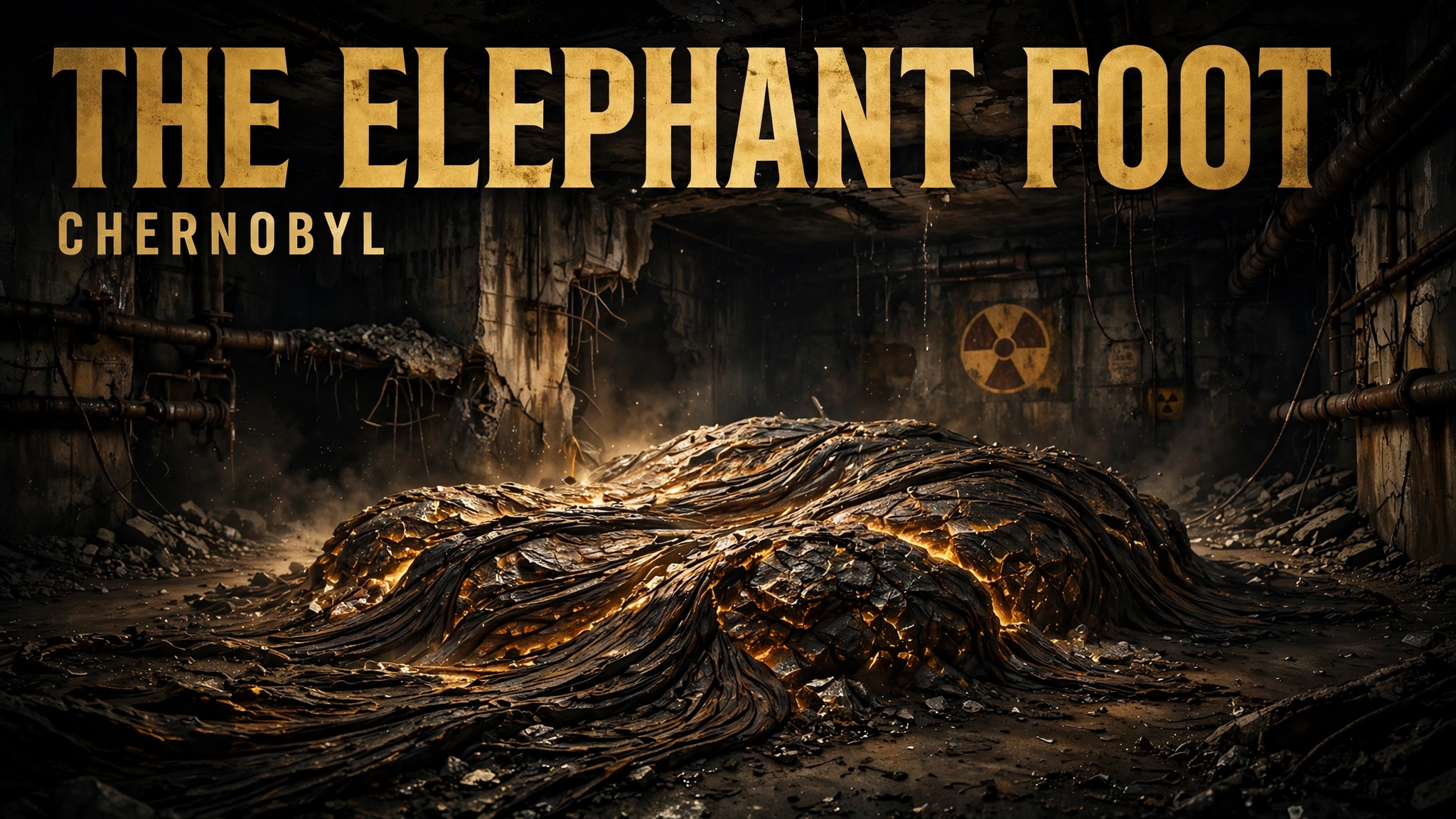
April 26, 1986, 1:23 a.m. Reactor Unit 4 of the Chernobyl Nuclear Power Plant in Ukraine, then part of the Soviet Union, exploded. A reactor core out of control, fragments of graphite thrown up into the night sky, and firefighters who fought the blaze — about eight months after that catastrophe, investigators who had advanced through a dark service corridor in the basement found, at the far end of a remote camera, the object itself.
A gray mass more than 2 meters wide, covered in wrinkles. Nuclear fuel that had melted out, together with concrete and sand, had become liquid at a heat of more than 1,600°C, had flowed down, and had cooled and hardened into corium. Because the shape resembled the foot of an elephant, the workers called the mass the Elephant’s Foot.
At the time of discovery, the radiation dose at the surface of the mass was about 10,000 roentgen per hour. Three hundred seconds — a stand of only five minutes in that place — was said to make death unavoidable. Invisible photons tear cells apart. The mass was, in the full sense of the words, an incarnation of death. Earlier accounts recorded this monster under the category of Lingering Memories. This article takes up that record and follows the subject with a clear separation among facts that can be confirmed, stories that have been handed down as rumors, and the reading offered by this site. No one can see the mass or touch the mass. Yet the mass is certainly there.
- Observing the Sealed Reactor on Google Maps
- A Death Sentence of 300 Seconds — The Room of 10,000 Roentgens
- Corium — Artificial Lava That Flowed into the Basement
- Bullets and a Photographer — The Struggle to Leave a Record
- A Monster Returning to Sand — Change That Continues Today
- Our Reading — A Negative Geology Made by Human Hands
- In the Area — Visiting Only the Places That Can Be Seen
- What to Eat — The Table of Kyiv
- Starting from Kyiv — A Journey Measured by How Close a Visitor Can Get
- Fragments Assembled
- Sources & Further Reading
Observing the Sealed Reactor on Google Maps
The observation point carried over from earlier accounts opens in satellite imagery. The place lies near Reactor Unit 4 of the Chernobyl Nuclear Power Plant. At the center of the satellite imagery stands a giant arch — the New Safe Confinement, or NSC. Beneath the arch lies the old Sarcophagus, and in a basement room beneath the Sarcophagus, the Elephant’s Foot crouches. From above, on a map, the form of the mass cannot be seen directly.
Zoom out, and the street grid of the town of Pripyat appears to the north, with the surface of the cooling pond to the south. This coordinate lies at the center of the Exclusion Zone, the restricted area with a radius of 30 kilometers. On the map, the land is a quiet expanse of green. Beneath that quiet, however, one of the most dangerous objects ever made by human hands lies asleep.
A Death Sentence of 300 Seconds — The Room of 10,000 Roentgens
The terror of the Elephant’s Foot lies in destructive power that cannot be seen. In December 1986, about eight months after the accident, when the mass was discovered, the radiation dose at the surface of the object was measured at 8,000 to 10,000 roentgen per hour. Exposure for 30 seconds was said to bring dizziness and fatigue, exposure for 2 minutes bleeding in the cells, exposure for 4 minutes vomiting, diarrhea, and fever, and exposure for 300 seconds — five minutes — a state beyond almost all hope of survival. The dose has also been described as equal to several million chest X-ray examinations. Within days of exposure, internal organs collapse, and a terrible death follows. The dose was so high that, according to reports, even the remote-controlled robots of the time suffered burned-out electronic circuits and repeated breakdowns. Into a space that rejected even machines, human beings stepped with a resolve to face death.
The guide figures above, of the form so many seconds bring such an effect, are values that have been introduced again and again in news reports and similar accounts, and the figures do not form a strict medical prediction. This article records the figures as a guide handed down in retelling. The firm core of fact is that, at the time of discovery, a stand of a few minutes beside the Elephant’s Foot was lethal.
The most famous photograph is one taken in 1996 by Artur Korneyev, a nuclear engineer, with an automatic camera. The image of Korneyev, in a protective mask, standing beside the object in darkness, spread around the world as a single image that symbolizes the distance between humanity and death. At the time of the photograph, the dose is said to have decayed to about one tenth of the level at discovery. Even so, the stay was limited to a very short time. The first photograph in history is recorded as the work of the photographer Valentin Obozinsky, taken between December 25 and December 31, 1986. The monster had stood beyond the lens since the winter of discovery.
In December 1986, about eight months after the accident. The mass was found by remote camera in a service corridor in the basement of Reactor Unit 4.
About 8,000 to 10,000 roentgen per hour. Exposure for 300 seconds is described as lethal. Reports also state that the electronic circuits of robots were burned out.
Artur Korneyev was photographed standing beside the mass. The dose is said to have decayed to about one tenth of the level at discovery.
Measurement in 2016 was reported at a decline to about 100 roentgen per hour. Even so, approach without protective equipment is not permitted.
A distinction belongs here. The numerical values of dose form a record of measurement and reporting, while the story of what happens in how many seconds also forms a guide that people have built in order to understand fear. The core of fact and the layer of retelling. A record of this monster needs both layers, held apart.
Corium — Artificial Lava That Flowed into the Basement
The true identity of the Elephant’s Foot is a substance called corium, nuclear fuel that melted and then hardened. On the night of the accident, the temperature of the reactor core, out of control, rose beyond 1,600°C. Uranium fuel melted and fell as the fuel reacted with the zirconium alloy of the cladding and with steel, and the melt mixed with concrete and sand to become fuel-containing material, or FCM. The material, which flowed like lava, reached a service corridor in the basement of Reactor Unit 4 and cooled and hardened there. A gray mass more than 2 meters wide, with a weight also reported at several hundred tons — that mass is the Elephant’s Foot.
The singularity of this substance lies in an alloy that does not exist in the natural world. Uranium, plutonium, zirconium, silicon, and components that came from concrete have fused under extreme temperature and radiation. Analysis of samples has also found a uranium-bearing crystal mineral called chernobylite, and researchers continue to study the behavior of this substance without precedent. Cases in which corium formed as a single mass number only a handful in human history: Three Mile Island in 1979, Chernobyl in 1986, and Fukushima Daiichi in 2011.
In the field of research, the Elephant’s Foot is regarded not as a specimen of the past but as an experiment in progress. Cracks form on the surface under radioactive decay and under the influence of moisture and air, and new uranium-bearing minerals are confirmed to form in the process of decay. Researchers study that process in order to predict how corium will change over the coming decades. The monster, even as the monster crumbles, continues to put questions to science.
And this monster is not complete. With the passage of time, the surface weathers, grows brittle, and crumbles toward a state like sand, according to reports. A solid mass is one matter. Radioactive dust that has become sand-like and rises into the air is another matter: inhalation of such dust destroys cells from inside the body. The process of crumbling itself gives birth to a new threat.
Fuel-containing material, or corium, formed by fusion of melted uranium fuel, cladding of zirconium alloy, steel, concrete, sand, and other matter.
The material became liquid at a heat beyond 1,600°C, flowed as far as a service corridor in the lower part of the reactor, and hardened there.
Weathering of the surface and a change toward a sand-like state are reported as in progress. The generation of radioactive dust has become a new matter of concern.
Bullets and a Photographer — The Struggle to Leave a Record
The record of the Elephant’s Foot preserves episodes in which the limits of science and the tenacity of human beings crossed. At first, the object was too hard, and collection of a sample was difficult. Soviet scientists therefore adopted, according to accounts that have been handed down, a rough method: fire from a distance with a Kalashnikov automatic rifle and recover the fragments scattered by the shots. This episode has been transmitted through research reports of institutions that include the V.G. Khlopin Radium Institute in Russia. The irony that the means of resistance against a mass of death that refused physical contact was destruction by a weapon reflects the age itself.
Another famous story concerns the roughness of the photograph of 1996. The grainy image has been handed down as a trace that radiation carved into film. This story, however, remains a story handed down in retelling, and no firm conclusion can be drawn on whether the grain of the photograph came from radiation or from the conditions of photography in a dark place. This site records the episode as rumor and tradition, kept separate from fact.
The posture of the recorders has remained consistent. Precisely because approach was impossible, the recorders tried to leave the form of the object by every means: by remote camera, by brief entry, and by rifle fire. Humanity did not turn away from the monster that humanity had made. The tenacity of that record is what allows the present generation to speak of this coordinate.
A Monster Returning to Sand — Change That Continues Today
Nearly 40 years have passed since the accident, and the radiation dose of the Elephant’s Foot has fallen greatly through natural decay. Measurement in 2016 was reported at a decline to about 100 roentgen per hour. The level is one ten-thousandth of the level at discovery. Even so, approach without protective equipment is not permitted, and the danger of dust produced by crumbling remains.
In recent years, moreover, reports have appeared that the monster in the basement has begun to awaken. In May 2021, the journal Science reported that neutron counts in one room inside the Sarcophagus, Room 305/2, had risen since about 2016 and had reached about twice the earlier level. The concern is one of recriticality, a renewed activation of nuclear fission within residual fuel, through contact with water and other factors. In the assessment of specialists, however, the possibility of a large-scale explosion is regarded as low, and countermeasures have also been reported, including the spraying of a solution that contains a neutron absorber. The pulse in the basement shows that confinement is not completion but a continuation of management.
The side of confinement has also evolved. The concrete Sarcophagus built after the accident aged, and in 2016 a giant steel arch, the New Safe Confinement, or NSC, was slid into place. The weight is 36,000 tons, and the design looks ahead to a service life of 100 years — a double confinement. Installation is reported in November 2016, with completion and handover in 2019. Inside the arch, plans have also been drawn for future dismantling of the Sarcophagus and removal of fuel-containing material by remote-controlled crane. In 2022, however, occupation of the power plant by Russian forces, from February to April, also took place, and reports state that the monitoring system was shaken for a time. Without relation to turmoil in the outside world, the monster simply continues to decay in accordance with the laws of physics.
A decline from about 10,000 roentgen per hour at discovery to about 100 roentgen per hour in 2016 has been reported.
Neutron counts inside the Sarcophagus have risen since about 2016. A scientific journal reported the rise in 2021. Concern over recriticality and plans for countermeasures are under discussion.
The New Safe Confinement (NSC) was installed outside the old Sarcophagus in 2016. Reports also state that occupation in 2022 shook the monitoring system for a time.
This point matters. The Elephant’s Foot is not a relic of the past. The mass decays, crumbles, and at times pulses — an existence in the present progressive form. Confinement was not an end. Confinement was the beginning of management. How many decades, how many centuries, that management will continue — no one holds an answer.
Our Reading — A Negative Geology Made by Human Hands
Earlier accounts read the Elephant’s Foot not as mere wreckage of an accident but as a new geological layer carved into the history of the Earth. An alloy of uranium and concrete that could not exist in the natural world. Energy that humanity dragged up from beneath the ground lost control, overflowed onto the surface, and returns again beneath the ground — this article also places that distorted circle at the center of the reading.
Consider the scale in geological time. Human civilization spans ten thousand years, and the Industrial Revolution spans a few centuries. On that scale, the time until the radioactivity of the Elephant’s Foot becomes harmless is longer than the time in which a single layer of strata accumulates. Humanity created a thing that cannot be managed within the human sense of time, and postponed the problem under the word confinement. In the face of tens of thousands of years, the Sarcophagus and the NSC alike are no more than temporary tents.
Even so, the act of recording holds meaning. The bullets of a Kalashnikov, the photograph by Korneyev, and the numerical values of neutron counters are all acts performed in order not to forget. When someone in the future digs into this stratum and strikes the layer, will a record remain that explains what the layer is? That record may be the only settlement within human power.
The Elephant’s Foot was born at the end of an evolution that has continued since humanity began to control fire. The desire that seeks energy, and the immaturity of a technology that cannot fully govern that energy. Both have hardened together and crouch in a basement room. The word monster is an easy word. The mass, however, is also a mirror that reflects humanity itself.
This reading, it should be noted, is a way of reading offered by this site and does not form a scientific conclusion. To hold the record of fact and the auxiliary lines of imagination apart — that separation is, in the view of this site, a form of sincerity toward the category of Lingering Memories.
In the Area — Visiting Only the Places That Can Be Seen
A visit to the Elephant’s Foot itself is impossible. Entry by a member of the general public into the basement room is 100 percent impossible. Within the Chernobyl Exclusion Zone, however, a managed system of visits once existed, and a journey existed in which the memory of the accident could be learned from places that can be seen. This section introduces that framework and the places that can be visited at present.
The town of the nuclear workers, evacuated on the day of the accident. A Ferris wheel, schools, and apartment buildings remain in the state of that time. On tours of the past, visitors carried a dosimeter and viewed the town along a designated route.
On tour routes of the past, the giant arch could be viewed from a fixed distance. The area formed the limit of approach to the Elephant’s Foot for a member of the general public.
A museum in the capital, Kyiv, that gathers the record of the accident. Protective clothing, equipment of the time, records of evacuation, and other materials are on display, and a visitor can come into contact with the memory of the accident even in a situation in which travel to the site is impossible.
Since 2022, Ukraine has been in a state of war, and sightseeing tours to the Zone are reported to remain suspended. Conditions change, and the latest official information must always be confirmed.
The term dark tourism carries a somewhat consumptive sound. Many people who visited Chernobyl, however, spoke the words in order not to forget. Whether a day will come on which visits resume is unknown. Even so, memory can be carried forward through records and through the museum.
What to Eat — The Table of Kyiv
A visitor to Kyiv, or a visitor who waits for a day of travel to Kyiv, may also wish to come into contact with the food culture of Ukraine. The dishes are dishes of a cold land, dishes that warm the body. Rather than naming a specific shop, this section introduces representative flavors long cherished in this land.
A red soup of beets. A representative home dish of Ukraine, eaten with sour cream. A flavor that sinks into the body on a cold day.
Boiled dumplings filled with potato, cabbage, cheese, or other ingredients. The filling differs by household, and the dish shows the individuality of the cook.
A traditional dish of thin slices of salt-cured pork fat placed on black bread. Plain in form, the dish is the memory of the table of Ukraine itself.
Business conditions and prices at shops change, so specific shop names and business hours are not listed. A traveler may also keep these flavors in reserve, as a pleasure for a time in which peace has returned.
Starting from Kyiv — A Journey Measured by How Close a Visitor Can Get
The journey to this coordinate is a journey that follows the question of how close a visitor can get. In conclusion, the distance to which a member of the general public can approach the Elephant’s Foot is zero. The act of drawing the route toward that zero, however, itself becomes the story of this place.
The capital of Ukraine. An old capital that spreads along the banks of the Dnipro River. A journey should begin with contact with the record of the accident at the Chernobyl Museum.
On tours of the past, a dedicated bus traveled from Kyiv for about 2 hours, and visitors entered the Zone after a strict passport check at a checkpoint. Carriage of a dosimeter and accompaniment by a specialist guide were mandatory.
Viewing along a designated route formed the limit. A point from which the arch of the NSC could be viewed in the distance was the place of closest approach to the Elephant’s Foot for a member of the general public.
Entry by a member of the general public into the basement room that holds the Elephant’s Foot is 100 percent impossible. Entry without permission must never be attempted.
Ukraine is in a state of war, and travel for sightseeing purposes is not realistic. The latest danger information from the Ministry of Foreign Affairs of Japan must always be confirmed. Beyond that point, the journey continues on Google Maps and Google Earth.
Never attempt entry without permission into the restricted area, evasion of a checkpoint, departure from a designated route, or approach to a facility. Hot spots with high dose levels still lie scattered within the area. Radiation cannot be seen, has no smell, and brings no pain.
Ukraine is in a state of war, and entry for sightseeing purposes is extremely difficult. Always confirm the latest danger information and travel information from the Ministry of Foreign Affairs of Japan, and do not plan travel to a region under an advisory to cancel travel. Conditions change, and reliance on information in old travel accounts must be avoided.
Stand in the city of Kyiv and think of the sky to the north. Places that can be visited and places that cannot be visited. A stand on that boundary line may allow the weight of this coordinate to be felt in a slightly more solid form. Acceptance of the fact that a place cannot be approached also forms part of a journey.
Fragments Assembled
The Elephant’s Foot of Chernobyl presses a hard question upon the present generation: how fragile, and how unmanageable, is the technology that human hands have taken up? The mass is a symbol of death that cannot be seen and cannot be touched, yet is certainly there. At the end of an evolution that has continued since humanity began to control fire, humanity produced this gray mass.
What is known is this. Corium born in the explosion of April 26, 1986, flowed into a basement room, released a dose of 10,000 roentgen at discovery, and continues in decay and weathering at present, while danger continues as well. What is not known is this. When, and by what means, will humanity be able to settle this monster? Between those two sides lie nearly 40 years of time, a double confinement, and an occasional pulse.
At this very moment, in that basement, the Foot becomes sand and continues to crumble in silence. That silence itself may be the Lingering Memory that humanity should fear most. This coordinate continues to show that behind shining energy lies a shadow that can never be wiped away.
Sources & Further Reading
- IAEA — International Atomic Energy Agency (official) — International knowledge on decommissioning at Chernobyl and on radiation protection
- BBC Science Focus — The strangest discoveries experts have made inside Chernobyl — An explanation of objects found inside the reactor, including the Elephant’s Foot and chernobylite
- The Naked Scientists — Chernobyl: nuclear material may be re-igniting — The rise in neutron counts and concern over recriticality (an interview with specialists)
- Wikipedia — Elephant’s Foot (Chernobyl) — An organization of the course of discovery and of the record of dose
- Wikipedia — The Chernobyl Nuclear Power Plant Accident (Japanese) — The course and background of the accident as a whole