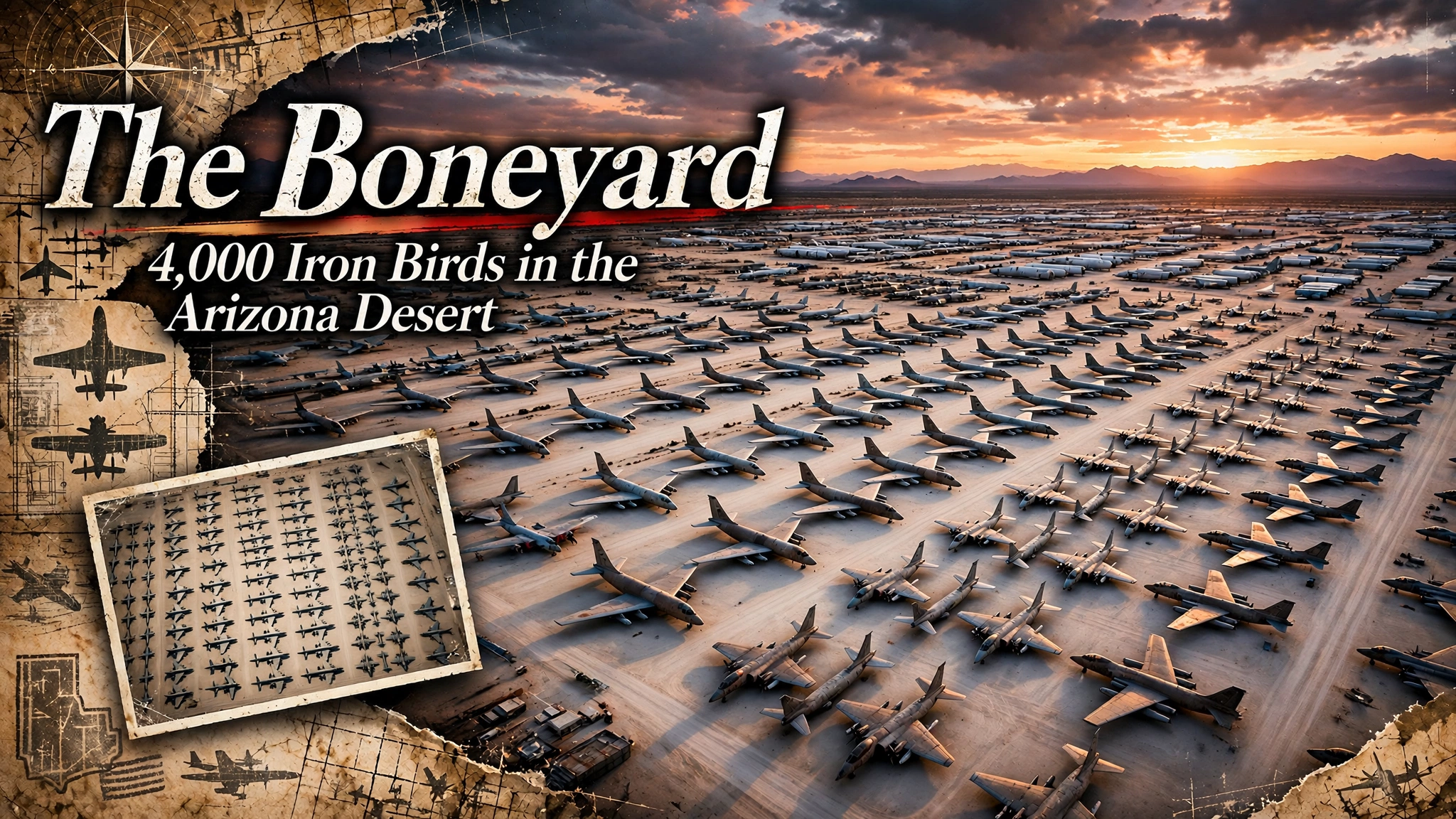
Tucson, Arizona, USA. Look down on that place through the eye of a satellite, and across the land scorched by the blazing sun lie thousands of “iron birds,” laid out in perfect order like silver scales spread over the ground. Bombers with folded wings, fighters with their noses aligned, rugged transports — sorted by type and arranged with barely a few centimeters of deviation, the sight from above resembles a giant circuit board, or a geometry drawn by the military power of a civilization.
It is commonly known as “the Boneyard” — the graveyard. Its official name is the 309th Aerospace Maintenance and Regeneration Group (309th AMARG), one of the largest aircraft storage and regeneration facilities in the world. From celebrated aircraft that fought through the Cold War to airframes that were in service until very recently, fragments of every era are gathered here, asleep. What we are witnessing through our monitors is the “residue” of a nation’s machinery of violence — and, at the same time, a “reserve” held for the future.
The history of this place begins in 1946. Immediately after the end of World War II, the U.S. Army established a facility at Davis-Monthan Air Force Base to store B-29 bombers and C-47 transports. That was the prototype of today’s Boneyard. The grounds cover about 2,600 acres (about 10.5 square kilometers). More than 4,000 aircraft sleep here, and their total acquisition value is said to reach 35 billion dollars. Judged by the numbers alone, it is the world’s largest “parking lot” — and at the same time, the world’s largest “aircraft graveyard.”
But this is less a graveyard than a “freeze box of time.” Many of the aircraft lined up here are preserved in a condition in which, with maintenance, they could return to the sky. It is not death, but sleep. Earlier accounts called this place a “gravestone of steel,” and recorded the unsettling presence that lies within its silence. This time, following that record, we will trace the facts that can be confirmed separately from the stories that have not yet been told.
- Observing the “Iron Flock” on Google Maps
- Why This Wilderness? — The Conditions of a Land Chosen for Preservation
- Aircraft That Woke from Sleep — Regeneration and the Circulation of Parts
- Aircraft Wrapped in White Cocoons — Spray Latex and the Technology of Sleep
- Disarmament Witnessed by Satellite — The Guillotine That Beheaded the B-52s
- The Groan of Metal Heard at Night — Collected Rumors
- Our Reading — A Silent Stockpile
- In the Area: Recommended Sights and Activities Around Tucson
- What to Eat: Food to Enjoy Locally
- Getting There: From Tucson International Airport — The Road to the Iron Graveyard
- Fragments Assembled
- Sources & Further Reading
Observing the “Iron Flock” on Google Maps
Open the satellite view at the observation point carried over from earlier accounts. Zoom in, and you can see the vast wings of the B-52 bombers, the sharp noses of the F-15 fighters, and the rugged silhouettes of the C-130 transports, lined up like inventory catalogued by type. Depending on when the satellite imagery was updated, you may also see rows of aircraft with their wings cut away — the claw marks of disarmament treaties. Take your time scrolling through the silver rows that go on and on.
One thing to keep in mind here: when we look at this iron flock as “a single mystery,” we must not cut it off from the context around it. Around the flock spread runways, hangars, and maintenance facilities, and the whole functions as part of one giant logistics system. Before cutting the flock out alone and mystifying it, we first need to know what this land exists for.
Why This Wilderness? — The Conditions of a Land Chosen for Preservation
Why Tucson? The answer lies in the climate and the soil. Annual rainfall here is low, and humidity is low. The blazing sun burns the moisture away and keeps the corrosion of metal to a minimum. The soil of this region, moreover, is alkaline and hard, and a calcareous layer called “caliche” supports the weight of aircraft of several hundred tons even without concrete paving. Had this been the humid East Coast, the aircraft would have been eaten away by rust within a few years and turned, quite literally, into “scrap iron.”
The dry air keeps the corrosion of metal to a minimum, and the hard soil keeps the aircraft from sinking into mud. This is a natural “freeze box of time” for preserving machines made by human hands with as little change as possible. The Boneyard’s location was decided not by military convenience, but by the requirements of preservation science. The conditions for putting machines to sleep were all present in this wilderness.
The facility’s origin goes back to 1946, immediately after World War II. It is said to have begun when the air technical service of the U.S. Army established a storage facility for B-29 bombers and C-47 transports at Davis-Monthan. By the time of the Vietnam War, nearly 6,000 aircraft are said to have been lined up here. With the end of the Cold War the number of aircraft fell, but in their place the retirement of the newest aircraft began, and the Boneyard continues to be a mirror reflecting the changing of the times.
Aircraft That Woke from Sleep — Regeneration and the Circulation of Parts
Though it is called a “graveyard,” the Boneyard has proven again and again that it is not a place of death. There are B-52 bombers that slept in the desert for more than a decade, then received maintenance and returned to active units. The white cocoon is peeled away, the engines are replaced, and they rise into the sky once more. From “graveyard” to “resurrection” — it is no coincidence that the facility’s official name carries the word “Regeneration.”
Its more everyday mission is the “recovery of parts.” Usable parts are removed from retired aircraft and put to use repairing aircraft still in service. In one fiscal year, it was reported, more than 5,700 parts were recovered, saving more than 400 million dollars in procurement costs. For older aircraft such as the A-10 attack aircraft, there would be no other source of parts without this place. The inventory shelves of the desert keep the aircraft of the U.S. military flying today.
Aircraft Wrapped in White Cocoons — Spray Latex and the Technology of Sleep
Look closely at the aircraft in the satellite view, and you will see that many are covered with a white film. It is a special protective coating called “spray latex.” The fuel is drained, the engines are removed, and the openings are sealed; then a white, vinyl-like film is sprayed over the entire aircraft. It reflects the fierce sunlight of the desert and keeps the temperature inside the airframe from rising. The cockpit and the electronics are all inside the white cocoon. Their appearance is exactly that of “machine mummies” awaiting a future resurrection.
The aircraft lined up here are managed under four distinct fates.
Aircraft in “full preservation,” able to return to the sky with maintenance. The removal of parts is restricted.
Aircraft from which dismantling and recovery proceed, as a source of parts for other aircraft.
Relatively short-term storage. The aircraft wait in a condition from which they can be returned to operation quickly.
Aircraft that exceed the needs of the Department of Defense. They become subject to dismantling, recycling, or sale.
What is here is not death, but a “sleep” awaiting a cycle called reuse. In fact, not a few aircraft have returned to the sky from here. There are B-52 bombers that woke from a sleep of more than a decade and returned to active service. From aircraft dismantled for parts, several thousand parts are recovered every year and used to extend the lives of aircraft still in service. In one year, the value of the recovered parts was reported to have reached the scale of 500 million dollars. The Boneyard is at once a graveyard and the largest “outdoor parts warehouse” of the U.S. military.
Disarmament Witnessed by Satellite — The Guillotine That Beheaded the B-52s
In a corner of the satellite photographs, rows of bombers with their wings torn off sometimes come into view. They are the claw marks of the disarmament of the 1990s. Under the First Strategic Arms Reduction Treaty (START I), signed in 1991, the United States and the Soviet Union promised to reduce their deployed nuclear warheads and strategic bombers. What the treaty demanded was “verifiable destruction.” Merely storing the aircraft was not enough; they had to be destroyed in a form that the other side could confirm by satellite.
The method chosen at Davis-Monthan was a “guillotine”: a steel blade of about six tons, lifted by a crane and dropped from a height of 60 feet. The blade cut through a B-52 four times — the wings twice, the fuselage twice. A single bomber became five pieces, laid out on the desert. The remains were left just as they were for 90 days, and only after Russian reconnaissance satellites had confirmed that they were “destroyed” were they finally sold off as scrap. It is the record of an era when disarmament was a ritual witnessed from space.
In the 1990s, about 365 B-52s are said to have been disposed of by this method. The rows of severed wings were also the largest gravestones on earth, announcing the end of the Cold War. To prove the end of violence with the corpses of the instruments of violence — that paradox lies sunk at the bottom of this coordinate.
The destruction procedures were laid down in detail in the treaty’s protocol. The tail section was to be severed from the fuselage, and the fuselage cut in two around the roots of the wings — in every case at places that are clearly not assembly joints. Among the dismantled B-52s, it is said, was “Memphis Belle III,” which had inherited the name of the famed World War II aircraft “Memphis Belle.” An aircraft bearing the name of history, beheaded in the ceremony that marked the end of that history — the Boneyard is also a crossroads of such stories.
The Groan of Metal Heard at Night — Collected Rumors
We would like to preserve here the “fragments of rumor” that earlier accounts gathered. These are not confirmed facts, but they are stories that have shaped the air of this place.
It is said that on windy nights, a strange sound can be heard near the Boneyard’s fence. The sound is the wind passing through the gaps in the airframes — but some local residents, it is said, believe that the memories of those who fell in battle long ago reside within the aircraft.
Reports that with each update of the satellite imagery, a “prototype aircraft that should not exist” appears in the photographs, only to be gone by the next update. In all likelihood these are phantoms produced by the seams of the images and by differences in update timing, but the reports themselves never cease.
There are also whispered accounts of aircraft that were supposed to be parted out having been moved, one day quite suddenly, into the “regeneration” rows. In reality it is a review of the storage categories, but to those who see it, it looks as if “the dead have risen.”
Savoring a rumor as a rumor, and treating it as fact, are different things. But stand before a flock of 4,000 iron machines, and anyone’s imagination catches fire. That is the magic of this coordinate, and it is probably why earlier accounts chose the word “ghosts.”
Our Reading — A Silent Stockpile
Zoom out from the Boneyard, and the individual aircraft disappear, and a pattern like a giant textile rises into view. Lying there is the total volume of a nation’s violence, held as inventoried stock.
But ironically, this “graveyard” is not a place of death. It is a place of sleep. The aircraft are wrapped in white cocoons, the parts are recovered, and they wait quietly — for an emergency that may someday come, or for the keeping of the peace. Death and regeneration living on the same grounds: that is the essence of the Boneyard.
When we gaze at this geometry through our monitors, we are onlookers. Bare iron, and sand dancing in the wind. There lies the all-too-quiet, all-too-eloquent sleep of the monsters that civilization gave birth to.
Learning what something is, and the disappearance of the strange impression it gives, are not the same thing. The mystery of fact and the mystery of feeling are different things. The former can be checked against materials. The latter is born within the experience and imagination of the person who sees the shape.
No one can stand at the center of the flock. Entry is not permitted; approach is not permitted. That is why this flock remains, forever, “a thing that belongs to the sky.” A place made for sleep has been set down on land that refuses to wake. That twist is what makes the Boneyard more than a mere parking lot.
Zoom in to the maximum, and follow the rows of aircraft wrapped in white cocoons. In each one there is the memory of the skies it flew, and the record of the day it came down. The Boneyard is at once the memory of a nation, and an accumulation of countless personal memories.
In the Area: Recommended Sights and Activities Around Tucson
The Boneyard itself is an active military facility, and the general public cannot enter it. On the other hand, Tucson, which serves as the base, has places where aviation and desert culture can be experienced safely. For an actual trip, plan around facilities that are open to the public.
One of the world’s leading aviation museums, adjacent to the base, exhibiting several hundred aircraft outdoors and in hangars. Bus tours of the base run by the museum (advance reservations and identity screening required) were once offered, but the U.S. Air Force has announced the end of the tours following a change in its security policy. Check the official site for the latest guidance before visiting.
A habitat of the giant “saguaro” cacti standing over the desert near Tucson. You can walk through the original landscape of Arizona.
An 18th-century church from the Spanish colonial era, known for its white architecture — the “White Dove of the Desert.”
A facility combining a zoo, a botanical garden, and a museum, exhibiting the plants and animals of the desert alive. After seeing the iron flock, it is good to touch the living desert as well.
These sightseeing spots and the Boneyard of this article are related within the broad area around Tucson; they are not neighboring facilities within walking distance. Approaching the base and visiting sightseeing spots should be planned as separate matters.
What to Eat: Food to Enjoy Locally
If you visit Tucson, turn your eyes not only to the scenery of the wilderness, but also to the food culture rooted in this city. In 2015, Tucson became the first city in the United States to be designated in the field of Gastronomy in the UNESCO Creative Cities Network. In this land close to the Mexican border, the food culture of the Sonoran region is rooted in everyday life.
A Tucson specialty: a bacon-wrapped sausage set in a bun and topped with beans and salsa. It has long been loved as the taste of the street stalls.
Burritos, tacos, enchiladas — dishes nurtured on both sides of the border. The city is also said to be the birthplace of the chimichanga (accounts differ).
The hearty breakfasts long cherished at diners along the main highways. A classic of the road, stopped for in the middle of a long drive.
Because shops’ business conditions, prices, and menus change, we do not list shop names or business hours whose existence cannot be confirmed. It is best enjoyed as the food culture of the city.
Getting There: From Tucson International Airport — The Road to the Iron Graveyard
The Boneyard is an active military facility. Knowing “how far one can approach” itself becomes part of the story of this place.
From a major international airport in your own country, fly to Tucson, the air gateway to southern Arizona. Secure a rental car here. In preparation for the desert drive, load drinking water as well.
About 15 minutes by car from the airport. At the museum adjacent to the base, you can see the retired aircraft up close. Because entry into the base is not possible, this is the public place where you can come closest to the “iron birds.”
From public roads around the base, such as Valencia Road, the flock of vertical tails can sometimes be seen over the fence. Take care not to stop for long, and not to obstruct traffic.
After seeing the iron flock, head for the living desert. The forest of giant cacti will show you another face of Arizona.
The full form of the Boneyard cannot be seen from the ground. Beyond that point, the journey is one you follow on Google Maps and Google Earth.
Do not attempt to cross the boundary of the military facility, to approach the fence, to fly drones, or to take photographs without authorization. Security is strict, and violations are subject to detention and punishment. To enter by any means other than a tour is to invite “immediate detention.”
In summer, there are days that exceed 40°C. Prepare drinking water and sun protection, and keep plenty of fuel in the car. Watch out for heatstroke.
About twenty minutes by car from Tucson International Airport lies the largest aircraft graveyard in the world. And yet the only eye that can see its full form is the satellite’s. “A distance that feels reachable” and “a place you may enter” do not coincide. That gap, too, may be one of the reasons this coordinate remains forever strange.
Fragments Assembled
The true nature of the Boneyard was neither a dwelling of ghosts nor a stage for conspiracies. The technology of preservation that has continued since 1946, and the record of the disarmament that announced the end of the Cold War, draw the outline of this place. That is the answer the investigation arrives at.
But after learning that answer, open the satellite imagery once more. The iron flock of 4,000 machines may still appear to be trying to convey something, even now. Rows of aircraft lined up in perfect order. Is that fact alone not fantastic enough?
On the map, the rows of wings can still be read. Human beings learned to fly, and in time lined up in the desert the machines that had ceased to fly. A gravestone is not for the dead; it is for the living, to confirm their memories by. This coordinate may be the largest memory device in the world, taking inventory of the total volume of a nation’s violence.
Sources & Further Reading
- 309th AMARG — U.S. Air Force (Official) — The mission and overview of the facility
- Pima Air & Space Museum — Available Tours — Tour guidance (for checking the latest information before a visit)
- Air Force Times — Aircraft Boneyard Keeps Planes for Parts or Possible Reuse — A field report on parts regeneration
- WION — Graveyard of Giants — A record of B-52 preservation and disarmament
- We Are The Mighty — How America Literally Chops the Heads off of Nuclear Bombers — A record of B-52 dismantling under the START treaty
- The Aviationist — Lightning Strikes a C-5 Galaxy’s Tail at the AMARG Boneyard — Photographic records of the Boneyard