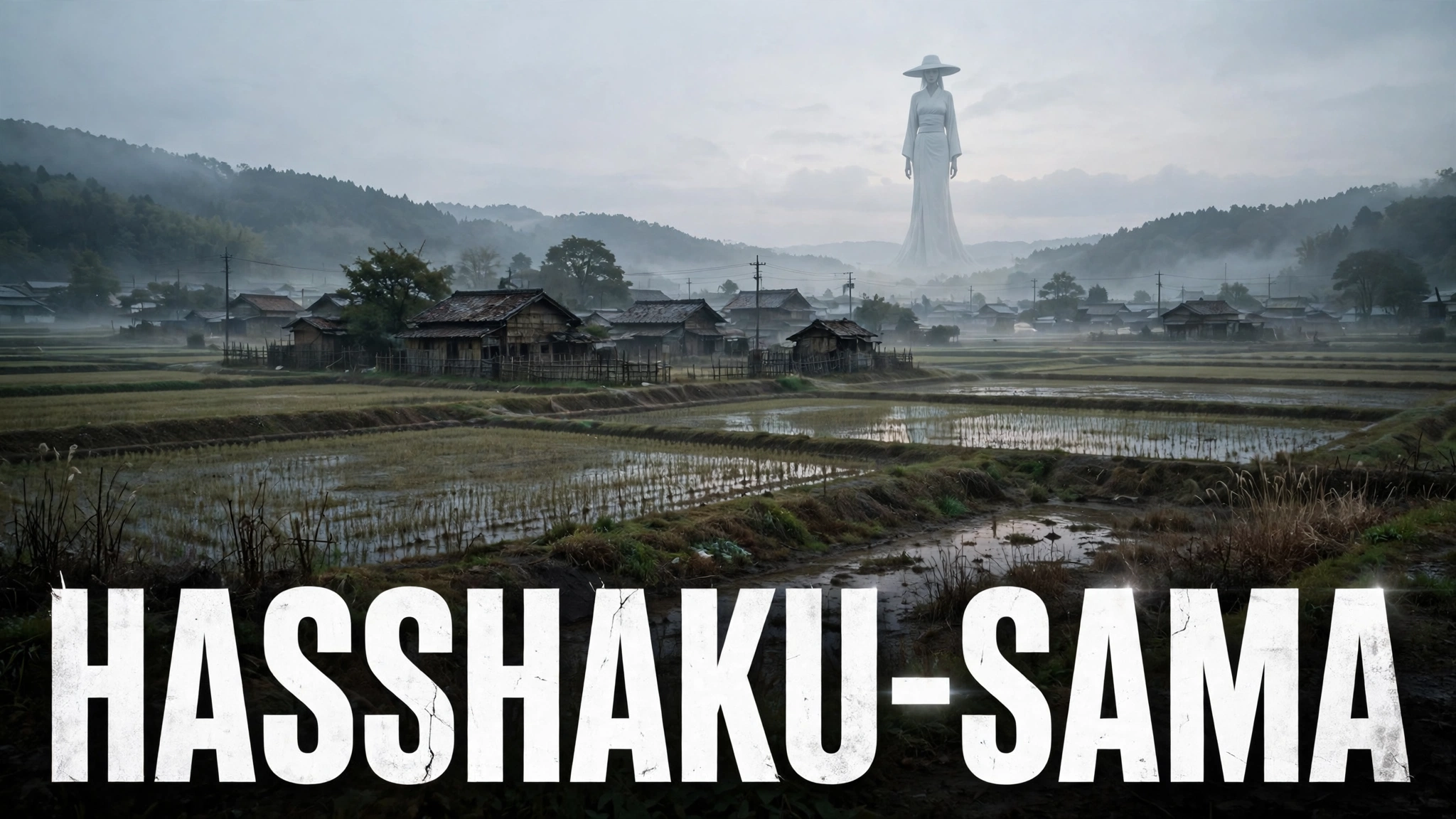
On the morning of August 26, 2008, a striking account of personal experience arrived in a thread for ghost stories on the internet. The account records how a boy visiting the countryside and the home of the grandparents of the boy was marked by an unnatural woman in a white dress, eight shaku tall at about 240 centimeters, “Hasshaku-sama”. She utters a low sound of “po po po…”, a sound that seems to belong to neither a human voice nor a machine. The account holds that a person who hears that sound will be taken and killed within a few days.
What makes this ghost story frightening is that the story is not a simple tale of a large female ghost. A seal formed by Jizo statues enshrined on four sides of a village, a dramatic escape with all blood relatives mobilized, a barrier broken. Local faith and the customs of a closed land are drawn in dense detail. This article preserves the fragments of rumor that have circulated, while following the record that can be confirmed and the parts that remain unsolved as separate threads.
Hasshaku-sama has no specific sacred site. For that reason, the coordinates of this article point to a location that represents a mountain village in the San-in region, as a typical example of the countryside said to form the stage of the story. The pin points not to a place but to a landscape of imagination. Read on while considering the meaning of the act of giving coordinates, on purpose, to a strange phenomenon that has no coordinates.
- Observing a “Typical Countryside” on Google Maps
- The Record of the Text — Nine Minutes of Posts on August 26, 2008
- The Sound of “Po Po Po” — A Strange Phenomenon of Voice
- The Seal of the Jizo Statues and the Boundaries on Four Sides — Local Faith
- A Leading Theory — A Yokai of a Giant Woman in the San-in Region
- Spread Into Popular Culture — Queen of Ghost Stories of the Internet
- Our Reading — Why Does Hasshaku-sama Live in the Countryside?
- In the Area
- What to Eat
- From the Airports of Yonago and Izumo — The Road to a “Typical Countryside”
- Fragments Assembled
- Sources & Further Reading
Observing a “Typical Countryside” on Google Maps
The stage of Hasshaku-sama cannot be identified, because the person who posted the account did not reveal a place name. The story, however, draws without question a typical countryside of Japan. A farmhouse enclosed by a hedge close to two meters tall, Jizo statues that guard four sides of a village, a mountain road where small trucks run. Here, as a typical example of that countryside, the satellite imagery opens around the town of Okuizumo in Shimane Prefecture, a mountain farming area in the San-in region. The landscape woven by terraced rice fields and cedar forests is more than enough to call to mind “that village” of the story.
Follow the terraced rice fields across the satellite imagery, and a small settlement held by the mountains comes into view. The “village enclosed on four sides by Jizo statues” of the story could lie anywhere in this area without any sense of wrongness. The act of trying to identify the village, however, may itself run against the manners of this ghost story.
The Record of the Text — Nine Minutes of Posts on August 26, 2008
The first point that can be verified about Hasshaku-sama is not a “date of sighting of a strange phenomenon” but a “date of publication of a text.” On August 26, 2008, on the occult board of the anonymous bulletin board 2channel, in the thread “Shall we collect scary stories that are no joke at all? 196”, a person under a single posting ID wrote nine texts in succession over about nine minutes in the morning, from post number 908 to post number 916. The first post came at 9:45:56 and the last at 9:54:54. The difference is only 8 minutes and 58 seconds.
The outline of the story runs as follows. In high school, on a day off, the narrator used to visit the farmhouse of the grandparents in the countryside by motorcycle. During spring break, just before the start of the third year of high school, the narrator was relaxing on the veranda when a strange sound of “po po po” reached the ears of the narrator, and beyond a hedge close to two meters tall stood a woman in a white dress and a hat, a woman of abnormal height. When the narrator told the grandparents, the manner of the two changed at once. The grandfather made a telephone call to some unknown place and drove away in a small truck. The grandmother explained. That woman was “Hasshaku-sama.” She appears once every few years to more than ten years, and she takes and kills a person who has seen her within a few days. She is sealed inside the village by Jizo statues enshrined on four sides of the village, the grandmother said.
The nine posts were written in a span of less than nine minutes. From that brevity, some readers have pointed out the possibility that a draft had been prepared in advance. A person who has lived through a real event, however, may also sort memory in order and write the whole account in a single burst. Speed of posting does not decide truth or falsehood. The point that deserves more attention is the fact that a text written in nine minutes has held the imagination of countless readers for the 17 years that followed. The life force of a ghost story may be decided not by truth or falsehood but by density of detail.
About 240 centimeters. The description of a hat visible beyond a hedge of two meters tells the abnormal scale of the figure. A giant body that voids the very concept of hiding.
She wears a hat like a straw hat with a wide brim and is clothed in a white dress. The figure is said to vary without fixed form, from a young woman to an old woman.
The narrator shuts in until 7 in the morning in a room on the second floor, with windows pasted over with newspaper, paper talismans fixed in place, and mounds of salt set in four corners. The narrator holds without pause a protective charm received from an old woman called A.
After dawn, the narrator escapes from the village in a convoy with the small truck of the grandfather in the lead, a van that carries the narrator, and a passenger car driven by the father. All of the men who gathered were blood relatives of the grandfather, and the account holds that the men gathered to draw the eyes of Hasshaku-sama away.
At about 1 in the night, Hasshaku-sama appears outside the window and knocks on the glass. From beyond the door, a voice in the voice of a person known to the narrator calls out in invitation, in words to the effect of permission to come over. The narrator sees that a mound of salt has turned black in color, holds back, clings to a Buddhist statue, and reaches morning. In the escape convoy, Hasshaku-sama runs alongside a car and tries to look inside while knocking on a window. The adults chant Buddhist prayers, and in time the sound fades.
Then comes an account of later events. The grandfather kept telling the narrator never to come again, and even when the grandfather died two years ago, the narrator could not attend the funeral. In the present, ten years later, a telephone call from the grandmother brings news that a Jizo statue that had sealed Hasshaku-sama has been destroyed by an unknown person. The thread closes at that point.
One distinction must be stated. The existence of a post and the reality of the experience written in the post are separate matters.No independent record can be confirmed that supports who the narrator was or where the narrator lived. The possibility of a draft prepared in advance has also been pointed out, based on the short span of successive posts. That point alone, however, does not allow a firm conclusion of fabrication. What can be confirmed here reaches only as far as the date and time of posting, the posting ID, and the order of the texts.
The Sound of “Po Po Po” — A Strange Phenomenon of Voice
The greatest feature of Hasshaku-sama lies in vocal sound. “Po po po” is a strange sound, like a human voice, like a machine, like air leaking out. In the story, when that sound is heard, the target has already been drawn across to the far side of a boundary line.
What is frightening is the premise that Hasshaku-sama can change vocal tone at will. She lures a target with the voice of a person known to the target, and she makes sound by knocking on doors and windows. The phenomenon is one of hearing and not of sight. Fear of hearing a name called by an unseen presence stirs human instinct through a circuit separate from fear of seeing a form.
Many readings of the true nature of the sound “po po po” have been told. More than identification of the true nature of the sound, attention belongs on the point that the sound functions as a “signal of arrival.” In ghost stories, a strange phenomenon often arrives together with sound. Footsteps, noises within a house, and “po po po.” Sound is the most primitive device for creating certainty about the existence of an unseen presence.
The Seal of the Jizo Statues and the Boundaries on Four Sides — Local Faith
The element that pulls the story of Hasshaku-sama out of the frame of a simple invented ghost story is the premise of a “seal formed by Jizo statues enshrined on four sides of a village.” The motif is rooted deep in folk faith in Japan. Jizo statues and Dosojin deities enshrined at village boundaries and at crossroads on paths remain in farming villages across the country to this day, as “guardian deities of boundaries” that block entry by evil spirits and epidemics from outside.
In the story, one of those Jizo statues is destroyed by an unknown person, and Hasshaku-sama enters a state in which free appearance anywhere is possible. Destruction of a seal. Collapse of a barrier. The pattern is a standard element of ghost stories, and at the same time the pattern calls to mind the reality of village rites that can no longer be maintained under depopulation. A boundary with no person left to guard the boundary becomes, in imagination, a path for a strange phenomenon.
A person holds a protective charm without pause, shuts in until 7 in the morning in a room with mounds of salt in four corners, and prays to gods and Buddhas. A strange phenomenon loses force with dawn. Time, direction, salt, and paper. Those concrete details give the story a texture like a “method of response actually practiced in that land.” Truth or falsehood aside, a reader senses in those details the scent of “local wisdom.” That quality makes Hasshaku-sama into a presence greater than a simple ghost story of the internet.
Faith at village boundaries still lives in farming villages in Japan. Rites such as michikiri and tsujikiri stretch sacred ropes across the boundaries of a village to block entry by evil spirits. Jizo statues and Dosojin deities have been enshrined as the core of that guard. The “Jizo statues on four sides” of the story can be described as a direct conversion of that real landscape of faith into a device of a ghost story. A reader feels that the story “could be real” because the landscape is in fact a familiar one. The reality of a ghost story often lies on an extension of daily life.
A Leading Theory — A Yokai of a Giant Woman in the San-in Region
On the stage of Hasshaku-sama, the person who posted the account revealed no place name. Theories of Yamanashi Prefecture and theories of Shizuoka Prefecture circulate on the internet, but no firm basis can be confirmed for either theory. Within that uncertainty, one leading theory remains in print. The theory, introduced by researcher of strange phenomena Shinichiro Namiki in Saikyo no Toshi Densetsu 4, holds that Hasshaku-sama derives from a “yokai of a giant woman” handed down in the San-in region.
Traditions of yokai and strange phenomena in the form of a woman of abnormal height are said to remain in the San-in region. The form of Hasshaku-sama as a “woman of 240 centimeters” can be considered on the lineage of such traditions. Whether the stage of the post was in the San-in region remains unknown, but the motif itself of a “tall woman as a strange phenomenon” has roots in a specific region of Japan, at the very least.
For that reason, this article chose a mountain farming area in the San-in region, around the town of Okuizumo in Shimane Prefecture, as the model for the coordinates. The choice serves not to indicate a specific sacred site but to present a typical example of the countryside that the story calls to mind. A settlement held by terraced rice fields and cedar forests, and Jizo statues that guard four sides. The world of Hasshaku-sama could lie anywhere in such a landscape without any sense of wrongness.
Spread Into Popular Culture — Queen of Ghost Stories of the Internet
Since the post of 2008, Hasshaku-sama has become a leading figure among ghost stories of the internet, alongside Kotoribako and Yamanoke, and has come to be called a “queen of ghost stories of the internet.” A boom formed among manga artists and illustrators, and countless derivative works were born on social media and across the web.
In episode 2 of the anime Otherside Picnic, titled “Hasshaku-sama Survival,” a strange phenomenon modeled on Hasshaku-sama appears. Alcina Dimitrescu, known as Lady Dimitrescu, who appears in the computer game Resident Evil Village, is also said to show inspiration from Hasshaku-sama. The form of a woman of 240 centimeters crossed the sea and influenced horror across the world.
In the course of that spread, details of Hasshaku-sama changed little by little. Manga on social media and across the web show exaggerated presentation in which the figure can say only “po,” but in the account of 2008, Hasshaku-sama can speak in imitation of the vocal tone of another person. The gap between the account of 2008 and derivative works is also interesting as a record of the growth of folklore.
Readers outside Japan have also pointed out similarity with Slender Man, a ghost story of the internet in the United States. A human form of abnormal height, a premise of targeting children, and a mode of existence that spreads within photographs and video. Slender Man was born in 2009 and Hasshaku-sama in 2008. The interesting point is not a question of which came first, but the fact that the soil of the internet raised strange phenomena of similar form on different continents. Awe toward a tall “something” may be universal to humankind.
Our Reading — Why Does Hasshaku-sama Live in the Countryside?
Hasshaku-sama does not appear in a city. She lives in the countryside, in the place of the home of the grandparents, in a farmhouse enclosed by a hedge, in land where Jizo statues guard four sides of a village. Why does a strange phenomenon choose the countryside?
One answer is that a sense of “boundary” remains dense in the countryside. Jizo statues at village boundaries, small shrines at crossroads, rules of a settlement. A sense of boundary that has faded in a city still lives in the countryside. Where a boundary exists, a presence that crosses the boundary also exists. Hasshaku-sama may be a symbol of that crosser of boundaries.
Another answer is more personal. The home of the grandparents. Summer vacation. A veranda. The story of Hasshaku-sama quietly mixes a foreign element into the “memory of the countryside” that every person holds. Nostalgia and fear are separated by a single sheet of paper.
The true form of Hasshaku-sama cannot be identified. That identification, however, may not be necessary. She was born on the morning of August 26, 2008, within posts that took nine minutes, and she still walks the country roads of the internet today, laughing with a sound of “po po po.”
One boundary line, however, must be observed. A visit to an unrelated farming village under the name of a “pilgrimage to a sacred site,” in a manner that causes trouble for residents, must be avoided with strict care. The stage of a ghost story lies within imagination. The real countryside is a place of life for real people.
In the Area
No place confirmed as the stage of Hasshaku-sama exists, and no object of a “pilgrimage to a sacred site” exists. The Okuizumo and San-in area used as the model for the coordinates, however, holds places where mountain nature and history can be experienced in safety. On an actual trip, a plan centered on facilities open to the public is the sound course.
A double loop bridge on National Route 314. The giant loop, built as if to stitch through the mountains, is known as one of the finest drive spots in Japan. The season of autumn leaves is especially beautiful.
A gorge of giant rocks and strange rocks that spreads along a tributary of the Hii River. The name is said to derive from a steepness great enough to make the tongue of an oni demon tremble. A scenic place of Izumo with a legend of a great serpent.
With a short extension of a trip, a visit can reach Izumo Taisha, known as a shrine of bonds and matchmaking. A visit to a center of faith in the San-in region, in contrast with the story of “boundaries” around Hasshaku-sama, is also a fine choice.
Terraced rice fields carved into the slopes of mountains form an original landscape of farming villages in the San-in region. A landscape that calls to mind “that village” of the story remains in this area to this day.
These sightseeing places are facilities around the model area for the coordinates, and are not places confirmed as the stage of Hasshaku-sama. No specific “sacred site” exists, and a visit to an unrelated settlement under the name of a pilgrimage must not take place.
What to Eat
A journey through the mountains of the San-in region is also a chance to encounter the food culture of the land. The scent of soba and the bounty of the mountains should gently calm the stir of a ghost story.
Soba of Izumo with a character of dark noodles ground with the husk included. Warigo soba and kamaage soba form part of the pleasure through variation in styles of eating.
A brand of rice raised by clear streams and by differences of temperature in Okuizumo. The flavor of rice grown in terraced fields is the climate of a mountain farming village in direct form.
In the mountain areas of the San-in region in autumn, mushrooms, wild vegetables, and other bounty of the mountains color the dining table. A search for seasonal flavor at a local direct sales shop is also a fine choice.
Business conditions, prices, and menus of shops change over time. For that reason, shop names and business hours that cannot be confirmed as real are not listed here.
From the Airports of Yonago and Izumo — The Road to a “Typical Countryside”
No place confirmed as the stage of Hasshaku-sama exists. The destination of this journey is therefore not a specific point but the landscape of the “countryside” itself that the story calls to mind. The route traces a path toward a mountain farming area in the San-in region.
The journey begins at the air gateway of the San-in region. Secure a rental car here. In preparation for a drive in mountain areas, a full tank of fuel is advisable.
After departure from the urban area, a landscape of terraced rice fields and cedar forests spreads in time. An original landscape of Japan that calls to mind “that village” of the story.
No specific “sacred site” exists. Do not enter an unrelated settlement and do not call out to residents. A landscape is a thing to savor from a distance.
With the afterglow of a ghost story held close, the journey leads to centers of history and faith in the San-in region. To savor both rumor and reality is the correct way to travel for these coordinates.
No place confirmed as the stage of Hasshaku-sama exists. A visit to an unrelated farming village or private home under the name of a “sacred site,” with photography or interviews, becomes an act of trouble for residents. Such action must never take place.
Mountain areas in the San-in region require care for snow accumulation and freezing in winter. Sections with weak mobile signal also exist. Driving on mountain roads after sunset should be avoided.
One and a half hours by car from Yonago Airport. The “countryside” of Hasshaku-sama lies within a landscape of surprising daily ordinariness. The absence of a specific place. That absence itself may form the core of this ghost story.
Fragments Assembled
The true form of Hasshaku-sama is highly likely to be neither a female ghost of 240 centimeters nor a yokai of a giant woman in the San-in region. What can be confirmed is only nine texts posted over nine minutes on the morning of August 26, 2008, and the footprint left by those texts on the occult board of 2channel. That footprint is the answer reached through investigation.
After that answer has been learned, however, read the story once more. The sound of “po po po” on a veranda, a hat beyond a hedge, a mound of salt turned black in color. The details remain vivid in the ears and eyes of a reader even now. This ghost story is frightening through a circuit separate from the question of fact.
On the map, the pattern of terraced rice fields can still be read. The countryside landscape that an unknown person once wrote into a bulletin board now lives on within the memory of countless readers, as “that village” for each reader. To learn a true form is not to lose a mystery. The form of the mystery changes.
Sources & Further Reading
- Hasshaku-sama — Wikipedia — An outline of the post of August 26, 2008, the synopsis, and the spread into popular culture
- Where Did Hasshaku-sama Come From — Tracing the Strange Phenomenon of “Po Po Po” From the Text of 2008 — Kaii Genten Room — A verification record of posting dates and times, post numbers, and IDs