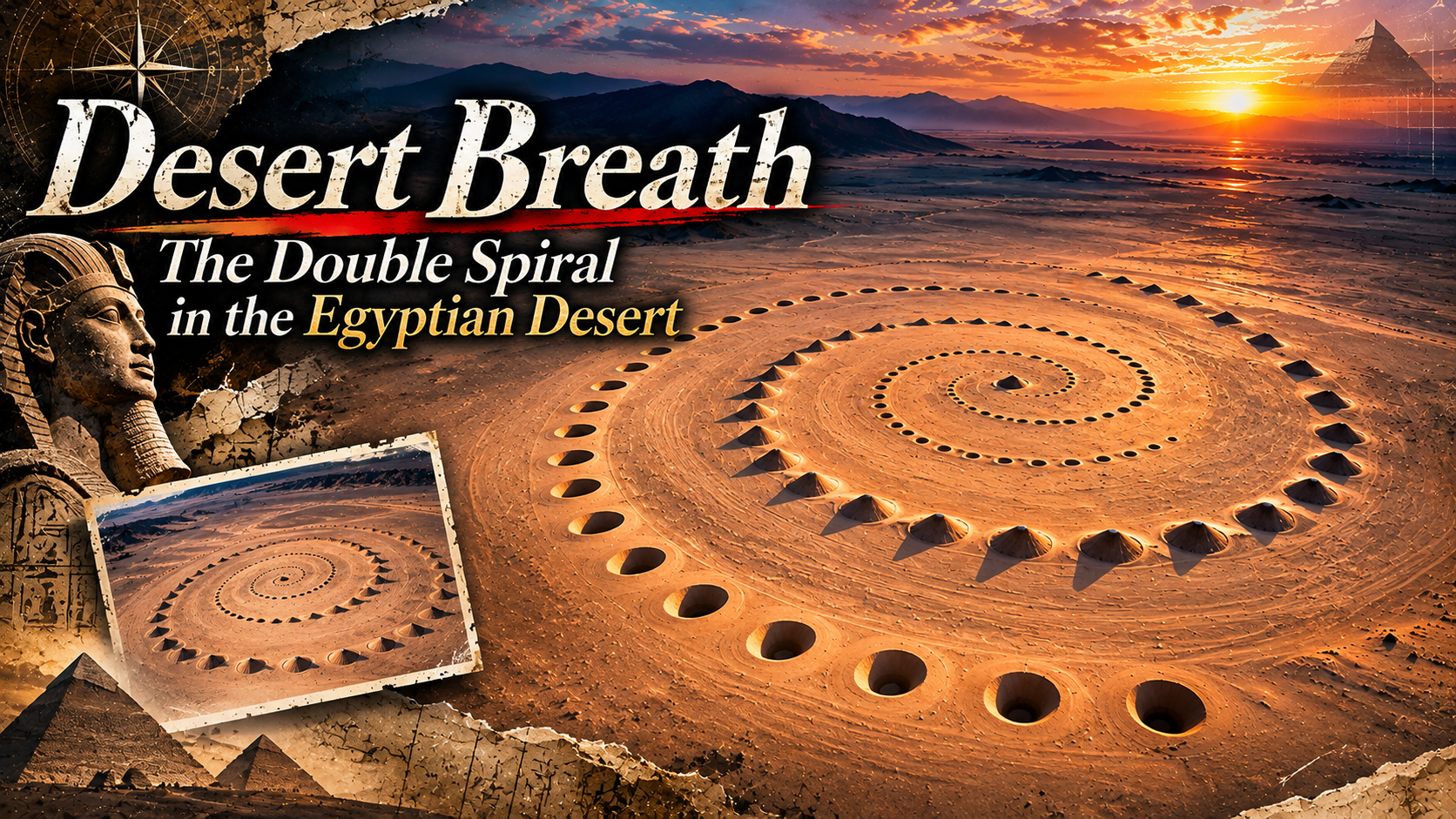
On Egypt’s Red Sea coast, look at the desert that spreads west of the resort town of El Gouna in the satellite view on Google Maps. Roads and the outlines of buildings are scattered across the dry land — and then, suddenly, a giant spiral appears. Conical mounds of earth and pits dug into the ground wind around one another as they draw toward the center.
An ancient ritual site? A symbol of an unknown civilization buried in the sand? Or a message sent toward the far side of the sky? It would be no surprise if someone who found it knowing nothing imagined any of these. Compared with the landscape around it, that one place is simply too orderly.
Its name is Desert Breath. It is a vast work on the ground, its name meaning “the breath of the desert.” What it is has already been established. And yet, as you follow the record of how it was made, another mystery comes into view: why do people read supernatural meaning into this shape?
- Observing Desert Breath on Google Maps
- An Alien Message, or a Secret Device? — The Imagination a Spiral Stirs
- 1997: What Three Creators Left in the Desert
- 178 Undulations and the Central Pool — Reading the Geometry
- Is the Mystery of “a Ground Drawing That Never Fades” Real?
- Between the Alien Theory and a Work of Art: What Remains at the Boundary
- In the Area: Red Sea and Desert Landscapes Around El Gouna
- What to Eat: Egyptian Food to Try Locally
- Getting There: Imagining the Journey to the Desert Spiral
- Fragments Assembled
- Sources & Further Reading
Observing Desert Breath on Google Maps
The site is in eastern Egypt, around El Gouna on the Red Sea coast. If you trace the observation point introduced in earlier accounts on Google Maps, you can find, in the satellite imagery, a series of regular circular undulations in the desert forming two spirals.
This work combines cones that rise from the ground with conical holes dug down into it in the opposite direction. Seen from above, they appear as a precise geometric pattern, formed by pale sand and the gradations of shadow. Stand on the ground, however, and the view changes completely. What is there is a set of enormous sand mounds and hollows, and it is difficult to take in the whole shape at once.
In satellite imagery it can be read as a single figure, yet on site it is experienced as vast terrain. Depending on the height from which you look, the same place becomes something different. It is this mechanism that makes Desert Breath seem like more than a mere formation of sand.
An Alien Message, or a Secret Device? — The Imagination a Spiral Stirs
Earlier accounts treated this ground drawing as something like a call to the sky, introducing interpretations that linked it to a signal to the cosmos, a hidden device, or a structure tied to a particular arrangement of celestial bodies. They also posed the unsettling question of whether something might be buried at its center.
Associations like these grew up apart from the production record the work’s makers made public. There are claims that it points to a specific star, readings that try to find a secret plan in it, and even a story that staring at the image for a long time causes ringing in the ears. The source of that last story has not been traced, but the very fact that such a story is told — a vast spiral whose whole form is hard to grasp on the ground, acting even on human senses and imagination — is interesting.
That said, there is no need to erase even the feeling that the spiral looks eerie. To begin with, why does this shape make people think that “someone is trying to convey something”? Human order has been placed within the natural blankness of the desert. That gap may be what makes the figure look like a kind of code.
Ancient ground drawings and vast works of land art are often spoken of in mystical terms because their full form cannot be grasped from the eye level of a person standing on the ground alone. For whom were they made to be seen? Why did they need to be so large? A pattern that comes into being only when seen from above directs the viewer’s imagination toward the sky.
Desert Breath gives the same impression. Here, however, there is a decisive difference. The names of the people who made it, the year it was made, and its design philosophy all remain. The answer to the mystery lies not beneath the desert, but in the words of its creators.
1997: What Three Creators Left in the Desert
Desert Breath was created by D.A.ST. Arteam, a collaborative team of three. Its members are Danae Stratou, Alexandra Stratou, and Stella Constantinides. The three, who work in the fields of art, design, and architecture, conceived the work using the place of the desert itself as their material.
According to the production record, construction began in June 1995 and was completed in March 1997. The work spreads over about 100,000 m². The amount of sand moved reached about 8,000 m³. This was not simply drawing lines in the desert. Sand was dug out and piled up, and three-dimensional undulations were combined to create a vast pattern.
What the three sought was neither a landing marker for a spaceship nor a marker for a facility hidden underground. In the creators’ explanation, the desert was a place that gives a sense of infinity, and also a landscape of the spirit. Taking as their starting point the conical form that sand naturally creates, they tried to bring the human sense of the body into a vast terrain.
Materials introducing the work describe two ways of seeing it: the visual image seen from the sky above, and the physical experience of walking the path of the spiral on the ground. In other words, its meaning does not begin only when it is seen in satellite imagery. Both the figure seen from afar and the sensations of a person moving through it were designed from the beginning.
Land art refers to a form of expression that incorporates land, natural materials, and terrain itself into the work. Unlike a painting hung on a museum wall, weather, light, the seasons, and the passage of time change how the work looks. It is difficult to preserve a work completely cut off from nature.
In Desert Breath, that change is not a flaw; it is built into the meaning of the work. The sand mounds collapse, sand enters the holes, and the outlines gradually grow indistinct. The order carved by human hands eventually comes undone through the workings of nature. It is a work that was made to disappear from the very start.
178 Undulations and the Central Pool — Reading the Geometry
What composes this spiral are “positive” cones of piled-up sand and “negative” cones dug down. The two spirals rotate in the same direction while taking positions offset from each other by 180 degrees. This is neither a simple set of concentric circles nor a labyrinth. It is a form in which two flows share a single center.
Architectural materials introducing the design state that there are 89 raised cones and 89 excavated cones, for a total of 178. Hearing only the number, you might imagine a precise mathematical device. However, this number, 178, is not the count of unknown components buried underground; it is the number of undulations created on the surface. When the viewpoint changes, the holes become shadow and the mounds receive light. The alternating sequence of light and dark creates an illusion of movement across the surface of the desert.
At the center, a structure filled with water, about 30 meters in diameter, had been provided. It is described as having a W-shaped cross-section. In photographs from the time of completion, the center holding water has a presence that contrasts with the undulations of sand. Water at the center of a dry desert. That alone would likely make it look to a viewer as if it had ritual meaning.
In the production record, this central pool, too, was designed as part of the work. The process by which the water is lost and the impression of the center changes also tells of how the work is exposed to time.
In the desert, there are few buildings or trees nearby to compare against. Even large things are hard to judge for distance, and conversely, small undulations can feel as if they continue far into the distance. The creators incorporated into their expression the way human scale wavers in a place like this.
As you move from the large cones on the outside toward the center, the size of the forms changes. A person walking may feel, as their relationship to the surrounding undulations changes, as if their own size had changed as well. The experience of viewing it as an orderly pattern in satellite imagery and the experience of measuring your own body anew on the ground — those two are the front and back of the same work.
Is the Mystery of “a Ground Drawing That Never Fades” Real?
Earlier accounts raised the question of why, in a harsh desert environment, the work has kept its form for so long. It is true that there is something surprising in the fact that traces of a work completed in 1997 can be read in satellite imagery from many years later.
The creators’ official site includes not only photographs from just after completion, but also records of the construction and Google Earth imagery from 2012. In other words, clues remain for following its changes at least up to that point. However, the fact that its outlines were clear in past images and the claim that the same form is preserved today are different matters. Without checking the capture date of satellite imagery, you cannot say that it is “still in perfect condition now.”
If you consider why traces of the work remain for a long time, first turn your attention to its scale. Because many large sand undulations were created to begin with, even if the outlines wear away, the overall arrangement of the pattern can be read for a certain period. Depending on the capture conditions of satellite imagery and the direction of light, shadows may be emphasized even for shallow undulations.
However, these are explanations based on general terrain observation, not the results of measuring Desert Breath’s current amount of wear. To know its latest state, images whose capture year and month are known, or an on-site survey, would be necessary.
In general, vast structures are expected to remain. Ancient ruins and city monuments alike are valued for being preserved as much as possible. This work, however, faces in the opposite direction. Disappearing itself is part of the expression.
The moment of completion was the peak of the work, and afterward it only deteriorates — it can be seen that way. Yet if you follow the creators’ intent, the process by which the form collapses is also included in the work’s time. The desert gradually takes back the traces of human hands. We are observing that change from the distant viewpoint of satellite imagery.
Between the Alien Theory and a Work of Art: What Remains at the Boundary
Who made it, when, and how? The answer lies in the production record left by D.A.ST. Arteam. And yet, knowing what something is and the disappearance of a strange impression are not the same thing. The double spiral placed in the desert still makes viewers imagine different stories.
Even so, the impression that it is “like a signal to extraterrestrials” remains. Here there is a difference between a mystery of fact and a mystery of sensation. The former can be confirmed in materials. The latter arises within the experience and imagination of the person who sees the form.
Some people overlay the spiral with DNA or a galaxy, while others picture traces of a ritual in the central pool. Even after reading the production record, is the mere fact that, in the middle of the desert, there was a scene in which two spirals surrounded water not fantastic enough?
Construction began in 1995 and the work was completed in 1997. It is land art by a collaborative team of three creators. It spreads over about 100,000 m² and forms a double spiral of mounded and excavated sand. At its center, the central pool was provided.
A secret device that responds to celestial arrangements, an unknown mechanism hidden underground, and the story that distinctive symptoms occur in people who view the satellite imagery. These are occult interpretations seen in earlier accounts and cannot be treated as confirmed facts.
The eeriness of this place lies less in hiding what it is than in the way order intentionally created by human beings is swallowed by natural time. It may look like a code conveying something because its form is simply too orderly.
If there is a secret, it lurks not beneath the ground, but within the way we look. Even after learning what it is, you still feel unease or awe when you see the same figure. That sensation does not disappear with explanation alone.
In the Area: Red Sea and Desert Landscapes Around El Gouna
Behind Desert Breath lies the distinctive landscape of eastern Egypt, where sea and desert meet. Rather than seeing the work alone as an isolated curiosity, the impression of the land grows richer when you overlay it with the nature of the Red Sea coast and how the surrounding towns came to be. However, the work itself is not necessarily a developed tourist attraction open to the general public.
A resort area planned and developed along the Red Sea coast. Its waterways, marina, and seaside scenery are its features, presenting a landscape in contrast to the dry terrain of the desert. After viewing Desert Breath on a map, if you look broadly at the terrain of this area, you can clearly see how close the sea, the mountains, and the desert are to one another.
An urban area on the Red Sea coast located south of El Gouna. It is known for marine tourism, and a rich marine environment spreads right beside dry land. It is an area where you can experience the geography of eastern Egypt from a different angle than the desert earthwork.
Turn your eyes inland from the coast, and dry mountains and vast desert continue. This terrain is also important for imagining why the creators valued the location “between the sea and the mountains.” If you visit, use an authorized tour open to the general public, or view it from a safe public location.
What to Eat: Egyptian Food to Try Locally
If you visit El Gouna or Hurghada, you will want to encounter not only the Red Sea scenery but also Egypt’s everyday food culture. Knowing the background of the dishes lets you see the life that lies beyond the glamour of a tourist destination.
A representative Egyptian everyday dish that combines rice, pasta, lentils, and more with tomato sauce and fragrant onions. Its distinctive combination, in which different ingredients are layered in a single dish, also conveys the breadth of the city’s food culture.
A dish of stewed fava beans seasoned with oil, spices, lemon, and other flavors. It is also a familiar breakfast dish and is often eaten with bread. It is a flavor rooted in the daily dining table, different from glamorous resort cuisine.
In areas facing the sea, you can also enjoy dishes of grilled or fried fish. Cooking methods and fish species vary by shop and season, so choose after checking the local menu and hygiene conditions.
Getting There: Imagining the Journey to the Desert Spiral
The spiral you arrive at in an instant on a map, if you actually try to approach it, means connecting flights, passing through a town on the Red Sea coast, and finally heading into the desert. Here, let us follow the route to the vicinity of the work, starting from arrival in Egypt by international flight.
① Fly into Egypt by International Flight
Head for Egypt on an international flight to Cairo or Hurghada. For example, you might fly to Cairo and then transfer to a domestic flight, or connect through a city outside Egypt. Operating days and connection conditions change depending on when you travel.
② From Cairo or an Overseas Connecting Airport to Hurghada
The gateway in the sky close to the destination is Hurghada International Airport (HRG) on the Red Sea coast. Use a domestic flight from Cairo, or head directly to Hurghada on an international connection. Do not plan on the assumption of a direct flight from your departure country to Hurghada.
③ From Hurghada Airport to El Gouna
According to El Gouna’s official information, the town is about 25 km from Hurghada, and the drive from the airport is given as within 40 minutes by car. Use a hotel transfer, a reserved car, a taxi, or similar. Once you reach a resort along the Red Sea, the desert earthwork lies just to the west on the map.
④ From El Gouna Toward the Vicinity of the Work
The creators’ official site introduces a method of heading from the El Gouna side by car or bicycle, parking near a service road, and walking. The information was published in the past and does not guarantee current road conditions or whether passage is possible. Plan after checking with local administrators or your place of stay.
Avoid trespassing and entering restricted areas
The work is land art that uses the desert terrain itself. Do not judge whether you may enter only by the presence or absence of fences or paved roads; check local guidance and passage conditions, and take care not to damage the work’s undulations.
Prepare for desert heat, dehydration, and vehicle trouble
Even though it is close to a seaside resort, the area around the work is desert with little to block the sunlight. Prepare drinking water and sun protection, and if you drive on unpaved roads, prepare for problems with your vehicle and plan your return route as well.
Observing by Satellite Imagery as an Option
On the ground, conical sand undulations continue; in satellite imagery, the two spirals become a single figure. If you zoom the map in and out before visiting, it becomes easier to imagine where the part you can see on site falls within the vast composition.
Fragments Assembled
The true nature of Desert Breath was neither a ruin of an unknown civilization nor a landing marker for extraterrestrials. It was vast land art that three creators built in the 1990s by moving sand. This is the answer reached through investigation.
But after learning that answer, open the satellite imagery once more. The two spirals may still look as if they are trying to convey something. The water at the center is lost, the outlines of the cones gradually collapse, and the pattern drawn by human beings returns to the desert over time.
Did human beings try to draw eternity in the desert? Or did they try to confirm that no such thing as eternity exists? When you recall the creators’ idea of “a device for measuring time,” the impression of this place quietly changes.
On the map, the spiral can still be read. But someday those lines, too, will disappear. What remains then may not be a symbol carved into the sand, but the memory of people who know that a vast breath once existed there.
Sources & Further Reading
- Danae Stratou — Desert Breath (the creators’ official site) — The work’s production record, structure, and design philosophy
- Desert Breath — D.A.ST. Arteam (Vimeo) — Video material about the production
- Geoengineer.org — Desert Breath — Commentary on the work’s form and changes over time
- El Gouna — How to Get to El Gouna (the area’s official site) — Access and transportation from Hurghada Airport
- Danae Stratou — Desert Breath / Visit (the creators’ official guide) — How to approach the area around the work and photography conditions