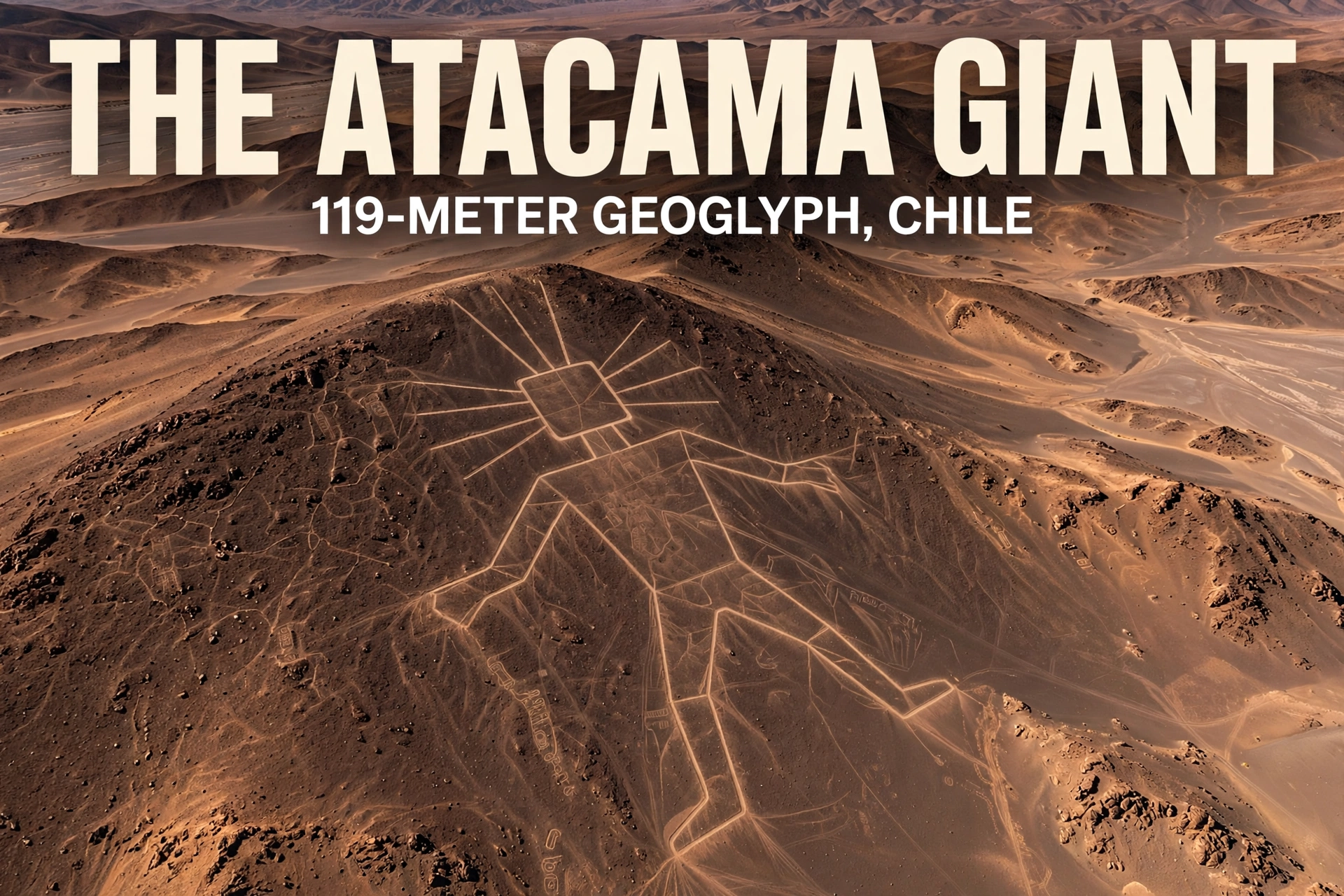
Chile, South America. Set your sights on the Atacama Desert, one of the driest places on Earth. When the reddish-brown slope of Cerro Unita (the Hill of Unita) appears on the screen, what emerges there is the silhouette of “someone” — far too strange, and far too large. It is 119 meters long. As a geoglyph in human form, it is regarded as the largest in the world: the “Gigante de Tarapacá” (the Atacama Giant).
Its form is far from the “human” we picture instinctively. From its square, angular head, several projections jut toward the sky like antennas, and its torso and legs are built from geometric straight lines. Drawn, it is believed, between about AD 1000 and 1400 by the people of the cultures that flourished in this land, this colossal figure has the air of something that foresaw the modern robot — or of someone who arrived from a distant star.
For centuries, in the silence of the desert, its gaze has gone on fixed on a single point. What is it trying to tell us? An ancient astronomical calendar? A prayer to a god? Or a “computer” that no one has yet deciphered? In what follows, we unravel the mystery of the oldest recording device carved into the earth.
Two images have been laid over this giant — “antennas turned toward another world” and “the oldest computer carved into the earth” — and it has traveled back and forth between occult imagination and scholarly interpretation. This time, holding both dear, we trace them separately: the record that can be confirmed, and the part that remains unsolved.
- Observing the “Desert Giant” on Google Maps
- A Giant of 119 Meters — The Largest Human-Shaped Geoglyph in the World
- A Land of 5,000 Geoglyphs — The Atacama Corridor
- Are the Projections on Its Head “Antennas”? — The Lineage of the Rumor
- The Oldest Computer — The Theory of a Calendar That Read the Moon
- Shaman or God? — Another Interpretation
- Our Reading — The Earth as an “External Memory Device”
- In the Area: Sights Around Tarapacá
- What to Eat: Food to Enjoy Locally
- Getting There: From Iquique — The Journey to the Far Edge of the Desert
- Fragments Assembled
- Sources & Further Reading
Observing the “Desert Giant” on Google Maps
Open the satellite view at the observation point. About 80 kilometers east of Iquique, the port town of northern Chile, on the slope of Cerro Unita, standing alone beyond the town of Huara, a shadow in human form should be visible. In the vast desert it looks vanishingly small, but zoom in, and the sharpness of its outline takes the breath away.
What deserves attention here is the “noise” mixed in around the giant. Look closely at the satellite imagery, and alongside the ancient lines you can see tire tracks from modern four-wheel-drive vehicles and footprints left by visitors carved into the surface. Sacred lines from a thousand years ago and traces of thoughtless modern destruction cross at the same coordinates. That unease, too, is part of the story of this place.
A Giant of 119 Meters — The Largest Human-Shaped Geoglyph in the World
First, let us set out the facts that can be confirmed. The Gigante de Tarapacá is given as 119 meters long (about 390 feet), and is regarded as among the largest human-shaped geoglyphs made in prehistoric times. In a book published in 2020, Karsen Lambers, an archaeologist at Leiden University, described this giant as “the largest human figure known to have been produced in prehistory.”
It was drawn about 15 kilometers east of the town of Huara, on the northwestern slope of Cerro Unita. The technique is known as a “negative geoglyph”: the dark stones and desert varnish covering the surface are removed, and the outline is drawn by exposing the pale soil beneath. In the Atacama, where vegetation is all but absent, a line once carved is exposed to the very minimum of weathering, and has kept its sharpness across more than a thousand years.
Its date of creation is estimated at about AD 1000 to 1400 (estimates vary, and some place it around the 9th century). It is thought to be the work of peoples of the Andean cultural sphere — Tiwanaku, Inca, and others — who flourished in this region in succession. It has been reported that in 2020 the Ministry of National Assets of Chile designated it a Protected National Asset, and it is protected as an important part of the cultural heritage of Chile.
119 meters long (about 390 feet). Regarded as among the largest human-shaped geoglyphs of prehistoric times.
The slope of Cerro Unita, about 15 kilometers east of Huara, in the Tarapacá Region of Chile.
Estimated to have been made around AD 1000–1400. The work of peoples of the Andean cultural sphere, including Tiwanaku and Inca.
A negative geoglyph: dark surface stones are removed to expose the pale soil beneath. The dryness preserves the lines.
Look once more, closely, at the figure of the giant. From its square head, four lines project at the top, and lines project from both sides as well. Its arms are spread, and its legs are long and stylized. Seen from far away, it looks like a shaman holding both hands wide and gazing up at the sky — and also like a machine with a receiver mounted on its head. This ambiguity, this quality of looking like both, has given rise to a range of interpretations.
A Land of 5,000 Geoglyphs — The Atacama Corridor
The Gigante de Tarapacá is not an isolated presence. More than 5,000 geoglyphs have been recorded in the Atacama Desert, spread across 150,000 square kilometers. Compare that with the distribution area of the Nazca Lines (about 250 square kilometers), and the difference in scale becomes clear. They are thought to have been made, in the main, between about AD 600 and 1500.
What they depict is not limited to people, animals, and geometric patterns. Many geoglyphs show llama caravans, telling of the trade routes that ran across the ancient Andes. The geoglyphs may have functioned as markers along the caravan routes linking the coast with the highlands — Spanish chronicles also preserve records of caravans, supporting this view from the side. And yet no direct archaeological evidence, such as caravan equipment, has been found, and the truth remains hidden.
In other words, this desert was a giant recording medium, where a culture of “writing information into the earth” continued for more than a thousand years. The Gigante de Tarapacá is the largest “letter” in that corridor. So what did that letter record? From here, we enter the world of interpretation.
There is a reason for the fine state of preservation as well. The Atacama is called “the driest desert in the world,” and in some places no substantial rain falls even once in several years. Without rain, lines drawn by removing stones are not washed away. The wind, too, over a surface without vegetation, has no power to erase them. This land, in short, is a natural archive that holds what was drawn on it on a scale of thousands of years. That is why the ancient people could entrust calendars and prayers to it, on the premise that they “would not disappear.” The harshness of the dryness has, paradoxically, protected the memory of humankind.
Are the Projections on Its Head “Antennas”? — The Lineage of the Rumor
What made this giant famous overnight was nothing other than its strange silhouette. The several projections jutting from its head looked, to enthusiasts of the ancient astronaut theory, like ideal “antennas.” Why would a human figure drawn more than a thousand years ago have a form that recalls modern robots and visitors from other worlds? Too perfect to be coincidence — so it has been whispered.
An interpretation that sees the projections on the head as a receiving device of visitors from another world. It has circulated in the context of the ancient astronaut theory.
The idea that, because its angular torso and projections resemble a modern robot, the figure is an image that foresaw the future.
A view that likens its construction from geometric straight lines to an electronic circuit or a blueprint.
A distinction must be made. These are rumors and imaginings that have actually circulated, not confirmed facts. No evidence shows that the projections are antennas, and no record points to the involvement of visitors from another world. Yet there is meaning in savoring a rumor as a rumor — because the strangeness of this colossus, regardless of the intention of its makers, has kept stirring the imagination of those who see it across a thousand years, and that fact itself is the power of this place.
What is interesting is that scholarly interpretation, too, pays attention to the “projections.” It has been pointed out that the projections may not have been mere decoration, but something meant to “point.” And what they pointed at was not visitors from space, but the Moon — that is the next theory.
The Oldest Computer — The Theory of a Calendar That Read the Moon
The most realistic, and at the same time most astonishing, hypothesis about a “function” hidden in this giant is the astronomical calendar theory. The arrangement of the projections jutting from the head, it is said, matches the setting positions of particular celestial bodies. By reading, for example, the season when the Moon sets in the direction indicated by the projections on the head, people could have predicted the time for planting crops and the arrival of the rainy season.
The Atacama Desert is one of the lands with the least rain on Earth. In an extreme environment where a single drop of rain divided life and death for the group, knowing “when the rain will come” and “when to sow the seed” was technology for survival itself. The giant may have been a prayer to a god and, at the same time, a precise calendar for keeping the group alive — that is the interpretation that has earned it the name “the oldest computer carved into the earth.”
The romance of this theory lies in the “orientation” of the giant. Drawn on the slope of the hill, the giant is thought to have been placed on the premise of being seen from far away. In other words, its makers drew a figure whose whole form they could never confirm from where they stood, on the basis of accurate astronomical knowledge. To draw a finished picture one cannot see — before the height of abstract thought that act required, one cannot help feeling awe across a thousand years.
Here, too, a distinction is necessary. Although some findings suggest a correspondence with the movement of the Moon, no decisive evidence supporting this theory has yet been presented. A strong hypothesis and an established fact must be kept apart. The calendar theory remains one of the most beautiful hypotheses explaining the “function” of the giant.
Shaman or God? — Another Interpretation
Alongside the calendar theory stands another strong interpretation: the view of this giant as a “shaman” or a “god.” Its posture, arms spread, seems to gaze up at the heavens. The radiating projections on its head may represent the headdress of a shaman, or the halo of a god — so some researchers read it.
For the people of this land, rain was the blessing of a god itself. It would be no wonder if a group living in an extreme dry land placed a giant human figure at the center of a ritual for calling rain. The giant may have been “an offering for calling the rain” and “a god itself.” Prayer and calculation may, in ancient times, have been one and the same act. To make a calendar was to read the heavens, and to read the heavens was to pray to a god.
Which interpretation is correct, no one yet knows. But both suggest that this giant was not a mere “picture,” but a “device” at the core of the survival and the faith of the people of the time. The 119-meter human figure was not drawn for decoration. It was drawn in order to live.
Our Reading — The Earth as an “External Memory Device”
Just as we entrust information to the cloud, the ancient people of the Atacama chose “the earth” as the most enduring medium of all. Paper decays within decades, and wood is burned by the desert sun. But a line drawn by removing stones lasts a thousand years, if no rain falls.
At these coordinates, they wrote the movements of the celestial bodies, the season for sowing, and prayers to a god. It was faith, it was astronomy, and it was knowledge for survival. The 119-meter giant is an “external memory device” that concentrated all of it into a single human figure.
The same paradox as the Nazca Lines is here as well. They drew a figure whose whole form cannot be seen by a person standing on the ground. The act of drawing in faith in a finished picture they themselves could not see — beyond it stood we ourselves, a thousand years later. That modern people, having gained the “eye of a god” called Google Earth, would open these coordinates again — may we be allowed to imagine that they foresaw it?
When we meet the gaze of this giant through the screen of a smartphone, the Andean people of a thousand years ago and the observers of today are connected at the same coordinates. It may be the strangest, loneliest form of communication of all, leaping over the very concept of time.
In the Area: Sights Around Tarapacá
The Gigante de Tarapacá is protected as an important part of the cultural heritage of Chile, and it can be visited. It has not, however, become a sightseeing destination to the degree of the Nazca Lines. Reaching it takes proper preparation, but in return, places where the history of the Atacama can be savored deeply are scattered around it.
Industrial heritage of saltpeter mining from the 19th and 20th centuries, near Iquique. Inscribed as a UNESCO World Heritage site, they tell the modern history of the Atacama.
A group of geoglyphs in the Pampa del Tamarugal National Reserve. A variety of figures beyond the giant can be seen, deepening an understanding of the geoglyph culture of the Atacama.
Iquique, a port town facing the Pacific Ocean. It has a beautiful beach, and the Zona Franca, a free trade zone known for duty-free shopping.
Around Cerro Unita, too, geometric patterns and human-shaped geoglyphs less famous than the giant are scattered. A place to search with imagination at work.
These sights and the giant of this article are connected within the broad region of the Tarapacá Region; they are not neighboring facilities within walking distance. Plan movement by combining cars and tours.
What to Eat: Food to Enjoy Locally
Iquique, the base for a desert journey, is a port town blessed with the bounty of the sea. Before and after a visit to the harsh desert, restore your strength with the food culture of northern Chile. What follows is not luxury dining for tourists, but flavors rooted in the daily life of local people.
A signature dish of northern Chile, fresh seafood cured in lime. In the port town of Iquique, it can be enjoyed with fish just landed.
A national dish of Chile, filled with beef and onion, boiled egg, and olives. Useful, too, as portable food on long journeys.
Chumbeque, a thin baked sweet that is a specialty of Iquique, and a cocktail of pisco, the signature distilled spirit of Chile. A fitting close to a desert night.
Because business conditions, prices, and menus change, we do not list shop names or business hours that cannot be confirmed.
Getting There: From Iquique — The Journey to the Far Edge of the Desert
The Gigante de Tarapacá has not become a sightseeing destination to the degree of the Nazca Lines. Reaching it, in return, takes preparation and resolve. The starting point is the port town of Iquique. From Santiago, the capital, a flight of about two hours brings you down at Diego Aracena International Airport. From there, head east, into the desert.
Reach Iquique by air from Santiago, the capital — about two hours by plane, with Santiago itself reached by international flights from major hubs. Here, secure a rental car, or consider joining a local tour. Fill the fuel tank in preparation for desert driving.
About an hour and a half east from Iquique. The road between Huara and Colchane is paved, and serves as a main route toward Bolivia.
Leave the paved road and follow the coordinates along unpaved desert tracks. The use of a four-wheel-drive vehicle is recommended. The unpaved section to the hill is very short.
The giant is cultural heritage under protection. Climbing the slope damages the site. Look up at its huge form from outside the surrounding fence.
When you return from the dryness of the desert, cool down with the sea breeze of the port town and a plate of ceviche. The whole form of the giant is best savored at leisure, after the journey home, on Google Maps and Google Earth.
Climbing the slope of the hill, walking over the geoglyph, or driving a vehicle across its lines damages the site. Follow the instructions for the protected area, and view strictly from outside the fence.
Strong daytime sun and severe dryness are dangerous. Carry ample drinking water, spare fuel, and shade, and avoid driving unpaved roads alone.
An hour and a half by car from the port of Iquique. The giant is at a distance anyone can build into an itinerary. And yet the whole 119-meter form cannot be taken in from the ground. “The distance you can approach” and “the viewpoint you can survey from” do not coincide. That gap may be exactly what keeps these coordinates forever strange.
Fragments Assembled
The true nature of the Gigante de Tarapacá was, in all likelihood, not an antenna of visitors from another world. What the Andean people carved into the slope of this hill between about AD 1000 and 1400 was a calendar for reading the movement of the Moon, a prayer begging for rain, and a record that wrote the wisdom of the group into the earth. That is the answer the investigation arrives at.
But after learning that answer, open the satellite imagery once more. The giant may still appear to be gazing up at the heavens, waiting for something, even now. The projections on its square head are turned toward the Moon across a thousand years. Is that fact alone not fantastic enough?
On the map, the giant can still be read. Humankind once looked up at the sky and sought meaning in the waxing and waning of the Moon. Now we live in an age when satellites look down on the ground and lay the desert giant before the eyes of the world. Knowing what something is does not mean losing the mystery. It means that the shape of the mystery changes.
Sources & Further Reading
- My Modern Met — The Atacama Giant, the Largest Prehistoric Anthropomorphic Geoglyph — An overview of the giant, its scale, and the astronomical calendar theory
- Ancient Origins — The Puzzling Case of the Atacama Giant — A survey of the theories surrounding the giant
- Lonely Planet — Gigante de Tarapacá — Location, access, and notes for visiting
- Ancient Wisdom — The Atacama Complex — The geoglyphs of the Atacama and an explanation of the lunar calendar theory