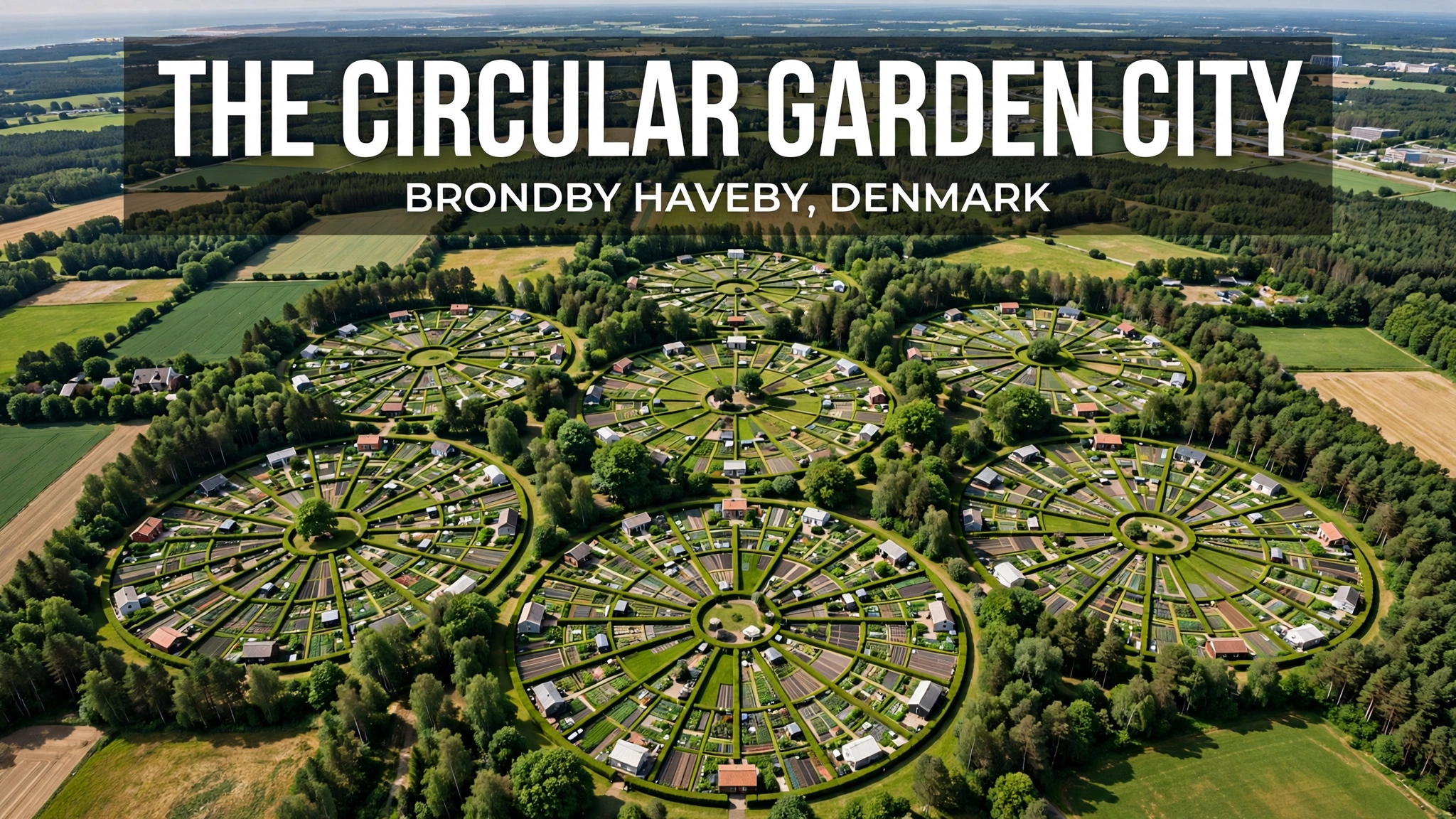
Denmark, Copenhagen. Aim at the suburbs of the polished Nordic capital. In that moment, what appears on the satellite imagery looks less like a residential district than like some kind of apparatus. Perfect circles, as if drawn with a giant compass, are divided radially like slices of a cake, edged with green hedges, and lined up in rows between forest and farmland.
Its common name is Brøndby Haveby. Born in 1964 from a design by landscape architect Erik Mygind, this place is a distinctively Danish kolonihave — an allotment colony with small garden houses, where people who live in the city spend weekends and touch the soil. But the view from above has already outgrown the frame of a garden. A giant geometric pattern carved into the earth. The trace of a social experiment calculated to the last detail. Or perhaps the remains of a ring-shaped city left behind by an alien civilization.
What is fascinating is that the beauty of these circles is almost invisible to the human eye standing on the ground. Day after day, the residents grow vegetables on their own plots, enclosed by hedges, and drink coffee with their neighbors. The full picture of the circle they live in opens only to a viewpoint several hundred meters above them.So for whom, exactly, was this circle drawn?
A settlement whose whole form can be grasped only through the lens of a satellite. Within it live together the blueprint of the utopia that 20th-century Scandinavia dreamed of, and the quiet unease that order creates. Earlier accounts treated these circles as a utopia held captive by order, and traced the unease of that geometry. This time, preserving that viewpoint, we follow the record that can be confirmed and the questions that remain unsolved, keeping the two apart.
- Observing the “Circular Garden City” on Google Maps
- 24 Circles and 284 Plots — The Facts That Can Be Observed
- Kolonihave — The Danish Tradition of Touching the Soil
- The Design Philosophy of Erik Mygind — Reviving the 18th-Century Village in the Present Day
- Rumors of an “Alien City” — The Visual Unease That Order Creates
- Our Reading — The Two Faces the Circles Show
- In the Area: Sights to Visit Around Brøndby Haveby
- What to Eat: Food to Enjoy Locally
- Getting There: From Copenhagen — The Road to the Circular Gardens
- Fragments Assembled
- Sources & Further Reading
Observing the “Circular Garden City” on Google Maps
Open the aerial imagery at the observation point carried over from earlier accounts. About 10 kilometers southwest of the center of Copenhagen, you should be able to see green disks lined up in orderly rows between residential streets and farmland. Zoom out, and you will find that their number reaches as many as 24. Each circle is complete in itself, like an independent small universe.
Boundary lines radiate outward from the center of each circle. The land of each household is divided into wedge shapes, and every sharp tip points toward the middle of the circle. At the center sit a parking area and gathering spaces shared by the residents. Zoom in on a single circle, and a charming form appears — like petals, or like a giant pizza cut into slices; photographers have in fact described it in exactly those terms. But return to the full view of 24 circles in a row, and the charm turns back into the intimidation of geometry. That swing is the magic of Brøndby Haveby.
24 Circles and 284 Plots — The Facts That Can Be Observed
First, let us organize the facts that can be confirmed. Brøndby Haveby today consists of 24 circular settlements and 284 plots. Each circle holds a dozen or so houses, and each one functions as an independent community. The design dates to 1964. The municipality of Brøndby allocated the land, and landscape architect Erik Mygind drew this circular plan.
What matters here is that this place is no ordinary residential district. The houses can be owned, but the land is leasehold. And under local regulations, stays are limited to the warm season from April to October, and to no more than six months in a year. In other words, this is a place where people who live in city apartments carry on a second life from spring into summer, and no one can live here all year round. To buy, one condition is that you also hold a main home within a radius of 20 kilometers, including Copenhagen.
1964, landscape architect Erik Mygind. The municipality of Brøndby allocated land for a garden city.
24 circular settlements, 284 plots. Each circle holds a dozen or so houses, and the plots are divided into wedge shapes.
Houses are owned, land is leasehold. Stays run from April to October, within six months per year. Holding a main home within a radius of 20 kilometers is a condition.
The tip of each plot faces the center of the circle, and shared parking and a gathering place are placed at the center. The outer edge is enclosed by hedges.
This condition — that no one can live here continuously — deepens the story of this place considerably. The beauty of the circles was designed not for the convenience of permanent residence, but to make the most of a limited season. In Danish, hygge is the culture of treasuring small, modest comfort. These circles are a device for carrying that hygge out of the city.
The trigger that made it famous around the world is also interesting. Photographer Henry Do happened upon this settlement while walking during a vacation, posted aerial photographs taken by drone to social media, and they spread in an instant. The photographs — which, in his own words, went unbelievably viral — gathered countless comments comparing the circular settlement to an alien civilization, a giant pizza, and snow crystals. Gardens that were everyday life for the residents appeared, to the eyes of the world, as the stage set of science fiction.
Kolonihave — The Danish Tradition of Touching the Soil
To understand the circles of Brøndby Haveby, you need to know the Danish garden culture of the kolonihave. Translated, it comes close to colony garden or community allotment, but its history reaches back to the working-class culture of the 19th century.
The organized movement began in 1884. It is said to have started when Jørgen Bertelsen, a lawyer on the Jutland Peninsula, leased land from the city of Aalborg and lent small plots to workers. People who had gathered in cities under industrialization spent weekends amid greenery and grew vegetables for their own tables. Tending a garden deepened family bonds, and became a place to talk with neighbors over tea or beer. In 1908 the first leaseholders association was founded, and the movement spread nationwide. During the First World War, potato growing was encouraged, and in the interwar years there are said to have been close to 100,000 plots. Even in the early 2000s, 60,000 plots remained, and the culture is still rooted in Danish life today.
Lawyer Jørgen Bertelsen begins the first organized kolonihave movement in Aalborg.
The first leaseholders association is founded. It later develops into the national organization, the Danish Kolonihave Federation.
Houses are owned, land is leasehold. Building a small house on land owned by the municipality is permitted. Year-round residence is not allowed.
More than 60,000 plots remain across the country. The element of self-sufficiency has faded, and the plots are cherished as places of leisure and community.
Speaking of circular garden cities, Copenhagen has another place to the north that could be called a brother of Brøndby: the oval gardens of Nærum, designed in 1948 by the celebrated Danish landscape architect Carl Theodor Sørensen. Forty oval plots stand in a row on undulating lawns, enclosed by hedges. Sørensen believed that the seed of quarrels between neighbors is the hedge, and is said to have deliberately given detailed guidance on how the hedges should be grown. The circles of Brøndby and the ovals of Nærum. Denmark has a tradition of thinking about gardens through form.
The Design Philosophy of Erik Mygind — Reviving the 18th-Century Village in the Present Day
So why did Mygind choose the circle? The answer lies in the Danish village of long ago. In the villages of 18th-century Denmark, the central square — the place around the common well — was the heart of gathering for the residents. People crossed paths there, stopped to chat, and exchanged rumors. Mygind sought to revive that old village custom of gathering at the center in the age of functionalism.
Houses are lined up along the circumference, and the single entrance faces the center of the circle. Every time residents go out, they are sure to meet their neighbors face to face at the center. On the drawing board, it is a physical implementation of enforced sociability. In modern city life, it is not unusual to go for years without knowing the face of a neighbor. Mygind tried to loosen that thinness with the power of architecture.
On the other hand, the outer edge of each plot is covered by tall hedges, and privacy inside is strictly protected. Openness toward the center, and closedness through the hedges. Two opposing elements coexist within a single circle. What earlier accounts called the pinnacle of the controlled community is this double structure. Inside circles that look like beautiful cells, an inescapable ring is closed — whether it feels that way depends on the standpoint of the viewer.
What is passed on in the testimony of residents, however, is rather a peaceful everyday life: a small community in which people meet face to face across the hedges and share beer and coffee. Even if the geometry of the circle looks intimidating to eyes from the sky, within life on the ground it works simply as a device for neighborliness in which faces are visible. The two faces of the circles — order from the sky, and conviviality on the ground. How to read that gap is the fascination of this coordinate.
Rumors of an “Alien City” — The Visual Unease That Order Creates
From here, we preserve the fragments of rumor that earlier accounts collected. Every time aerial photographs of Brøndby Haveby spread, the same kinds of voices rise from around the world. Is it not an alien base? It must be the king of all crop circles. It has to be an aerial photograph of some experimental facility. The circular settlement has even earned the nickname alien city.
The reason such reactions arise is a human reflex toward geometry that is too perfect. Natural terrain is usually irregular. Forests and fields do not draw evenly spaced circles. When human order is placed there, the brain sounds the alarm — this is not natural — and begins to search for a reason. When no reason is quickly found, the imagination leaps to aliens and conspiracies. Awe toward the circles is awe toward geometry itself.
A nickname that spread together with the aerial photographs. The fact that the full form can be seen only from above invites imaginings reminiscent of the remains of an alien civilization.
A reading from earlier accounts. The view that the structure — in which every dwelling can be surveyed from a standpoint at the center of the circle — calls to mind an all-around surveillance facility.
The imagining that life managed inside perfect circles is like a sample observed by a greater intelligence. A question posed in earlier accounts.
Let us keep a distinction in mind. These are rumors and imaginings that have actually circulated, and they are not confirmed facts.The records of the 1964 urban plan show clearly what this settlement really is. It is neither an alien base nor a secret facility, but garden land for Danes to enjoy their weekends. But knowing what something is, and the disappearance of the shock of how it looks, are different matters. The mystery of fact and the mystery of sensation live in different places.
Let us preserve here the question that earlier accounts posed. If the Nazca Lines were drawn for the gods, then for whom, exactly, were these circles drawn? Designer Mygind may have brought in this mathematical coldness as a quiet rebellion against modern urban planning, which pursues efficiency alone. There are strict rules for the height and care of the hedges on the grounds, and individual freedom is subordinated to the order of the whole in order to preserve the beauty of the circles. Order creates beauty, but at the same time it harbors the suffocation called homogenization. When you zoom out and compare them with the irregular residential streets around them, the very otherness of these circles is the lingering scent of the controlled paradise that 20th-century humankind dreamed of.
Our Reading — The Two Faces the Circles Show
Brøndby Haveby becomes an entirely different place depending on the height from which you look. On the ground, there are small gardens enclosed by hedges, and the laughter of neighbors. It is simply a beloved weekend retreat.
But raise the viewpoint by several hundred meters, and in that instant it changes into an exhibition hall of perfect geometry. Twenty-four circles stand in formation, and 284 plots spread out radially. In that gap, perhaps, lies the essence of this place. When a scale exceeds what human beings can take in, a residential district sheds its function and is elevated into an ornament applied to the earth.
Mygind modeled his design on the 18th-century village not out of nostalgia. He was trying to recover, through the power of architecture, the face-to-face relationships that were being lost. Ironically, that attempt appears to the eyes of the satellite age as an alien city. A benevolent design, and an intimidating view. Both are real, and both are faces of these circles.
The circles change color with the seasons — white circles in winter, deep green circles in summer. Even that shifting begins to seem like part of a calculated pattern. But we must not forget that within that green there are people digging potatoes and brewing coffee. The intimidation of geometry, and an everyday life that smells of soil. There are not many places in the world that hold both at once.
In the Area: Sights to Visit Around Brøndby Haveby
Brøndby Haveby itself is not a tourist facility, but a place where people live. Visitors cannot step inside the circles, but scattered around it are places where you can feel the fusion of Nordic urban planning and nature. Combine them with a viewing of the circles.
A beautiful coastline spreading south of the settlement. You can stroll along the quiet Nordic sea and sandy beach. A good stop before or after viewing the circles.
A museum of contemporary art in nearby Ishøj. It is known as a place to encounter Nordic design and art. Check the official information for opening status.
The remains of the historic line of defenses that ringed Copenhagen. Maintained as a green corridor, it is popular for cycling and walks.
The colorful harbor streets of Nyhavn, Tivoli Gardens, and the statue of the Little Mermaid. A walk through the city center of Nordic design pairs well with a viewing of the circles.
These sights and the circular settlement of this article are connected within the broad region around Copenhagen; they are not neighboring facilities within walking distance. Plan your movement by combining railways and rental bicycles.
What to Eat: Food to Enjoy Locally
Indispensable to a Danish weekend spent in the gardens of the circles is the plain, deeply flavored food culture of the North. We introduce tastes rooted in daily life, not glamorous cooking for tourists. The spirit of hygge, which treasures small happiness, appears at the dining table as well.
A Danish open sandwich of rye bread topped with herring, shrimp, roast beef, and more. It is cherished as a national dish.
The home of the sweet bread known in Japan as a Danish. Locally, it is called wienerbrød — Viennese bread.
The sausage stand on the street corner is a symbol of Danish food culture. One eaten in a break from garden work is said to be something special.
Because business conditions, prices, and menus change, we do not list shop names or business hours that cannot be verified.
Getting There: From Copenhagen — The Road to the Circular Gardens
Brøndby Haveby is an active garden residential district, and it has not been turned into a tourist attraction. But viewing from public places, and walking in the surrounding area, are possible. The starting point is Copenhagen Airport (Kastrup). From one of the leading hub airports of the Nordic countries, the circles are surprisingly close.
The gateway to the Nordic countries. From the airport station, about 15 minutes by train to Copenhagen Central Station. This becomes the starting point toward the circles.
From the Central Station, board the A line or E line of the S-tog suburban trains and get off at Brøndby Strand Station. The journey takes about 20 minutes.
The road continues flat, so the rental bicycles for which Copenhagen is famous are the most comfortable option. By car, about 15 minutes from the center on the E47 motorway.
Because the inside of the circles is private land of the residents and shared space, viewing from the public roads around the perimeter is the rule for visitors. The full form can be seen only from above.
To savor the full form of the circles, open the coordinates once more in Google Maps and Google Earth after you return home.It becomes a journey that overlays two faces — the ground and the sky.
What is here is not an exhibit, but the private land of people. Do not peer inside the hedges, and do not enter private land without permission. The parking inside the circles is for residents only; visitors should use the public parking in the surrounding area.
You may want to take beautiful aerial photographs, but in Denmark, strict permission is said to be required for drone flights over residential areas. Do not fly without permission.
The closeness of reaching it in under an hour from the airport, and the remoteness of a full form that can be seen only from above. That twist in the sense of distance is the true pleasure of a journey to Brøndby Haveby.“The place you can reach” and “the scenery you can see” do not coincide. Visit with the ease to enjoy that gap.
Fragments Assembled
The true nature of Brøndby Haveby was neither an alien base nor a secret facility. The records of the 1964 urban plan tell the whole story. Twenty-four circles drawn by landscape architect Erik Mygind to revive the customs of the 18th-century Danish village in the present day. A blueprint full of goodwill, for people who live in the city to touch the soil on weekends and meet their neighbors face to face. That is the answer the investigation arrives at.
But after learning that answer, open the aerial imagery once more. The circles may still look as if they are asking something, even now. Perfect geometry lined up on green earth, beautiful quite apart from life on the ground. Is that fact alone not fantastic enough?
On the map, the circles can still be read. Humankind once sought meaning in the arrangement of the stars. Now we live in an age in which satellites look down on the ground and expose the geometry of a garden city to the eyes of the world.Knowing what something is does not mean losing the mystery. It means that the shape of the mystery changes.
Sources & Further Reading
- Open Culture — Denmark’s Utopian Garden City Built Entirely in Circles — An overview of the circular garden city, its history, and its rules of use
- Verve Magazine — Heavenly Brondby Haveby — An introduction to the circular settlement, with aerial photographs
- EcoDisciple — The Art of Creation: A Piece of Garden — The history of the kolonihave culture of Denmark
- Denmark.net — Naerum Allotment Gardens — The oval gardens of Nærum and the allotment culture of Denmark