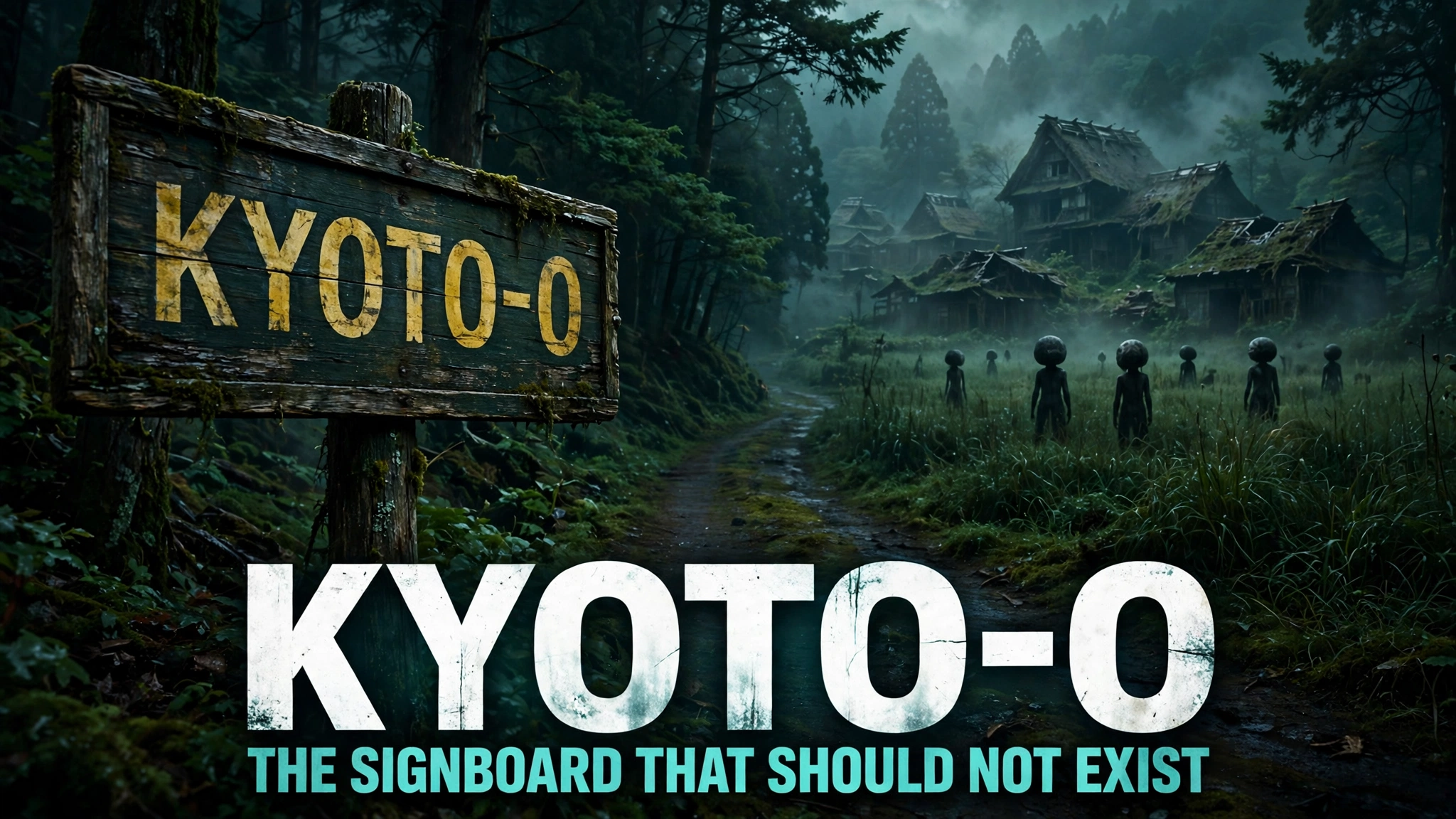
February 22, 2006. On the occult board of the giant forum 2channel, a horror story of only a few hundred characters was posted. The title was Kyoto-o, read as kyotouo. The brevity of the story, and the absence of explanation, have kept the imagination of countless readers captive for close to twenty years.
The story runs as follows. As a child, the poster had visited a village deep in the mountains, where a small inn stood, together with both parents. The musty room of the old inn was unpleasant, and so was the television that showed nothing, but one memory alone remained strong: going out early in the morning with his father to catch rhinoceros beetles. Grown up, the poster used a run of holidays to drive back to that village. On the road as the village drew near, a signboard that should once have read a distance onward had become Kyoto-o.
With an uneasy feeling and a wish to go and see mixed together, the poster drove in, and the village had become an abandoned village. Vines were wrapped around the buildings. At the moment of trying to step out of the car, from the tall grass about 20 meters ahead, a figure that seemed human, with a head far too large, appeared. More stood all around as well. With both arms pressed tight against the legs and the huge head swaying from side to side, the figures came after the poster in an eerie movement. Without stepping out of the car, the poster reversed at a terrifying speed, raced back to the national highway at a tremendous pace, and escaped. At home, a check of the map showed, so the story ends, that the village visited years before and the place visited that day had not been mistaken.
That is the whole text. No sequel follows, and no detailed explanation is given. Not even the name of a prefecture appears, let alone the name of the village. And yet, or rather for that very reason, these few characters became deeply carved into the history of horror stories on the internet. Alongside Inunaki Village and Sugisawa Village, the story is still retold today as a leading example of the haunted village tale.
Earlier write-ups linked this rumor to specific places, an abandoned village in Kagoshima Prefecture and a locality called Ushikubi. This article returns to the record of the 2006 post itself, and follows twenty years of the rumor, including the signboard discovery that actually took place in 2018 and the film adaptation of 2026. One point also needs recording here: the text of the 2006 post itself names no prefecture, and the Kagoshima theory derives from discussion in later years and from the report of 2018.
- Observing the Place Where the Signboard Stood on Google Maps
- February 22, 2006 — Four Characters Posted to the Sharekowa Thread
- Three Theories About the Identity of the Letter O
- In 2018, the Real Thing Appeared on a Forest Road in Kagoshima
- Why the Story Has Been Retold for Twenty Years — The Structure of Fear
- In Winter 2026, Kyoto-o Returns on Screen
- Our Reading — Kyoto-o as a Glitch in Reality
- In the Area
- What to Eat
- From Kagoshima Airport — The Road to the Mountain Where the Signboard Vanished
- Fragments Assembled
- Sources & Further Reading
Observing the Place Where the Signboard Stood on Google Maps
According to the report of the signboard discovery in 2018, the signboard was found on a forest road near Mount Kinpo, in the area of Minamisatsuma City in Kagoshima Prefecture, at a point reached after advancing 4 to 5 km from Kinpo Dam. The exact point has not been made public, and the signboard itself has now disappeared, so no single point on a map can be declared as the place. Please open the satellite imagery below as an outline of the area around Kinpo Dam named in the report.
Look down on the mountain ridges covered in deep green, and an intuition forms that this land holds many places that slip through the mesh of the map. Forest roads, a dam, cedar woods. Somewhere among them, in the summer of 2018, a signboard that could indeed be read as Kyoto-o is said to have stood.
February 22, 2006 — Four Characters Posted to the Sharekowa Thread
The first appearance of Kyoto-o was a post of February 22, 2006, to a thread on the occult board of 2channel with a title that asked readers to gather stories so frightening that no joke could cover them. The thread is known by the nickname Sharekowa, and is known as the place that produced, one after another, later classics of internet horror such as Hasshaku-sama, Kisaragi Station, and Kotoribako. Kyoto-o is counted among the masterpieces of that hall of fame as well.
The outline of the post deserves one more careful tracing. A few years earlier, the poster suddenly remembered a certain village. The village had a small inn deep in the mountains, and the poster had visited with both parents as a child. After asking the parents for the place, the poster drove alone during a run of holidays. As the village drew near, a signboard should have marked the place, but on finding that signboard, a small jolt followed. What should have read, as far as memory served, a distance onward now read Kyoto-o.
An uneasy feeling and a wish to go and see crossed, but the decision was to go. Driving in, the village had become an abandoned village, and vines were wrapped around the buildings. On trying to step out of the car, from the tall grass about 20 m ahead, something that seemed human, with a head far too large, came out. While the poster could only wonder, more stood all around as well. And the figures came in pursuit with an eerie movement — both arms pressed tight against the legs, the huge head swaying from side to side. Good fortune lay in never having stepped out of the car. The car reversed at a terrifying speed, and raced to the national highway at a tremendous pace. At home, a check of the map showed that the village visited years before and the place visited that day had not been mistaken.
This structure, in which everything ends while still a mystery, has been pointed to as the factor that stirred the imagination of readers and kept the story retold for years. What was the true nature of the village? Who were the large-headed residents? Why did the figures give chase? What happened afterward? No correct answer has been prepared. For that very reason, readers fill the blank with the worst imaginings of their own.
A post of February 22, 2006, to the Sharekowa thread on the occult board of 2channel, the thread that asked readers to gather stories so frightening that no joke could cover them.
Read as kyotouo. The story is classed among village urban legends and otherworld horror tales, and is known as a haunted village tale alongside Inunaki Village and Sugisawa Village.
The text is very short, at only a few hundred characters. No village name and no prefecture name is specified. No sequel and no detailed explanation follows.
The poster is known to have posted another occult story on the same day, and a strong view holds that fabrication is likely. Whether the story was fabricated, however, is a separate matter from the vitality of this rumor.
One distinction needs care. A high likelihood of fabrication and a dull story are separate matters. In the world of research on urban legends, an urban legend is said to remain an urban legend because the legend always seems to be true. Even if Kyoto-o was fabricated, the story planted fear in the hearts of readers and has been handed down. That, in all likelihood, is the essence of an urban legend.
Three Theories About the Identity of the Letter O
The eeriness of the string Kyoto-o lies in the fact that the string does not hold together as language. Up to the part that means giant head, the sense can be followed. But what does the final katakana letter O mean? Around this letter O, discussion has accumulated on the internet over many years. Three theories carry weight.
The character for village is formed of a part that means tree and a part that means measure. If the measure part peeled away under wind and rain, the remaining shape, like a tree over a single stroke, would look like the katakana letter O. In other words, the signboard may originally have read Kyoto-o Village, using the characters for giant head and village. If so, the further thought that people of the giant head may have lived in this village since long ago swells the fear still more.
A theory that the signboard read Giant-Headed Man. If the lower part of the character for man, the part that means strength, broke away, a shape like the character for field would remain, and a misreading as O cannot be ruled out. In that case, the signboard may have been a warning about a being with a huge head.
An interpretation that the notation was made meaningless on purpose. Showing a string that cannot be understood in ordinary terms keeps intruders away. Or the signboard may have been made by a being outside the language system of humans. In any case, the meaning of the letter O remains an eternal mystery.
At the time of the signboard discovery affair of 2018, testimony from a local resident was reported, holding that the letter O was short for boar, and that the signboard had warned readers to take care against giant-headed boars. The ending feels almost deflating, but as a practical matter for a signboard in the mountains, the account is entirely plausible.
Earlier write-ups introduced an interpretation that the character for village in Kyoto-o Village had crumbled and come to look like O, and a speculation that the name may have been a coded term for a place where people with a physical trait had been isolated. These points remain discussion on the internet, and are not confirmed facts. The accumulation of such discussion itself, however, is the ecosystem of the rumor called Kyoto-o.
In 2018, the Real Thing Appeared on a Forest Road in Kagoshima
In August 2018, twelve years after the post, a startling post went up on Twitter. A user posted a photograph with a comment that, while driving through the mountains by car, a strange signboard had been found where the road divided from an animal trail. On that signboard, characters that could indeed be read as Kyoto-o were captured. The post spread in no time, and became a major topic among fans of the occult.
According to the poster, the place where the signboard was found was in the area of Minamisatsuma City in Kagoshima Prefecture, on a forest road near Mount Kinpo, at a point reached after advancing 4 to 5 km from Kinpo Dam. Of interest is the fact that the finder did not know the urban legend of Kyoto-o. The photograph was taken purely from the thought that the signboard was strange, and only then did the internet erupt with the cry that the signboard was none other than Kyoto-o.
After this discovery, people from across the country arrived one after another on pilgrimage to the sacred site. At present, however, no signboard exists at that place. Whether the signboard was removed, or was a prank from the start, the truth remains unknown. Only the photograph of the signboard remains on the internet, and only testimony of having seen the real thing kept increasing.
Here, a comparison with earlier records is in order. Earlier write-ups linked the setting of this rumor to specific places, Kagoshima Prefecture and Ushikubi. The text of the 2006 post specifies no prefecture, yet the discovery report of 2018 placed the find in Minamisatsuma City in Kagoshima Prefecture, showing a strange agreement with the sense of place in those earlier records. A rumor called forth a rumor, a signboard reading Kyoto-o appeared on real land, and then vanished. This sequence itself holds value as a record of the materialization of an urban legend.
Why the Story Has Been Retold for Twenty Years — The Structure of Fear
Why has a horror story of only a few hundred characters been retold for close to twenty years? The reasons can be considered in three structures.
The first is the way a scarcity of information stimulates the imagination. Where exactly was the village? Who were the large-headed residents? Why did the figures give chase? What happened afterward? All of these points end as mysteries. The human brain has a nature that tries to fill blanks. For that very reason, readers fill the gaps with the worst imaginings of their own.
The second is the depiction of an abnormal movement. Read the single sentence about both arms pressed tight against the legs and the huge head swaying from side to side, and in that instant an image plays in the mind. The movement is clearly wrong as human motion. And yet the movement can be imagined in concrete terms. This realistic abnormality freezes the spine of the reader.
The third is the fear that a nostalgic place has changed. The setting of the story is a village of memory that the protagonist visited in childhood. Driven by nostalgia, the protagonist returns, and finds ruins, with an unknowable presence settled in place. A sense of loss and fear, that a place of return can never be returned to and that a memory has been defiled, lies at the base of this horror story.
The rumor also has a side as an urban legend of the kind built around words that must not be searched. A thrill lies in the act of investigating an unknowable thing itself, and the fact that nothing becomes clear at the end of the search amplifies the fear still further. A structure in which the searching fingers cannot stop has supported a lifespan of twenty years.
In Winter 2026, Kyoto-o Returns on Screen
And then came 2026. This urban legend, a veteran of twenty years, at last becomes a film. Adaptation into a film was announced in August 2026, and nationwide release from Friday, December 25 was set. The director is Ryota Kondo, who drew attention with Missing Child Videotape. Kentaro Maeda stars, with Shiori Kubo in a supporting role. Distribution is by Fine Films, with release at Theatre Shinjuku, Human Trust Cinema Shibuya, and cinemas across the country.
The story of the film version rebuilds, as a feature, the short scary story of the 2006 post, in which an encounter simply ends. A father who visited a village deep in the mountains twenty years before later met an inexplicable death. In pursuit of the truth, a son, Haruma Takao (Kentaro Maeda), heads deep into the mountains together with a fiancee, Shiho Tajima (Shiori Kubo), in search of that village, of which neither the name nor the place is known. What the pair sees there is a strange signboard reading 50 m to Kyoto-o. In the abandoned village beyond, a mysterious custom called nieokuri was still being carried on.
This film, made by imagining what lay beyond the signboard, a stretch never depicted in the 2006 post, can be called an extreme case of secondary creation from an urban legend. Imagery in 2026 is trying to fill a blank that the poster of 2006 left unwritten. Given a new vessel in the screen, the rumor may now walk out toward the next twenty years.
Our Reading — Kyoto-o as a Glitch in Reality
Earlier write-ups treated Kyoto-o as a glitch in reality. The view holds that the signboard, which does not hold together as Japanese, feels like an error message generated in the system of the real world. This intuition has not faded, even now, twenty years on.
A signboard is always a boundary line that divides what lies beyond from what lies before. The incomplete string Kyoto-o may be an error code showing that the place is the far end of information, and that the order of this world has begun to collapse. A place where language does not pass and reason does not pass. In such a place, even the form of a human being, as known to us, cannot be maintained.
One more reading deserves addition. In Kagoshima in 2018, a signboard of the real thing appeared, people gathered from across the country, and in time the signboard vanished. This sequence of events can also be seen as a case in which collective attention on the internet created a temporary singularity on real land. Through imagination, we may have built, in the mountains of Kagoshima Prefecture, a village that should not exist. Your search, too, forms part of that work of construction.
The distinction, however, needs to be made clear. Fabrication of the 2006 post is likely, and the true nature of the signboard of 2018 has not been settled either. No place name Kyoto-o Village exists anywhere in Japan. These points are not confirmed facts, but rumors and discussion that have actually circulated. To savor a rumor as a rumor and to treat a rumor as fact are separate matters.
Even so, a reason certainly exists for the survival of this rumor across twenty years. A text that is too short, a broken string of characters, and fear that is never explained. Across generations, those elements have kept readers at the work of filling the blank called imagination.
In the Area
The area around Minamisatsuma City, where the signboard of 2018 was reported, is at once the setting of the rumor and a land where the history and nature of Satsuma overlap. The signboard itself is gone, but a visit to this region invites a round of places where the memory of the land can be touched.
Elevation 636.28 m, and one of the One Hundred Famous Mountains of Kyushu. From a resemblance to the profile of a beautiful woman lying down, the mountain is fondly known by the nickname Bijindake, the Mountain of a Beautiful Woman. Together with Mount Kaimon and Mount Noma, the mountain is called one of the Three Peaks of Satsuma. On the western side, just below the summit, stands Kinpo Shrine, and on October 19 each year a pilgrimage to Mount Kinpo is held. Kinpo Dam, named in the signboard report of 2018, lies along Prefectural Road 20, which runs around this mountain.
A historic port town known as the place where the monk Ganjin came ashore. The area once prospered as a port of call on a maritime Silk Road. At the Kitsukan museum, visitors can come into contact with the history and culture of Bonotsu.
A facility in Mansei, Kaseda, in Minamisatsuma City. Exhibitions convey the history of the special attacks and entrust a wish for peace to visitors. Within a journey to a land of rumor, the hall also becomes a place for facing a different kind of memory.
A stopping place where experiences such as making soba noodles by hand are offered. The station serves as a base for a drive toward Mount Kinpo and Kinpo Dam.
These sightseeing places and the forest road where the Kyoto-o signboard is said to have stood are connected within the same broad region of Minamisatsuma City, and are not adjoining facilities within walking distance. Exploration of the place where the signboard stood and visits to sightseeing places need to be planned as separate matters.
What to Eat
A visit to Minamisatsuma City invites contact not only with the atmosphere of the mountains, but also with the food culture of Satsuma. In the intervals of a journey in pursuit of the mystery of the signboard, a pause over local flavors also has merit.
A local dish that represents Kagoshima. Freshly fried satsuma-age carries a flavor that belongs to the land where the dish is eaten.
A signboard name in the food culture of Kagoshima. In shabu-shabu or in tonkatsu, the sweet fat of this black pork deserves a full tasting.
A presence that cannot be separated from the dining table of Satsuma. Breweries also stand in Minamisatsuma City, and a glass here becomes a way to feel the water and the climate of the land.
The bounty of the sea from Bonotsu, a historic port town. Seafood landed locally, beginning with Souken saba, can be enjoyed here.
Business conditions, prices, and menus of shops change over time. For that reason, shop names and business hours that cannot be confirmed as real are not listed here.
From Kagoshima Airport — The Road to the Mountain Where the Signboard Vanished
The place where the Kyoto-o signboard is said to have stood cannot be reached by public transport. Travel by car is a premise. And above all, the signboard has now disappeared. For readers who still wish to confirm the atmosphere of the land, the route is recorded here.
The southern gateway. International visitors reach Kagoshima Airport through major hubs in Japan, with domestic connections from cities such as Tokyo and Osaka. Secure a rental car here. In preparation for mountain roads, keep fuel in ample reserve.
Head south on national and prefectural roads. The time is a guide and changes with road conditions. Once the urban area falls behind, ridges of deep green mountains come into view before long.
To the foot of Mount Kinpo, along Prefectural Road 20. The signboard report of 2018 is held to have come from a forest road in this area, at a point reached after advancing 4 to 5 km from Kinpo Dam.
Many roads are unpaved, and sections without mobile phone coverage are also reported. Never enter private land or managed land without permission.
The signboard of 2018 has now disappeared. Even on a pilgrimage to the sacred site, the signboard itself cannot be met. What remains is only the atmosphere of the mountains and the lingering scent of the rumor.
Never enter private land or managed land without permission. Forest roads are unpaved and carry a risk of landslides and fallen trees, and sections without mobile phone coverage also exist. Take care against wild animals such as wild boars and pit vipers, and against sudden changes in weather, and avoid entering the mountains alone.
The signboard of 2018 has already disappeared, and no Kyoto-o signboard exists on site. Strict care is needed against acts that trouble local residents, such as noise late at night, entry onto premises, and abandonment of litter. A journey in pursuit of a rumor must come as a set with respect for the land.
From Kagoshima Airport, about 1 hour and 30 minutes by car. Anyone can build an itinerary as far as Minamisatsuma City. The signboard that certainly stood there in the summer of 2018, however, is gone. The distance that can be traveled and the signboard that can be met do not coincide. That gap may be exactly what keeps Kyoto-o a rumor forever.
Fragments Assembled
Look back over twenty years of Kyoto-o, and the outline of this rumor comes into view. A horror story of a few hundred characters, posted on February 22, 2006, in a corner of 2channel. The broken string Kyoto-o, an abandoned village, and something that gave chase while swaying a huge head from side to side. The absence of explanation kept the imagination of readers captive, and discussion called forth discussion.
In 2018, a signboard of the real thing appeared on a forest road in Minamisatsuma City in Kagoshima Prefecture, and people gathered from across the country. In time, the signboard vanished. And in 2026, given a new vessel in the screen, this rumor is about to walk out toward the next twenty years. Even while fabrication is held to be likely, the story is still retold. That is the ecology of the living creature called an urban legend.
On the map, the green of Mount Kinpo runs deep again today. The truth of the signboard seen by the poster of 2006 can no longer be known by anyone. All that is known is the single fact that these few characters have kept the imagination of people captive for twenty years. To learn the true nature of a rumor is not to lose the rumor. The shape of the rumor changes.
Sources & Further Reading
- Kyoto-o — Wikipedia — The post of February 22, 2006, the Sharekowa thread, and classification among haunted village tales
- What Is Kyoto-o? A Full Examination of an Urban Legend Born on 2channel — Choge Blog — Details of the signboard discovery report of 2018, in Minamisatsuma City, Kagoshima Prefecture, near Kinpo Dam
- Eiga.com — Trailer and Poster Visual for the Film Kyoto-o Released (October 18, 2026) — An outline of the film adaptation and release information
- Denfaminicogamer — Internet Urban Legend Kyoto-o to Become a Film (August 21, 2026) — Details from the time of the announcement of the film adaptation
- Mount Kinpo (Kagoshima Prefecture) — Wikipedia — Elevation 636.28 m, one of the One Hundred Famous Mountains of Kyushu, the nickname Bijindake, and the Three Peaks of Satsuma
- International Research Center for Japanese Studies (Nichibunken) — A reference point for research in folklore studies