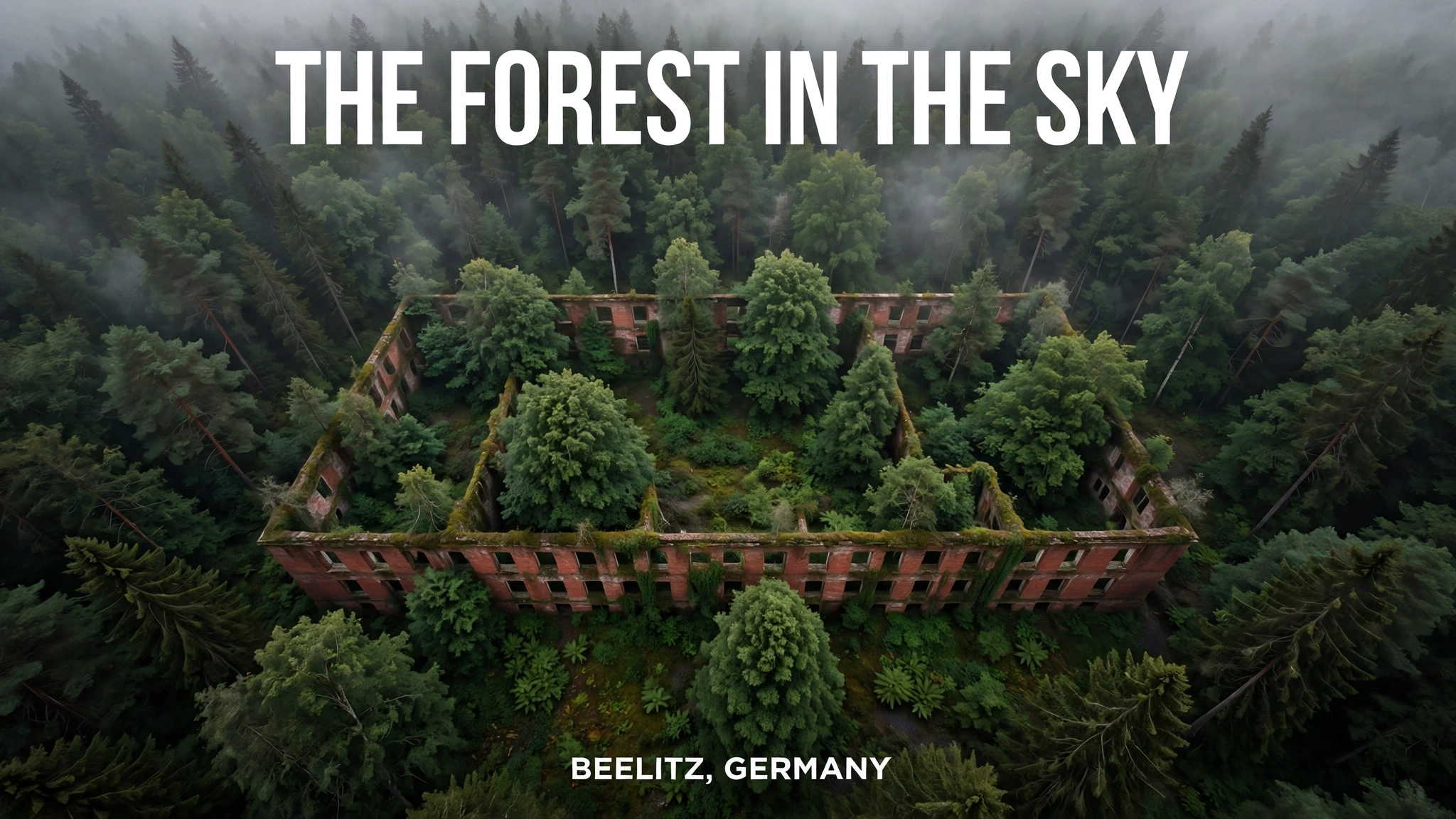
A deep forest in Brandenburg, Germany. When the coordinates are caught in satellite imagery, an observer may end up doubting their own eyes. The outer walls of red brick, cut out in an unnatural rectangle, and an interior filled completely by a forest denser than the woods around it, a forest floating in the air. This is the ward at Beelitz-Heilstätten said to hold the most harrowing and mysterious memories of the whole complex, known as the Alpenhaus. A square of green set into a frame of red brick.
At the end of the 19th century, this vast sanatorium complex was built to save workers from the threat of tuberculosis that had struck Berlin, and it was once praised as a place so clean and functional that it was called a “white angel.” Through the turbulent age of two world wars, however, the place changed from a “sanctuary of healing” into a “storehouse of despair.” The story that the young corporal Adolf Hitler, wounded at the Somme in the First World War, received treatment here in 1916 has been widely reported around the world, but the degree of support behind that story calls for care.
In 1945, when the flames of the Battle of Berlin took the roof, the forest began to grow vertically toward the void. Today the place functions not as a “building” but as a single “ecosystem.” Earlier accounts read this ruin through a double memory, the “scar of the dictator” and the “forest in the sky.” This time, while preserving that rumor, we follow the record that can be confirmed and the parts that have not yet been solved, keeping the two apart.
- Observing the “Forest in the Sky” on Google Maps
- From the “White Angel” to the “Storehouse of Despair”
- The Forest That Healed a Dictator
- 1945 — The Day the Roof Was Lost
- Lingering “Sounds” — What Is Told as Rumor
- After 1994 — When a Ruin Becomes a “Sacred Place”
- Our Reading — The Giant Bandage Laid by Nature
- In the Area: Sights Around Beelitz-Heilstätten
- What to Eat: The Food of Beelitz
- Getting There: Starting from Berlin Brandenburg Airport — The Road to a Ruin in the Forest
- Fragments Assembled
- Sources & Further Reading
Observing the “Forest in the Sky” on Google Maps
Open the satellite imagery, taking over the observation point used in earlier accounts. The interior of the rectangular ruin, occupied completely by trees, should be visible. The roof vanished in the fire of 1945, and the forest grew toward that “void.” Looking down on the ruin of the Alpenhaus from directly above, the “square of forest” framed by the outer walls of red brick can be confirmed clearly.
What is interesting is that this “forest in the sky” grew without the work of human hands. Not planting, but seeds carried by the wind and fruit dropped by birds, piling up a layer of green over more than 60 years. The sight of a forest on the roof of a ruin looks like proof that the relation of master and servant between civilization and nature has been reversed.
At an ordinary ruin, plants grow from a garden or from gaps. Here the case is different. The building that lost the “lid” of a roof became a huge flowerpot in itself. The walls are the rim of the pot, the former wards are the soil, and the collapsed beams are the humus. These coordinates go on showing, from the sky, the moment when a hospital, an artificial object, turned into a vessel for an ecosystem, a natural object.
From the “White Angel” to the “Storehouse of Despair”
In 1898, the Berlin Workers Insurance Association began construction of a sanatorium for tuberculosis. To protect workers from the tuberculosis striking the rapidly expanding capital, a complex of more than 60 buildings was built in the deep forest southwest of Berlin. With a power plant of its own, a butcher shop, a bakery, a laundry, a restaurant, and even a beer garden, the complex was a “small town.” Each ward was provided with large balconies facing south, and patients could receive “air baths” without stepping outside the walls of the hospital. Fresh air itself was the finest treatment of the age.
Built by the Berlin Workers Insurance Association for workers suffering from tuberculosis. The clean air of the forest was treated as part of the cure.
At the peak, the complex could house several thousand patients at the same time. The facilities included a power plant, a butcher shop, a bakery, and a beer garden.
With the outbreak of the First World War, the sanatorium became a military hospital of the Imperial Army. The “sanctuary of healing” began the change into a “storehouse of despair.”
In the age when this facility was praised as the “finest medical environment in the world,” everyone called the place the “white angel.” White walls, orderly gardens, the silence of the forest. That beauty, however, would soon take on a completely different meaning in the age of war that was about to arrive.
The Forest That Healed a Dictator
Among the memories lingering in this place, the heaviest is the record of 1916. The story that the young corporal Adolf Hitler, wounded in the thigh at the Battle of the Somme, received treatment at Beelitz-Heilstätten has been widely reported by media around the world. Wounded by a shell fragment, he was at the time no more than one of the millions of unknown soldiers. Ironically, the quiet air of this forest healed the wound of the dictator and sent him back to the battlefield.
One distinction should be kept. That Hitler received treatment at Beelitz is itself widely reported, but whether the place where he stayed was the Alpenhaus or another ward within the complex has not been supported in the materials that could be confirmed for this article. The story of the whole complex and the story of a specific building need to be read apart.
In the second half of 1916, the junior corporal Adolf Hitler, wounded at the Battle of the Somme, is said to have received treatment at Beelitz-Heilstätten.
Whether the ward where he recuperated was the Alpenhaus (Pavilion B IV) or another ward cannot be identified in the materials that could be confirmed.
The story of the whole complex, that treatment was received at Beelitz, and the story of a specific building, that treatment took place in this building, should be read at different levels of certainty.
The label of the “hospital that healed a dictator” made this facility known around the world. Because of the strength of the label, however, the memories of individual buildings melt into a single story. The forest growing on the roof of the Alpenhaus keeps a much quieter time, apart from that large story.
Consider the temptation of a “what if.” If the unknown corporal wounded at the Somme in 1916 had not been healed in this forest, history might have been slightly different. The reason these coordinates attract people is not only the beauty of the ruin, but also a sense of touching a turning point of history. That, too, belongs to the realm of imagination, and the point must not be forgotten.
1945 — The Day the Roof Was Lost
In the Second World War as well, Beelitz again took on the role of a military hospital. In 1945, when the Battle of Berlin began, the place turned into a literal battlefield, not a place of healing. A clash between the retreating German forces and the advancing Red Army of the Soviet Union, and fierce bombing and shelling. On this occasion, the symbolic roof of the Alpenhaus (Pavilion B IV of the sanatorium for women with tuberculosis) was wrapped in flames and collapsed completely. The “rooftop forest” visible today in satellite imagery is the result of seeds falling, over decades, into the “hole of memory” pierced by the fire of 1945, and of roots spreading there.
After the end of the war, this vast complex was seized by the forces of the Soviet Union and became a “blank on the map,” cut off from the countries of the West, until the forces of Russia withdrew completely in 1994. For close to half a century, the complex was operated as the largest military hospital of the Soviet Union outside the territory of the Soviet Union. Graffiti in Cyrillic letters left on the walls, rusted operating tables, and underground passages where the air of the Cold War era has solidified. Many of the “lingering thoughts” reported by urban explorers are tied to the layer of this era.
Half a century is a span of time that paints memory over in layers. The coughs of patients with tuberculosis, the groans of wounded soldiers, the footsteps of Soviet soldiers, and the laughter of explorers adding graffiti. The bricks of the Alpenhaus are like a sponge that has absorbed all of that. While the rooftop forest grew, another memory was quietly maturing beneath the forest.
The history of the facility holds one more famous anecdote. In 1990, Erich Honecker, the leader of East Germany, is said to have received treatment for cancer of the liver here, and, after the collapse of the regime, to have attempted an escape abroad with this place as the starting point. That story, too, is left here as a record based on reporting. The connection between dictators and a sanatorium may not have ended with Hitler alone.
Lingering “Sounds” — What Is Told as Rumor
From here begins the shelf of rumors. According to reports by urban explorers, the whispers of former patients and the sound of heavy military boots are said to echo at night from the windows of the Alpenhaus, where no one should be. Corridors covered in graffiti, peeling paint, and rusted beds. Such reports have become established as the “ambient sound” of this place.
The whispers of patients and the sound of military boots said to be heard from the ruin at night. The stories have become established as reports by urban explorers.
Ghost stories told in connection with suspicious deaths said to have occurred during the era of Soviet occupation, and with events in the underground passages.
After the withdrawal of 1994, the place was left untouched for a long time, and the layers of history remained exactly as the layers had formed. Rumors are born from the gaps between those layers.
One distinction should be kept. These are rumors that have in fact circulated, and are not confirmed facts. To savor a rumor as a rumor and to treat a rumor as fact are different matters. Still, such voices may be born precisely because this is a place where history was never once “swept clean.”
After 1994 — When a Ruin Becomes a “Sacred Place”
After the complete withdrawal of the forces of Russia in 1994, the facility was left untouched for a long time. The walls were covered in graffiti, and the corridors lined with rusted beds became a “sacred place” for urban explorers. People who slipped inside at the risk of collapse, people who took photographs, and people who collected ghost stories. Beelitz became known to the world as a mecca of dangerous exploration of ruins.
The grandeur of the ruin drew attention from the world of film as well. Filming for The Pianist, directed by Roman Polanski, and for Valkyrie (2008), starring Tom Cruise, took place here. That stories depicting the tragedy of the 20th century chose, as a stage, buildings soaked in the tragedy of the 20th century is probably no coincidence.
Afterward, part of the facility began to follow a path of regeneration. Some buildings were bought and converted into housing, and in other buildings, research in medicine and rehabilitation is reported to be continuing. In 2015, the treetop walk called Baumkronenpfad opened, and the ruin became an object to be “viewed from above.” The era of dangerous infiltration ended, and the era of approaching the “forest in the sky” by an official route began.
The irony is that this change turned the Alpenhaus into a “ruin that is viewed.” Once cut off as a blank on the map, next an object of dangerous exploration, and now opened as a highlight of tourism. To be viewed and to be understood are different matters. The fact that the place came to be viewed is itself, however, the beginning of a new history for these coordinates.
Our Reading — The Giant Bandage Laid by Nature
This archive does not regard the forest growing wild on the roof of the Alpenhaus as a mere result of neglect. Could the forest be part of an activity of life, in which the earth preys upon the negative history of humanity and tries to render that history harmless? The roots of the trees bite into the gaps in the bricks that once healed a dictator and let many soldiers die, and the roots slowly return the bricks to soil. The square of green visible from the sky looks even like a “giant bandage” laid by nature.
Beneath that bandage, however, charred traces from the fire of 1945 and claw marks left at the very end by soldiers remain with certainty. An observer must not forget that the uncanny silence given off by these coordinates exists not because the gruesome events of the past were resolved, but only because the events are covered by the leaves of the trees. When we zoom in on a digital map, we are peering into a wound of history.
Knowing what a thing is, and the fading of a strange impression, are not the same thing. The mystery of fact and the mystery of feeling are different things. The former can be confirmed in materials. The latter is born in the experience and the imagination of the person who has seen the shape.
In the Area: Sights Around Beelitz-Heilstätten
Beelitz-Heilstätten, once a mecca of dangerous exploration of ruins, is now maintained as a tourist destination, a place where the ruin can be viewed as a witness to history. Unauthorized entry into the interiors remains strictly forbidden, but official routes allow a safe approach to the “forest in the sky.”
Opened in September 2015, the first treetop walk in Brandenburg. A wooden path 17 to 23 meters above the ground crosses the ruin of the Alpenhaus (Pavilion B IV). An admission fee is required.
An observation tower 40.5 meters high, equipped with an elevator and barrier-free access. On a clear day, the view is said to reach as far as the television tower of Berlin.
Official tours tracing the history of the ruin complex are held. Chances to view the interiors of buildings that are normally closed also arise.
The old town of Beelitz, the “town of asparagus.” A museum dealing with the history of Spargel (white asparagus) also stands in the town.
Unauthorized entry into the interior of the Alpenhaus carries an extremely high risk of collapse and is strictly forbidden. The realistic method for observing the ruin is the treetop walk or an official tour.
What to Eat: The Food of Beelitz
Beelitz is also known as a Spargelstadt, a “town of asparagus.” In spring, the town is wrapped in the scent of white asparagus. The gloom of the ruin and the brightness of a seasonal taste. That contrast is the flavor of this journey.
The season runs from late April to late June. Boiled asparagus with hollandaise sauce, served with ham and potatoes, is the standard combination.
The facility of the treetop walk has a bistro attached. A place for a rest while viewing the forest.
Beyond the asparagus of spring, the plain regional cooking of Brandenburg can also be enjoyed. The season and the business conditions should be checked before a visit.
Because seasons and the business conditions of shops change, shop names and prices that cannot be confirmed to exist are not listed.
Getting There: Starting from Berlin Brandenburg Airport — The Road to a Ruin in the Forest
The distance allows a day trip from Berlin. The nearest station can be reached by a single railway line. The former sanatorium for tuberculosis is now opened as a tourist destination in the forest.
From the airport to Berlin Central Station, travel by S-Bahn or by the Airport Express is possible.
Ride the RE7 heading southwest and get off at Beelitz-Heilstätten Station. The journey takes about 1 hour.
Vast grounds spread within the forest. Follow the signs toward the entrance of the treetop walk.
The walk crosses the ruin of the Alpenhaus and allows a close view of the rooftop forest. Do not enter the interior of the ruin; observe from the official route.
Unauthorized entry into the interior of the Alpenhaus, approach to the ruins, and drone flights are strictly forbidden. The risk of collapse is extremely high. Use an official guided tour or the treetop walk.
This place is also a site of historical tragedy. Nuisance acts, such as making noise and adding graffiti, must be strictly refrained from. In winter, opening hours are short, so confirmation on the official site before a visit is advisable.
About 1 hour by train from Berlin. From the era as the “white angel” of sanatoriums, through war, occupation, and abandonment, the place is now opened as a tourist destination in the forest. The boundary between a ruin that can be visited and a ruin that cannot be entered is clear at these coordinates. Respect for that boundary is respect for the memory that lingers here.
Fragments Assembled
The name Alpenhaus was given with hope, the hope of regaining health in clean air like the air of high mountains. Today the name indicates a “false mountain” built on top of an artificial object. A sanctuary of healing became a sanatorium of a dictator, became a battlefield, became a hospital of an occupying army, and was then swallowed by the forest.
Many of the people who visit this place come in search of the label of the “hospital of Hitler.” From the top of the walk, however, looking down on the rooftop forest, the label fades a little. What exists there is plain “green,” larger than the memory of a dictator and deeper than the memory of war.
Coverage by the forest does not mean that memory has vanished. The roots biting into the gaps in the bricks look both like a rendering of history as harmless and like a sealing of history away. Which reading is correct is decided by the heart of the visitor.
The square of green seen in satellite imagery is a beautiful and cruel “gravestone of memory.” When we zoom in on these coordinates, we are seeing the same sky that wounded soldiers and soldiers of the Red Army looked up at decades ago. To learn what a thing is does not mean to lose the mystery. The mystery changes shape.
Sources & Further Reading
- Abandoned: Beelitz-Heilstätten (Take Me North) — An overview and history of the complex
- The Hospital That Treated Hitler During the Battle of the Somme (Abandoned Spaces) — An introduction to the record of treatment in 1916
- The Hospital of Hitler: The Phantom Sanatorium (Bored Panda) — A record of the history and photographs of the complex
- Tree-top walk Beelitz-Heilstätten (Wikipedia) — Specifications of the treetop walk and the record of the opening
- Baumkronenpfad Beelitz-Heilstätten (aroundus) — An overview of the walk and an explanation of the Alpenhaus (Pavilion B IV)
- Baumkronenpfad in Beelitz (Top10 Berlin) — Visitor information and a tourist guide