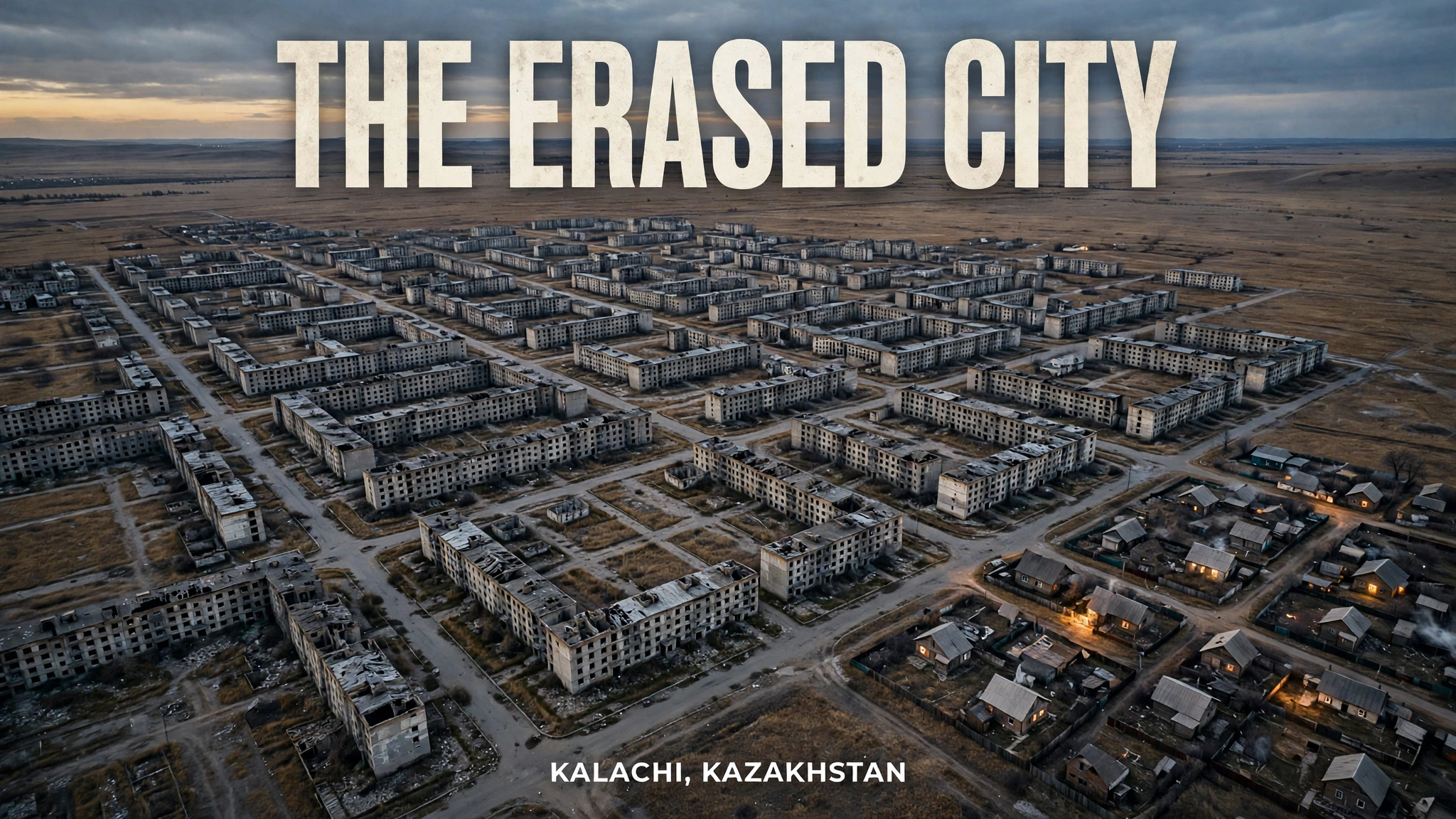
Deep in the abyss of the internet, in the depths of anonymous message boards in particular, a strange code name lies sleeping. “Bana-Eren.” The name is said to belong to a secret city of the Soviet era, from which 2,700 residents vanished in a single night. The name exists on no official map and in no public document. And yet the place that the name points to does remain, clearly, in satellite imagery. Kalachi, a small village a short distance from Krasnogorsk, a former uranium mining city on the great steppe of Kazakhstan. A “dead grid” left behind on the horizon of the steppe, where no one should be walking.
In the 21st century, an incident of mass sleep that modern science could not fully explain took place in the village of Kalachi. In the middle of a school lesson, in the middle of a walk, people collapsed as if a switch had been turned off, and went on sleeping for days afterward. When they woke, they had lost memories and complained of hallucinations. The villagers called this place a “Sleepy Hollow,” and in time the village was abandoned through a collective relocation funded from the national budget.
Earlier accounts read these coordinates through two overlapping rumors, “Bana-Eren” and the “sleeping sickness.” This time, while preserving those unsettling rumors, we follow the record that can be confirmed and the parts that have not yet been solved, keeping the two apart. Let rumor and fact be labeled clearly and set side by side. That is the honest way to enjoy these coordinates.
What waits ahead is the record of a uranium city erased from the map, an incident of mass sleep that modern science could not fully explain, and the declaration of a solution by the government, together with the objections that remain to that declaration. The record beyond the rumor is as strange as the rumor itself, and just as human.
- Observing the “Dead Grid” on Google Maps
- Behind the Claim That 2,700 People Vanished
- Krasnogorsk — A Secret City Born for Uranium
- The Strangeness at Kalachi — People Who Fell Asleep as if a Switch Had Been Turned Off
- The Sleepy Hollow Watched by Media Around the World
- The Declaration of a Solution by the Government, and the Objections That Do Not Fade
- Our Reading — A Ghost of Information Born from a Blank in the Record
- In the Area: Sights Around Astana
- What to Eat: The Food of Kazakhstan
- Getting There: From Astana — Approaching the Far Edge
- Fragments Assembled
- Sources & Further Reading
Observing the “Dead Grid” on Google Maps
Open the satellite imagery, taking over the observation point used in earlier accounts. In the wilderness of the steppe, sections cut out in unnatural rectangles stand in rows. Foundations of apartment blocks, shadows of collapsed walls, traces of roads that no one travels. Straight lines of human construction, showing that several thousand people once lived there. Zoom in again and again, and it becomes possible to understand that this was once a place of daily life.
Looking at the map, what stands out is a difference in the density of the silence. The surrounding grassland carries even a hint of nomadic life, yet this section alone is hard, as if time had stopped. That gap makes this place look like a kind of cutout. As if someone had cut this city out of the map, or out of history, with scissors.
Behind the Claim That 2,700 People Vanished
The figure that supports the legend of “Bana-Eren” is “2,700 people.” This number overlaps, in a strange way, with the scale of the population of Krasnogorsk at its peak. According to reports, the population of the city reached about 6,500 at its peak. After the collapse of the Soviet Union, when distribution and subsidies from the state stopped, the uranium city lost population rapidly. In the official explanation, the residents are treated as having been relocated in a planned manner.
And yet the orderly ruins, with household goods left behind, and the fact that the city had been erased from maps, raised the folklore of a vanishing in a single night. A population outflow that was too rapid, and a past in which the name had been erased for the sake of secrecy, gave later imagination the form of a mass disappearance.
The making of a legend always needs a blank. The parts that public documents do not tell, the parts that maps leave white: into those parts, people pour stories. The strength of the phrase “2,700 people vanished in a single night” comes not from the accuracy of the number, but from the depth of that blank.
One point should be stated clearly. The name “Bana-Eren” is in all likelihood not an official code name of the Soviet era, but a name given in later years on internet message boards. The name is not in the official record. What exists is only the substance of an erased city, and the imagination that gathered around it.
Krasnogorsk — A Secret City Born for Uranium
Krasnogorsk was a closed city (a ZATO, a closed administrative-territorial formation) built for uranium mining in support of the nuclear development program of the Soviet Union. Residents were registered, entry and exit were controlled, and the name did not appear on maps. The city was run as a city that did not exist. Closure of the mine began in the final years of the Soviet Union, and in the 1990s the city rapidly lost its people. After the city fell into ruin, the residents, who had once numbered several thousand, had fallen to about 130, according to reports.
The ZATO system of the Soviet Union (closed administrative-territorial formations) erased names from maps and concealed the existence of residents. Krasnogorsk was one such city.
A population said to have reached about 6,500 at its peak fell sharply through relocation after the collapse of the Soviet Union. After the city fell into ruin, the number had fallen to about 130, according to reports.
The hollowed-out underground cavities go on behaving like a giant lung, holding water and breathing out gas. The strangeness at Kalachi may have crawled out from exactly that underground.
A mine fallen into ruin is not a mere remnant of concrete. Underground cavities that have left human hands take in groundwater and go on breathing out gas over long years. Every theory of the “sleeping sickness” examined in later chapters is tied to this behavior of the underground.
The Strangeness at Kalachi — People Who Fell Asleep as if a Switch Had Been Turned Off
The village of Kalachi is a small village a short distance from Krasnogorsk. From about 2012 to 2016, some of the villagers were struck by sudden coma-like sleep. In the middle of a school lesson, in the middle of a walk, they collapsed “like robots whose power had been cut,” and went on sleeping for days afterward. The sleep is said to have lasted six days at the longest. The people who woke are said to have complained of violent hallucinations, disorders of memory, and states of abnormal excitement.
In 2014, an investigative report in the Russian newspaper Komsomolskaya Pravda told the world of this strangeness. The article recorded the appearance of an episode as follows. “The patients seem to be conscious, and can even walk. But they fall into a deep sleep and snore. And when they are woken… they remember nothing.” As of January 2015, more than 140 cases had been reported. The figure amounts to close to 20 percent of the population of the village.
Many of the victims are said to have suffered episodes not once, but many times. Even after waking from sleep, the cause remained unknown, and days in which no one knew when sleep might come again covered the whole village. Anxiety called up rumor, and rumor amplified anxiety still further. A village where everyone lived thinking that the next turn might be theirs. That was Kalachi from 2013 to 2015.
On the internet, debate boiled over: radiation, poison in the water, mass hysteria. With a uranium mine of the Soviet era close by, voices suspecting radioactive contamination were especially numerous. But a later environmental survey confirmed that radiation levels in the village were at normal levels.
The Sleepy Hollow Watched by Media Around the World
What told the world of this incident was the investigative report of 2014 in Komsomolskaya Pravda. The reporter interviewed the families of people who had actually fallen asleep in the village, and recorded testimony that people could even walk, yet suddenly fell into a deep sleep, and, when woken, remembered nothing. With this report as the trigger, media from overseas also visited Kalachi one after another. The Guardian of the United Kingdom (2015) reported that more than 140 people in two villages had suffered episodes, and that close to 20 percent of residents had been caught up in the incident.
The official view of the government, holding carbon monoxide and hydrocarbons leaking from the abandoned mine after closure to be the cause. The theory was regarded as the strongest among the explanations offered.
A counterargument from researchers of Nazarbayev University, holding that chemical substances buried in the abandoned mine may have contaminated the source of the well water shared by the village.
The possibility of a psychogenic cause, pointed out by specialists in sleep disorders. The theory was compared to the “Bin Laden itch,” a psychosomatic rash that spread in the United States in 2002.
The media gave this village the nickname “Sleepy Hollow.” The name recalls the ghost story “The Legend of Sleepy Hollow” by Washington Irving, but what was happening here was not fiction. Real people were falling asleep, in reality. That gap is the reason these coordinates go on appearing on lists of strange places around the world.
The Declaration of a Solution by the Government, and the Objections That Do Not Fade
In July 2015, the government of Kazakhstan declared this mystery solved. Deputy Prime Minister Berdibek Saparbayev announced that carbon monoxide and hydrocarbons leaking from the closed uranium mine nearby were the cause. Measurements are said to have detected carbon monoxide at ten times the normal level. The Russian scientist Leonid Rikhvanov explained that groundwater had gathered in the abandoned mine, and that inert gases such as radon, produced by the decay of uranium, were being pushed out and rising to the surface. The government moved ahead with the collective relocation of the residents of the two villages, Kalachi and Krasnogorsk.
The announcement concluded that a rise in the concentration of carbon monoxide and hydrocarbons had reduced the oxygen in the air and caused the sleep disorders.
An explanation holding that groundwater gathered in the abandoned mine pushed out gases derived from the decay of uranium, and that the gases rose through cracks in the surface of the ground.
Relocation of the residents of the two villages moved ahead, and the villages were in effect abandoned. From 2016 onward, reports of new episodes have ceased.
Objections to this conclusion remained, however. First, at the start of the same year, the Ministry of Health had reported that no evidence of carbon monoxide poisoning had been found in the blood of patients. In addition, research by epidemiologists of Nazarbayev University put forward a counterargument: chemical substances buried underground in the abandoned mine may have contaminated the source of the well water shared by the villagers. In the comprehensive environmental survey conducted by the National Nuclear Center from 2014 to 2016, radiation levels were at normal levels, and an expert conclusion was also issued holding that radiation could not have been the cause of the sleeping sickness.
In other words, at present, the broad outline — that environmental contamination derived from the abandoned mine was involved — is shared, but whether the cause was carbon monoxide, water contamination, or both has not been settled. That is the reason these coordinates are still placed in the category of the unexplained.
Our Reading — A Ghost of Information Born from a Blank in the Record
This archive reads the legend of “Bana-Eren” as modern folklore born from the Soviet system of the closed city (ZATO), a system in which information was cut off. The system erased names from maps, concealed the existence of residents, and, when a place was no longer needed, erased the place together with every trace of it. The shadows of people who were made, by a giant eraser called the state, into people who had not existed — those shadows may have changed shape and become the name “Bana-Eren.”
The incident of mass sleep showed that this land is still an otherworld, unsuited to human habitation. The cause may lie in a physical toxin, or in a spiritual dissonance given off by a place whose existence was denied. Staring at the coordinates in satellite imagery, a section cut out in an unnaturally rectangular shape comes into view. The section is the skeleton of the former city, a “dead grid” that no one walks anymore.
The fact of having been erased is different from the fact of never having been. A place whose existence was denied keeps the denial itself as memory. The name Bana-Eren may be like a bubble that that memory set afloat on the sea of the internet.
Knowing what a thing is, and the fading of a strange impression, are not the same thing. The mystery of fact and the mystery of feeling are different things. The former can be confirmed in materials. The latter is born in the experience and the imagination of the person who has seen the shape.
In the Area: Sights Around Astana
Around these coordinates there are no tourist facilities for general visitors. The base is the capital, Astana, and the area around the capital. Travel here becomes a journey to visit the modern face of the land of the steppe.
An observation tower regarded as a symbol of independent Kazakhstan. From the top, the streets of the capital and the horizon of the steppe can be taken in at a glance.
A mosque regarded as one of the largest in Central Asia. A place to come into contact with the form of faith in Kazakhstan today.
A museum covering the history of nomadism, the Soviet era, and the present day. The museum also serves as a base for learning the historical background of the era of the closed cities.
The central town of the Esil District, where the village of Kalachi lies. A regional town of the steppe, passed through as a relay point on a journey to the coordinates.
These sights and the coordinates of this article are connected within the broad region from around Astana to the Esil District; the sights are not neighboring facilities within walking distance. Approach to ruins and sightseeing in the city should be planned as separate matters.
What to Eat: The Food of Kazakhstan
The table of Kazakhstan is one in which the memory of nomadism and the memory of the Soviet Union overlap. Mutton and fermented milk, bread in the Russian style and spices of Central Asia. On a journey across the steppe, a meal itself becomes a record of the history of the land.
The name means “five fingers.” A national dish of boiled mutton and flat noodles, eaten by hand. A dish at the center of the table of hospitality.
A traditional drink of fermented mare milk. A taste of summer on the steppe, with a slight sourness and a touch of carbonation.
Skewers grilled over charcoal, and Baursak, a fried bread. Everyday flavors, tasted with ease at markets and canteens.
Because the business conditions, prices, and menus of shops change, we do not list shop names or business hours that cannot be confirmed to exist.
Getting There: From Astana — Approaching the Far Edge
The area around these coordinates is not a tourist destination, and a zone where the risk of collapse of ruins and concern over harmful gases still remain. For observers who still wish to see this erased city with their own eyes, the journey of tracing how close a visitor can come is itself part of the story of this place.
The journey into the steppe begins from the capital, Astana. In preparation for long-distance travel, secure fuel, drinking water, and emergency food.
A long journey of about five to seven hours by train or by car. Outside the window spreads the horizon of the steppe, continuing without end.
The road toward Kalachi continues as rough, unpaved track. A four-wheel-drive vehicle and a driver with knowledge of the land are desirable. Travel alone should be avoided.
A small number of residents have been confirmed in the village. The proper form is not to enter land without permission, but to speak to residents and obtain agreement.
Signs are almost entirely absent. Do not come too close to the interior of ruins or abandoned mines. The final observation should be made from satellite imagery and from a safe distance.
Harmful gases may still be pooled around the old mine. Entry into ruins without permission, and approach to abandoned mines, are strictly forbidden. Going deep into the area alone can endanger life. Do not enter zones where regulatory signs stand.
Around the area there are almost no lodging facilities, shops, or hospitals. Food, drinking water, fuel, and medical supplies must all be procured by the traveler, and means of communication and a system of contact in an emergency must be secured.
From the airport of Astana, more than half a day by car. As far as the village of Kalachi, anyone can assemble an itinerary. Walking the dead grid of the ruins on the ground, however, is a separate problem. The distance that looks reachable and a place where entry is possible do not coincide. That gap may be exactly what keeps these coordinates strange, without end.
Fragments Assembled
The true form of “Bana-Eren” was not a city that never existed, but the record of a city whose existence was erased. The 2,700 people did not vanish by magic. They were erased from the record for reasons of the state. And as the end of that story, the people who remained were cut off from reality in the form of sleep.
Judging by the numbers alone, this incident has been filed away in the folder marked solved. But as long as objections to the cause remain, the lid of the folder does not close completely. The sleep of Kalachi has ended in the record, but as a question, the sleep may still be continuing.
Even if the explanation of the government was correct, the eeriness of these coordinates does not vanish. Underground cavities hold water, breathe out gas, and rob people of consciousness. The earth itself looks as if the land were breathing the secrets of the past.
On the map, the rectangular grid can still be read. The grid is a seam that a former superpower tried to hide, and today, in silence, the grid goes on calling out to the sky that life once existed there. To learn what a thing is does not mean to lose the mystery. The mystery changes shape.
Sources & Further Reading
- Mystery of Kazakhstan Sleeping Sickness Solved, Says Government (The Guardian, reprinted) — Reporting on the announcement of the cause by the government and the course of events
- Sleepy Hollow: Why residents of a Kazakh village fell asleep for days at a time (Qatar Tribune) — An overview of the sleeping sickness incident and an introduction to dissenting views
- COMPREHENSIVE SURVEY OF KALACHI VILLAGE (NNC) — Report of the comprehensive environmental survey of 2014 to 2016
- Kalachi, Kazakhstan (Wikipedia) — An overview of the village and the course of the sleep incident
- “Sleepy Hollow”: In this Kazakh village, residents fell asleep for days at a time (Times Now) — Detailed reporting on the incident