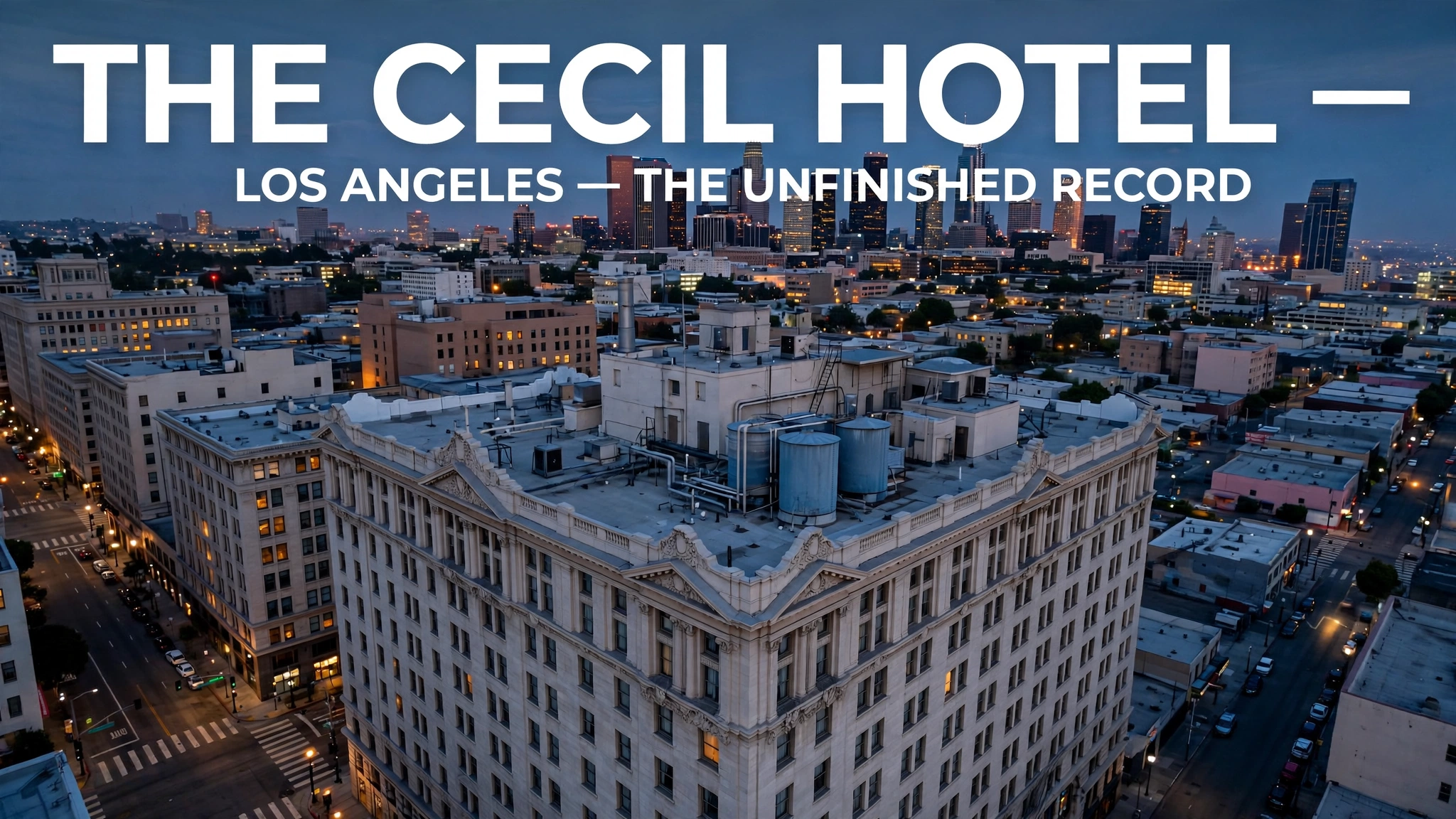
Downtown Los Angeles. On a corner of Main Street, where the shadows of the skyscrapers fall thick, stands an old building with a solid Beaux-Arts facade. Almost a century has passed since it opened in 1924. Its name is the Cecil Hotel. It was renamed “Stay on Main” in 2011, and from 2021 it began a new life as housing for people on low incomes, but the weight of the stories the building has carried has not grown any lighter. Its facade, lit by neon at night, holds a hundred years of memory in quiet stillness.
In February 2013, the body of a young woman was found inside one of the large water tanks lined up on the roof of this hotel. Elisa Lam, a university student from Vancouver in Canada, was 21 years old. The Los Angeles County coroner concluded that her death was an accidental drowning. What turned the case into a ghost story known around the world, however, was not that conclusion itself. It was the puzzling elevator footage, the conflicting records about the lid of the water tank, and the dark history the building itself had accumulated.
In this article, we preserve the fragments of rumor gathered in earlier accounts, while following the official record that can be confirmed and the rumors that spread online as two separate things. Not as sensational consumption, but as an unfinished record of the death of one young traveler.
- Elisa Lam, the Traveler — A 21-Year-Old Before the Case
- Observing the Cecil Hotel on Google Maps
- Four Minutes in the Elevator — Security Camera Footage That Shook the World
- Skid Row — The District That Swallowed the Building
- The Lid of the Water Tank — A Scene Record That Was Rewritten
- A Century of the Cecil Hotel — A Building That Accumulated Tragedy
- What the Official Record Says, and What It Does Not Say
- Our Reading — Reading This Place as a Gathering Point of Darkness
- In the Area: Sights in Downtown Los Angeles
- What to Eat: Food to Enjoy Locally
- Getting There: From Los Angeles International Airport — Into the Heart of Downtown
- Fragments Assembled
- Sources & Further Reading
Elisa Lam, the Traveler — A 21-Year-Old Before the Case
Before she became the subject of a ghost story, she was a young traveler. Elisa Lam, 21, from Vancouver in Canada, was a student at the University of British Columbia. In January 2013 she came to Los Angeles on a solo journey along the West Coast, and in late January she checked in to the Cecil Hotel. She had been in contact with her parents every day, but after January 31 the contact stopped, and a search began after her family reported her missing.
She kept a Tumblr blog named “Nouvelle-Nouveau,” where she wrote about fashion and her daily thoughts. In it was the figure of a young person of her own generation, living while facing bipolar disorder. The existence of the blog reminds us that she was not a character in a ghost story, but a real human being. When we follow this case, we must not lose that perspective.
The reason she chose the Cecil Hotel is said to have been its low price. Whether she knew about the darkness of its history is not known. In all likelihood she chose it simply as inexpensive lodging. She can have had no sense that she was stepping onto the stage of a ghost story. That lack of awareness is part of what makes this case so painful.
Observing the Cecil Hotel on Google Maps
First, let us look down on the building in satellite imagery. It is a long, narrow building of 14 floors. On its roof at the time of the case, four cylindrical water tanks stood on concrete blocks. Each measured about 1.2 meters by 2.4 meters. The body of Elisa Lam was found inside one of them.
The door leading to the roof is said to have been locked and fitted with an alarm. The water tanks had no fixed platform, and maintenance workers climbed a ladder to check the surface of the water. A heavy lid, a tall tank, a locked roof. The height of these physical hurdles became the ground from which countless speculations later grew.
Four Minutes in the Elevator — Security Camera Footage That Shook the World
The last place where Elisa Lam was seen was in security camera footage from an elevator inside the hotel. The footage, about four minutes long, was recorded on January 31, 2013, and released in mid-February by the Los Angeles Police Department (LAPD). Wearing a red hoodie, she presses the buttons of the elevator again and again, peers out at the corridor beyond the open doors, leans against the wall as if hiding herself, and makes puzzling gestures toward an empty space.
People around the world who saw the footage held the same questions. Who was she in conversation with? Why did the doors of the elevator not close?
Here, let us separate fact from rumor. As a matter of fact, the LAPD has acknowledged that this footage is genuine. At the same time, it has also acknowledged that the footage was edited. The official explanation is that the timestamp was made unclear and the playback speed was lowered in order to protect the privacy of people unrelated to the case.
This is security camera footage released by the LAPD in February 2013. The footage has been edited and slowed down, and the timestamp has been made unclear, as the LAPD has acknowledged.
Claims by analysts that a few seconds have been cut in an unnatural way, and that the change in playback speed was made to conceal something. No official answer has been given to these claims.
The family of Elisa Lam told police that when she neglected to take the medication prescribed for bipolar disorder, she would at times show delusional behavior or act as if hiding herself. This is often spoken of alongside the puzzling behavior in the footage.
The strangeness of the footage cannot be denied. But how that strangeness is read changes with the position of the viewer. Some see evidence of a paranormal phenomenon. Others see a record of the suffering of a young woman whose health had broken down. Neither reading can be settled from the footage alone. That is what makes this footage so difficult, and so sad.
We must also not forget another tragedy that this footage produced. In the midst of the case, self-appointed detectives online treated an unrelated person as the culprit on the basis of fragments from the footage and social media, and subjected that person to severe abuse. The Netflix documentary of 2021 also depicts how such runaway speculation destroyed the life of one human being. The fervor of chasing a mystery can, at times, wound someone real. Enjoying a rumor and judging a person by a rumor are entirely different acts. What this case teaches is not only how to solve a mystery, but how difficult it is to live alongside one.
Skid Row — The District That Swallowed the Building
To speak of the Cecil Hotel while looking only at the building is to see only half of the story. The area around Main Street, where the hotel stands, adjoins the district long known as Skid Row. The city of Los Angeles has historically treated this area, in part, as a containment zone for people in poverty and people living on the streets, and documentaries have pointed to a structure in which people leaving prisons and hospitals were sent into this district.
In other words, the gathering of guests with troubled pasts at the Cecil Hotel was in all likelihood not a curse of the building, but a consequence of urban policy and economics. A room at 14 dollars a night, a front desk that asked no questions, and indifference all around. The reason Richard Ramirez chose this place, and the reason Jack Unterweger could disappear into it, may have lain not in a paranormal phenomenon, but in that very invisibility.
A ghost story often covers over the structure of reality. It is easy to call the building a cursed hotel, but that name also has the effect of turning our eyes away from the reality of the people who were left behind in this district. As recorders of coordinates, we want to leave written down both the ghost story of the building and the reality of the district.
The Lid of the Water Tank — A Scene Record That Was Rewritten
The discovery of the body began with complaints from guests. The water pressure was poor. The water was discolored. The taste was strange. On February 19, 2013, a maintenance worker named Santiago Lopez went up to the roof in response to the complaints and found the body of Elisa Lam floating inside a water tank. She was unclothed, and the clothes she should have been wearing, along with her wristwatch and room key, had sunk in the water, covered, it is said, in sand-like fine particles.
From here begins the greatest reason this case is called unfinished. In the reports at the time of the discovery, the lid, or hatch, of the water tank was said to have been closed. The lid of the tank is heavy, and closing it from inside is considered extremely difficult. If it had been closed, there would have to have been a third party who placed her in the tank.
Later records, however, tell a different story. The maintenance worker who found the body himself testified that the lid had been open. What a spokesperson for the LAPD had said before the cameras at first, that he believed the lid had been closed, conflicted with the testimony of the person who found her. This rewriting is the core of what earlier accounts called a scene record that had been painted over.
The lid was reported to have been closed, and the view spread that entry by her own power was close to impossible.
Santiago Lopez, the maintenance worker, testified that the lid had been open at the time of the discovery. If it was open, the physical contradiction in the idea that she entered by herself is resolved.
The door to the roof is said to have been locked and fitted with an alarm, but it has been pointed out that the roof could have been reached by using the fire escape. In video released after the case, it is said that the roof could be reached by way of the fire escape, and that the lids of two of the tanks can be seen standing open.
If the lid had been open, she could have entered the tank by herself. Then why did she enter? Why could she not get out? Even if the mystery of the lid is solved, the mystery of motive remains. Even if the conflict in the records is resolved, the blank in the case is not filled. Such is the nature of this case.
A Century of the Cecil Hotel — A Building That Accumulated Tragedy
Behind the scale of the story that the case of Elisa Lam became lies the history of the building itself. The Cecil Hotel opened on December 20, 1924. Designed by Loy Lester Smith in the Beaux-Arts style, it was to welcome business travelers and tourists as a luxurious hotel with 700 rooms.
Within five years of opening, however, the Great Depression struck, and the area around Main Street changed into the poor district known as Skid Row. From then on, the hotel came to be named again and again as the stage for suicides, murders, and unexplained deaths. At least 16 or more suspicious or unexplained deaths are said to have been recorded there.
It opened on December 20 as a luxurious hotel with 700 rooms. It was a Beaux-Arts building with a marble lobby and stained glass.
Elizabeth Short, known as the Black Dahlia, who was brutally murdered in January 1947, is said to have been seen at the bar of the hotel a few days before the case. Some historians, however, question this account, and it is not an established fact.
In 1962, a woman who jumped from the ninth floor took a pedestrian down with her. In 1964, Goldie Osgood, a long-term resident, was murdered in her own room, and the culprit has never been found.
The serial killer Richard Ramirez, known as the Night Stalker, stayed for a time on the 14th floor of this hotel. The low price of 14 dollars a night drew guests like him to this place.
Jack Unterweger, an Austrian serial killer and journalist, stayed for about five weeks under the pretext of reporting. During that time, he murdered three women in Los Angeles.
It was renamed Stay on Main in 2011. It closed and entered renovation in 2017, and on December 13, 2021, it reopened as housing for people on low incomes, with about 600 units, in partnership with the Skid Row Housing Trust. In 2017 it was also designated a historic-cultural monument of the city.
Once this history of the building is known, it becomes clear why the case of Elisa Lam is so easily consumed as a ghost story that happened because it was the Cecil Hotel. But care is needed here: the darkness of the history and the cause of each individual case are separate matters. A dark building does not automatically make the truth of each death a matter of the uncanny.
What the Official Record Says, and What It Does Not Say
The judgment of the Los Angeles County coroner is clear. The autopsy of February 21, 2013, could not determine the cause of death, but the report published in June of that year gave the cause as accidental drowning, and named bipolar disorder as an important contributing factor. Toxicology testing detected medication such as the mood stabilizers that had been prescribed to her, but blood levels were lower than the prescribed amount, and it was pointed out that her use of the medication may have been irregular. No illegal drugs or alcohol were detected, and there were no signs of trauma or sexual assault.
The story of the official record, in other words, is this. A young woman whose use of prescribed medication had become irregular, and whose mental state had grown unstable, went up to the roof by way of the fire escape or another route, entered a water tank that stood open, and drowned because she could not get out by herself. It is painful, and terribly abrupt.
At the same time, there are also things the official record does not say. Why did she make for the roof? The reason for the behavior she showed in the elevator. And the point, persistent online, that the case closely resembles the film Dark Water of 2005, in which the body of a girl is found in a water tank on the roof of an apartment building. The coincidence of reality tracing fiction poured oil on the rumors.
Accidental drowning. Bipolar disorder was an important contributing factor. No illegal drugs or alcohol. No trauma.
The LAPD has acknowledged the authenticity of the footage, and explains that the editing and slowing down were done to protect privacy.
Her motive in making for the roof, the reason for her behavior in the elevator, and how the records about the lid came to differ. No complete official answer exists for any of these.
In 2021, the Netflix documentary series Crime Scene: The Vanishing at the Cecil Hotel was released, and the case drew worldwide attention once again. The testimony of the hotel manager of the time, of former detectives, and of web detectives intersects in a structure that asks the viewer how they would judge the case. The director, Joe Berlinger, sought to exclude sensationalism and to look at the case again through an accumulation of facts. The program ultimately came down on the side of the accident account, but many viewers, it is said, were not convinced. That very lack of conviction may be the true nature of what keeps this case unfinished.
Our Reading — Reading This Place as a Gathering Point of Darkness
Earlier accounts read these coordinates as a gathering point of darkness that draws malice toward itself, and presented the reading that Elisa Lam may have received the dark residual thoughts piled up by the history of the building. It is an occult interpretation, but the reason this reading strikes a chord with so many people is understandable. Ramirez, Unterweger, the Black Dahlia, and Elisa Lam. The chain of deaths gathered at the same address is too dense to be dismissed with the single word coincidence.
Here, however, we want to pause and think. The darkness of the building is also a darkness of reality, born of urban poverty and indifference. The district of Skid Row, a room at 14 dollars a night, and guests whom no one noticed. Before consuming this place as a ghost story, to look at the structure of society that was there is also, we believe, one way of recording these coordinates.
Elisa Lam was a student of 21, loved by her family, who had been looking forward to her journey. The one thing we want to avoid is reducing her death to an episode of a haunted place. What should be left as an unfinished record is not the entertainment of a mystery, but the weight of the death of one human being.
Not to hurry toward a conclusion. That is the manner of the category called Unfinished Records. Hold the official view in mind, savor the rumor as a rumor, and still carry the blank that remains as a blank. The right way of living alongside this case is, most likely, something like that.
In the Area: Sights in Downtown Los Angeles
The building of the Cecil Hotel itself is housing today, and the interior cannot be toured. Around it in downtown, however, are gathered places where the history of Los Angeles can be felt. Walking in the daytime, while taking care for safety, is recommended.
A central square in downtown, a few minutes on foot from the hotel. It has a subway station as well, and serves as a base for getting around.
A historic indoor market founded in 1917. Its food culture is introduced in the section on food.
A historic building completed in 1893. Its open interior of ironwork and elevators is beautiful, and it is known as a filming location. Viewing of the interior is within the areas open to the public.
A famous secondhand bookstore in downtown. Its tunnel of books and its art spaces are popular, and it is a place where the subculture of Los Angeles can be felt.
All of these places are public facilities or shops, and have no connection with the building of the Cecil Hotel. On the premise that entry to the scene of the case is not possible, we want to enjoy them as a walk through the city.
What to Eat: Food to Enjoy Locally
The food culture of downtown Los Angeles is multinational and rooted in everyday life. To step a little away from the weight of the case and touch the everyday flavors of the city is also one of the pleasures of a journey.
Multinational stalls line the market founded in 1917. Latin flavors typical of Los Angeles, such as tacos and burritos, can be enjoyed with ease.
In old-fashioned diners open from morning, a hearty American breakfast becomes fuel for a journey.
In Little Tokyo, adjoining downtown, Japanese food culture has taken root. It is an option for those seeking a comforting flavor in the midst of a long journey.
Because the business conditions and menus of shops change, we do not list specific shop names or business hours. Please check the latest information before visiting.
Getting There: From Los Angeles International Airport — Into the Heart of Downtown
The building of the Cecil Hotel still stands, but it is operated as housing today, and neither staying there nor touring the interior is possible. Plans should be made on the premise that a visit will be a viewing of the exterior only.
The gateway to the West Coast. Downtown is about 40 minutes to one hour away by car, depending on congestion. Use of rideshare services or a taxi is realistic.
Within downtown, use of the subway (Metro) is convenient. From Pershing Square Station, a walk of about five minutes along Main Street brings you to the block where the building stands.
The Beaux-Arts facade retains the appearance of its time. Because the building is housing today, however, entry to the grounds is not possible. Limit a visit to viewing from outside.
Sights in the area, such as Grand Central Market and the Bradbury Building, are reassuring to visit in the daytime. Walking alone at night should be avoided.
The area around the building adjoins the district known as Skid Row, and many people live on the streets there, including people who use drugs. Walking at night is extremely dangerous, and care for the surroundings must not be neglected even in the daytime. Because the building is housing, entry without permission is prohibited.
The current residents are ordinary people with no connection to the case. When photographing or viewing the building, do not forget consideration so as not to disturb the privacy and the daily life of residents.
LAX is a little under an hour away by car. The physical distance is close. But entry into the building is no longer possible. Here too, a place you can go to and a place you can enter do not coincide. To gaze at the facade from outside and imagine a hundred years of stories. That is the way of living alongside these coordinates today.
Fragments Assembled
The official conclusion in the case of Elisa Lam is accidental death. The coroner report is clear, and an explanation exists for the editing of the footage. The conflict in the records about the lid, too, can be explained in physical terms if the testimony of the person who found her is adopted. Set out in that way, the case appears to have been solved.
Even so, a reason remains to place this article in Unfinished Records. Why did she make for the roof? What was she looking at inside the elevator? No one holds an answer to those two questions. The answers are written neither between the lines of the coroner report nor in the explanations of the LAPD. While we carry questions without answers, the footage goes on being played, even today.
The water in the tanks was replaced long ago, and the building has become housing. Yet what the coordinates recorded does not disappear. The elevator footage, the conflict over the lid of the water tank, and the chain of deaths across a hundred years — all of it is folded together at this address. To acknowledge that a record is unfinished is also one form of a record.
Sources & Further Reading
- Cecil Hotel (Los Angeles) — Wikipedia — The history of the building, its renaming, and its conversion to housing
- Elisa Lam and the Cecil Hotel: Separating Fact From Fiction — MuseumFacts — An ordering of the facts of the case
- Crime Scene: The Vanishing at the Cecil Hotel — Den of Geek — Commentary on the Netflix documentary, including the question of whether the lid was open or closed
- Hotel of Horrors: The Dark History of the Cecil Hotel in Los Angeles — The Lineup — The dark history of the building, including the Black Dahlia, Ramirez, and Unterweger
- The Curse of the Cecil — The Compendium Podcast — The course of the case and the conflict in the records about the lid
- Cecil Hotel Becomes Affordable Housing — Oxygen — The course of the conversion to housing in 2021