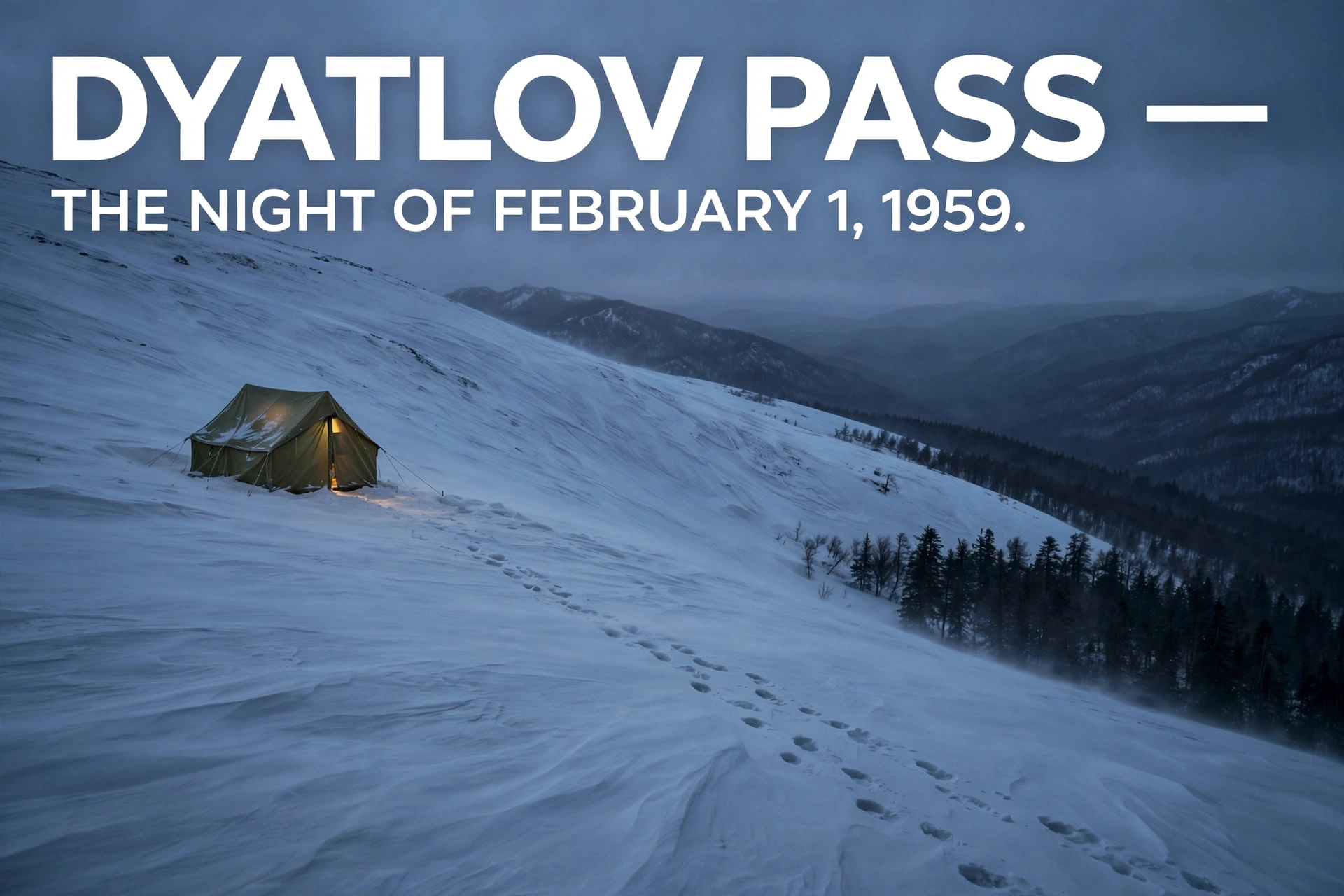
Northern Ural Mountains, Russia. On the eastern slope of Kholat Syakhl (also read Kholat Chakhl), a name that means “Mountain of the Dead” in the local Mansi language, a single coordinate is inscribed. On the map it looks like nothing more than a white slope, yet this place, the stage of one of the greatest mountain mysteries of the 20th century, goes on holding the imagination of people around the world. On the night of February 1 into February 2, 1959, nine young hikers lost their lives on this slope. The incident later took the name of the leader of the group and came to be known as the Dyatlov Pass incident.
The tent, when found, had been cut open from the inside, and the nine had fled out onto the snowfield in extreme cold of tens of degrees below zero, without adequate warm clothing and without footwear. Some of the bodies bore fractures said to equal the impact of a traffic accident, yet the skin showed no notable wounds. The Soviet investigation of the time closed with the words “an irresistible force of nature,” and for more than 60 years the incident has been retold as one of the greatest unsolved mysteries in the world.
Then, in 2019, the Russian prosecution authorities took up a reinvestigation, and in 2020 they issued the avalanche theory as the official view. In 2021, a peer-reviewed scientific paper supported the mechanism of that avalanche. The incident should have moved toward a solution. And yet the silence of the snowfield has not fully lifted. In this article, while preserving the rumors gathered in earlier accounts, we follow the established facts and the parts that remain unexplained, keeping the two apart. The story of the camera found among the belongings of the group, and of the final photograph, is recorded in detail in the sister article, “The 31st Frame Left Behind by the Dyatlov Group.”
- Observing the Slope of the “Mountain of the Dead” on Google Maps
- The Night of February 1, 1959 — The Vanishing of the Nine
- The Faces of the Nine — Youth Preserved in Diaries and Photographs
- Cut from the Inside — The Story the Tent Tells
- Crushed Without Wounds — The Mystery of the Bodies
- The Reinvestigation of 2019 and the Avalanche Theory — Where the Official View Stands Now
- The Theories That Remain — Infrasound, Katabatic Wind, and Military Experiments
- Our Reading — What Was Called an Unseen Force
- After the Incident — The Name of the Pass and How Memory Is Carried On
- In the Area: Sights Around Yekaterinburg
- What to Eat: The Food of the Urals
- Getting There: From Yekaterinburg — The Expedition to the Mountain of the Dead
- Fragments Assembled
- Sources & Further Reading
Observing the Slope of the “Mountain of the Dead” on Google Maps
Look down on the slope in satellite imagery, and what lies there is a bare, windswept white slope with nothing to block the wind. The nine pitched their tent on the eastern slope of Kholat Syakhl, on a gentle incline at an elevation of less than 1,000 meters. Why did these experienced hikers choose this exposed slope, and not the forest where the wind could be avoided? That alone remains as the first mystery.
About 1.5 kilometers southeast from the site of the tent. The footprints left on the snow were, it is said, not the scattered run of panic, but a single-file track that descended in haste while keeping discipline. Ahead of them stood a great cedar (kedr) at the edge of the forest. The first two bodies were found beneath that tree. Marks were left on its trunk where bark had been stripped away, as if someone had tried to climb it, so the accounts say.
The Night of February 1, 1959 — The Vanishing of the Nine
The party set out on January 23, 1959 — ten people, centered on students of the Ural Polytechnic Institute (now Ural Federal University). The leader, Igor Dyatlov, was 23 years old and an experienced mountaineer. The destination was Mount Otorten. This was a full-scale winter expedition of difficulty Category III.
On January 27, the full journey began from Vizhai. The next day, January 28, one member, Yuri Yudin, turned back because of illness (including a worsening of sciatica). That decision would save his life. On February 1, the remaining nine pitched their tent on the slope of Kholat Syakhl. According to the diary and the records of the cameras, the weather that day was deteriorating.
February 12. The day they were due to return passed, no word came from the party, and in time a search party was organized. On February 26, the searchers found the empty tent. Warm clothing, boots, and food had been left inside. And the side of the tent had been cut open with a blade from the inside.
The ten set out from Sverdlovsk (now Yekaterinburg). The destination was Mount Otorten.
Yuri Yudin withdrew because of illness, and the journey continued with nine. He later devoted his life, as the sole survivor, to uncovering the truth.
The tent was pitched on the eastern slope of Kholat Syakhl. Judging from the photographs left in the cameras, the party was active until the evening, before sunset.
The search party found the empty tent: the side cut open from the inside, the equipment left behind, and footprints leading out onto the snowfield.
The first two beneath the cedar, three more on the slope, and in May the remaining four were found beneath the snow of a ravine. All of them had lost their lives.
Let the names of the nine be recorded here. Igor Dyatlov, Zinaida Kolmogorova, Lyudmila Dubinina, Alexander Kolevatov, Rustem Slobodin, Yuri Doroshenko, Georgiy Krivonishchenko, Nikolay Thibeaux-Brignolle, and Semyon Zolotaryov. The youngest was 20, the oldest 37. They were not numbers. We do not want to forget that each one of them was a young person loved by family.
The Faces of the Nine — Youth Preserved in Diaries and Photographs
Reading the record of the incident, what comes through is that they were not mere victims of a mountain accident, but vivid young people. The party kept a shared diary, and the members took turns writing the events of each day. The writing of Kolmogorova is bright, and tells of the strong start of the early days of the trip. The photographs preserve smiles as they joked around on the snowfield, backs walking under heavy packs, and serious faces confronting the severity of nature.
Dyatlov was a student of radio engineering, a technician who brought along a homemade radio and stove of his own making. Doroshenko and Krivonishchenko were cheerful mood-makers, and Dubinina is said to have been trusted by her companions as a woman of strong core. The record of their youth makes the tragedy of the incident stand out all the more. Why did young people of such skill and strength meet such an end? That gap is the core of the mystery of this incident.
The search began only after February 20 had passed. A volunteer search party of family and friends was organized, and local Mansi hunters joined as well. The tent was found on February 26. From there, the discovery of the bodies took further weeks to months. Snow and cold revealed, little by little, how the nine had met their end.
Cut from the Inside — The Story the Tent Tells
What fixed the strangeness of this incident was the state of the tent. The multiple cuts in its side were assessed as having been cut open with a blade from the inside. Normally, the entrance would have been used. Why did they have to tear the tent open and go outside?
And their clothing was far too light for a night in snowy mountains. Some wore no boots; some wore no warm clothing. In extreme cold said to reach minus 20 to minus 30 degrees, that was an act equal to suicide. And yet the footprints ran in a single file, toward the forest. The track, it is said, was not the run of panic, but a movement with a purpose.
The reinvestigation by the Russian prosecution authorities in 2019 and 2020 offered one explanation of this point: the weight of snow piled on the tent (a slab avalanche) nearly crushed it, and the nine cut it open from the inside in an emergency escape. The absence of traces of an avalanche at the scene had long been the counterargument, but a peer-reviewed paper of 2021 (Gaume and Puzrin) demonstrated the mechanism of a small, delayed slab avalanche in a model, and scientifically reinforced the official view.
That the tent was cut open from the inside. That the party went outside without adequate warm equipment. That the footprints continued toward the forest.
The Russian prosecution authorities concluded that a slab avalanche crushed the tent and forced an emergency escape. A scientific paper of 2021 supported the mechanism.
That no clear traces of an avalanche remained at the scene, and that the angle of the slope was one on which avalanches do not easily occur. These are still raised as grounds for counterargument.
The avalanche theory is strong, but it is not all-powerful. Whether it can explain all of what the nine did after leaving the tent — above all, all of the damage to the bodies — is a separate question.
Crushed Without Wounds — The Mystery of the Bodies
The greatest reason the incident goes on being called unfinished lies in the state of the bodies. Of the four found beneath the snow of the ravine in May, Thibeaux-Brignolle had fractured his skull, and Dubinina and Zolotaryov had suffered severe crushing fractures of the ribs. In the assessment of physicians, the force was equal to “the strong impact of a traffic accident.” And yet, puzzlingly, the skin bore no notable wounds, and only the bones inside had been destroyed.
Furthermore, Dubinina had lost her tongue. There are also reports that the skin of the bodies had discolored to orange. Records from the time also remain saying that radiation was detected on some of the clothing and bodies, and these became grounds for voices suspecting the involvement of military experiments. However, these reports are said to contain exaggeration and misreporting as well, and separating what is accurate record from what is later rumor is not easy.
Supporters of the avalanche theory hold that compression under the weight of snow, or the collapse of a snow cave, can explain such injuries. On the other hand, criticism remains strong that the avalanche alone cannot answer why there were no external wounds, or why the tongue was lost. The mystery of the bodies continues to be the core of the incident.
A skull fracture and crushing fractures of the ribs were confirmed on several of the bodies. External wounds to the skin were few.
Reports exist of the loss of the tongue of Dubinina, of discoloration of the skin, and of the detection of radiation. Debate continues over the accuracy of each record.
One view attributes the injuries to the pressure of snow or the collapse of a snow cave, but experts remain divided on whether this can explain all of the findings.
The Reinvestigation of 2019 and the Avalanche Theory — Where the Official View Stands Now
Sixty years after the incident. In February 2019, the Prosecutor General Office of the Russian Federation began a reinvestigation at the request of the families. The scope was narrowed to three natural phenomena — avalanche, slab avalanche, and storm wind — and criminal or military causes were excluded from the investigation from the start. This framework itself drew criticism, but in July 2020 the authorities announced the conclusion that the cause was “an avalanche (a slab avalanche) and poor visibility.”
The head of the investigation at the time is said to have remarked: “They fought heroically. There was no panic.” Cutting the tent open was an emergency escape from the weight of the snow, and hypothermia and injuries afterward took their lives — that is the storyline.
In January 2021, a peer-reviewed paper by researchers of the Swiss federal snow and avalanche research institute was published in an academic journal. Using a numerical model, it showed that the cutting into the slope made when the tent was pitched, together with snow deposited by strong wind, could trigger a small slab avalanche after a delay. Cutting into the slope to pitch the tent created a weak surface in the snow layers; snow carried by the wind piled onto it, and hours later it slid down — that is the storyline. In later follow-up research, similar small slab avalanches were reportedly confirmed on video at this very pass. The official view was given scientific support.
Even so, many among the families and researchers do not accept this conclusion. No traces of an avalanche at the scene. The angle of the slope. The insufficiency of the explanation of the injuries to the bodies. The official view is “the most likely explanation,” not “the answer that solves every mystery.” That is what makes this incident so tangled, and so fascinating.
The Theories That Remain — Infrasound, Katabatic Wind, and Military Experiments
Apart from the official view, there are theories that have been advanced over many years. These are no more than theories, and not confirmed facts. On that premise, let the alternative theories that have stirred the imagination around this incident be introduced.
Proposed by filmmaker Donnie Eichar in his book of 2013, Dead Mountain. The shape of the summit of Kholat Syakhl generates wind vortices (Kármán vortices), and the resulting infrasound caused severe anxiety and panic in the hikers and drove the escape from the tent, so the theory holds. It is said to have been examined together with an expert of NOAA.
A theory suggested by a joint Swedish and Russian investigation in 2019. A violent downslope wind racing down the slope made it impossible to remain at the tent and forced the party to take refuge in the forest. It is told together with an incident of 1978 in the Anaris Mountains of Sweden, in which eight people died.
Declassified documents have shown that experiments by the Soviet military were being conducted in the surrounding region at the time. Testimony also remains from another hiking group that saw orange spheres of light floating in the northern sky. However, no direct evidence linking the experiments to the deaths of the party has been confirmed.
Theories of a yeti, of UFOs, and of an attack by local Mansi people also circulated, but they have no supporting evidence and are now almost entirely dismissed. They should be kept as rumor, and no more.
Every theory fits some of the facts, and collides with others. The fascination of the alternative theories tells of the size of the blank space in this incident. Precisely because the blank is large, there is room for imagination to enter.
Our Reading — What Was Called an Unseen Force
Prosecutor Lev Ivanov, who led the investigation of 1959, closed the incident as the work of “an irresistible unknown force (непреодолимая стихийная сила).” These words were a declaration of defeat, and at the same time an honest record. He wrote, of a thing that was not understood, that it was not understood.
Earlier accounts read this incident as a tragedy caught between two unseen forces — the fury of nature and the secrets of the state. Now that the avalanche theory has become the official view, this reading has not faded. Because two unseen forces did indeed stand behind the incident. One was the severity of nature in the Urals. The other was the secretiveness of the Soviet state, which classified the records and gave birth to all that was never told.
The file was designated classified, the region was closed to entry for three years, and testimony was fragmented. Into that blank, 60 years of imagination flowed. Half of the mystery of this incident may have been born not on the snowfield, but inside a filing cabinet.
Even as science advances, the questions left in the human heart do not disappear. That night, what happened inside the tent? What did the nine see, and what were they fleeing from? Even when an answer emerges, the question remains. That, perhaps, is what an unfinished record means.
After the Incident — The Name of the Pass and How Memory Is Carried On
After the incident, this pass came to be called Dyatlov Pass, taking the name of the leader. The area around the scene was designated a closed zone for three years. Within the secretiveness of the Soviet era, the investigation file was classified, and the truth was placed, for a long time, beyond the reach of the families.
In time, the families and friends founded the Dyatlov Memorial Foundation and began work calling for the release of materials and the uncovering of the truth. At Ural Federal University (the former Ural Polytechnic Institute) there is a place of memorial to them, and a gathering of remembrance is said to be held every year on February 2. The reinvestigation of 2019, too, was the fruit of the long years of appeals by the families.
The incident has now become a kind of sacred place, visited by trekkers from inside and outside Russia. Yet most of those who visit stand on the snowfield not in search of thrills, but to offer a silent prayer to the nine young people. A coordinate is not only an exhibition hall of mystery. It is also a grave marker.
In the Area: Sights Around Yekaterinburg
Dyatlov Pass itself is a remote place, but Yekaterinburg, the base city, is a central city of the Ural region with much to see. Let it be introduced as a city to stop in before and after an expedition.
A church built on the site where Nicholas II, the last emperor of the Romanov dynasty, and his family were executed. A place where the weight of modern and recent Russian history can be felt.
The site of a mine said to be where the bodies of the imperial family were discarded. Today it is a pilgrimage site lined with a monastery and wooden churches.
A monument in the outskirts of Yekaterinburg marking the boundary between Europe and Asia. Many travelers stop by as a memento of a visit to the Urals.
A museum gathering the minerals and geology of the Ural region. It offers clues for understanding how the mountains that formed the stage of the incident came to be.
These sights and Dyatlov Pass are connected within the broad region of the Urals; they should be planned as an itinerary separate from an expedition to the pass.
What to Eat: The Food of the Urals
The food culture of the Ural region is a plain one, where Russian home cooking meets the preserved-food culture of the north. Taste it in Yekaterinburg before and after an expedition.
Small boiled dumplings, a specialty of Siberia and the Ural region. Bite-sized, with the juices sealed inside, they developed as preserved food for cold lands.
A traditional open pie of the Ural region, baked with potato or cottage cheese on top, with a plain and simple taste.
Soups such as borscht and solyanka for surviving the severe winter. They are beloved as staples of the cafeteria.
Because the business conditions and menus of shops change, we do not list specific shop names or business hours. Check the latest information before visiting.
Getting There: From Yekaterinburg — The Expedition to the Mountain of the Dead
Dyatlov Pass is still not a place that general travelers can visit casually. Winter temperatures reach minus 40 degrees, and a sudden change in the weather leads directly to danger to life. To go, joining an expedition led by a professional guide is, in practice, an absolute requirement.
The central city of the Ural region and the gateway for international visitors to the area, reached by air through major hub cities. Here, make the final check of equipment and lay in supplies of food. The airport and the city often serve as the meeting point of an expedition.
Travel north by night train or chartered car. Beyond this point, infrastructure grows sparse.
The last inhabited settlement. Beyond here, the road becomes a trackless way.
In winter, approach by snowmobile; in summer, combine four-wheel-drive vehicles and walking, and draw near to the coordinates over several days. Moving without a guide is strictly forbidden.
With the cost of a guided expedition, equipment, transport, and local stays combined, a total of several hundred thousand yen or more should be expected. This figure is an estimate, as exact prices differ greatly by organizer.
Depending on the international situation, advisories or recommendations concerning travel to Russia may have been issued by the foreign ministries of each country. Always check the latest consular information. Winter temperatures reach minus 40 degrees, and sudden changes in the weather lead immediately to danger to life. Never approach without a specialist guide carrying a satellite phone.
Complete winter mountain equipment, emergency food, and means of communication are essential. Some visit the pass as a sacred place, but do not forget that it is a place with a history of disaster, and do not enter it with a light heart.
North from Yekaterinburg: half a day by train, several hours by car, and then several days on foot. “Being able to go” and “being able to come back” are different things. That may be exactly what the nine of 1959 taught us.
Fragments Assembled
The Dyatlov Pass incident has received, officially, the answer “avalanche.” The reinvestigation of 2019, the announcement of 2020, the scientific paper of 2021. The conclusion reached by an investigation spanning 60 years was a natural phenomenon — the plainest thing imaginable.
And yet this article places the incident among the Unfinished Records. Even if the reason the tent was cut open is explained, not all of the damage to the bodies has been explained. The sighting of orange light, the mystery of the body that lost its tongue, and the truth or falsity of the radiation records all remain outside the official view. The questions that remain after an answer has emerged. To record the incident while holding those questions — that, we believe, is the proper way to treat these coordinates.
The whiteness of the snowfield covers everything over. The footprints, the tent, and the terror of the nine. But the record remained. The words “an irresistible unknown force,” more than 60 years later, are still frozen in the sky above these coordinates.
Sources & Further Reading
- Dyatlov Pass — The Archive of Teodora Hadjiyska — An English-language archive of the materials of the incident (investigation files, photographs, testimony)
- The Dyatlov Pass Incident — Grim Chronicle — The course of the reinvestigation of 2019 to 2020 and an organization of the avalanche theory
- The Mystery That Haunted Russia for 60 Years — Travel and Tannins — The flow from the reinvestigation to the paper of 2021
- The Grim Theories Behind the Dyatlov Pass Incident — History Collection — An introduction to the theories, including the infrasound theory of Eichar
- Dyatlov Pass Incident: Why Nine Hikers Cut Their Way Out — Dongri Archive — The mystery of the escape from the tent and an explanation of the avalanche mechanism