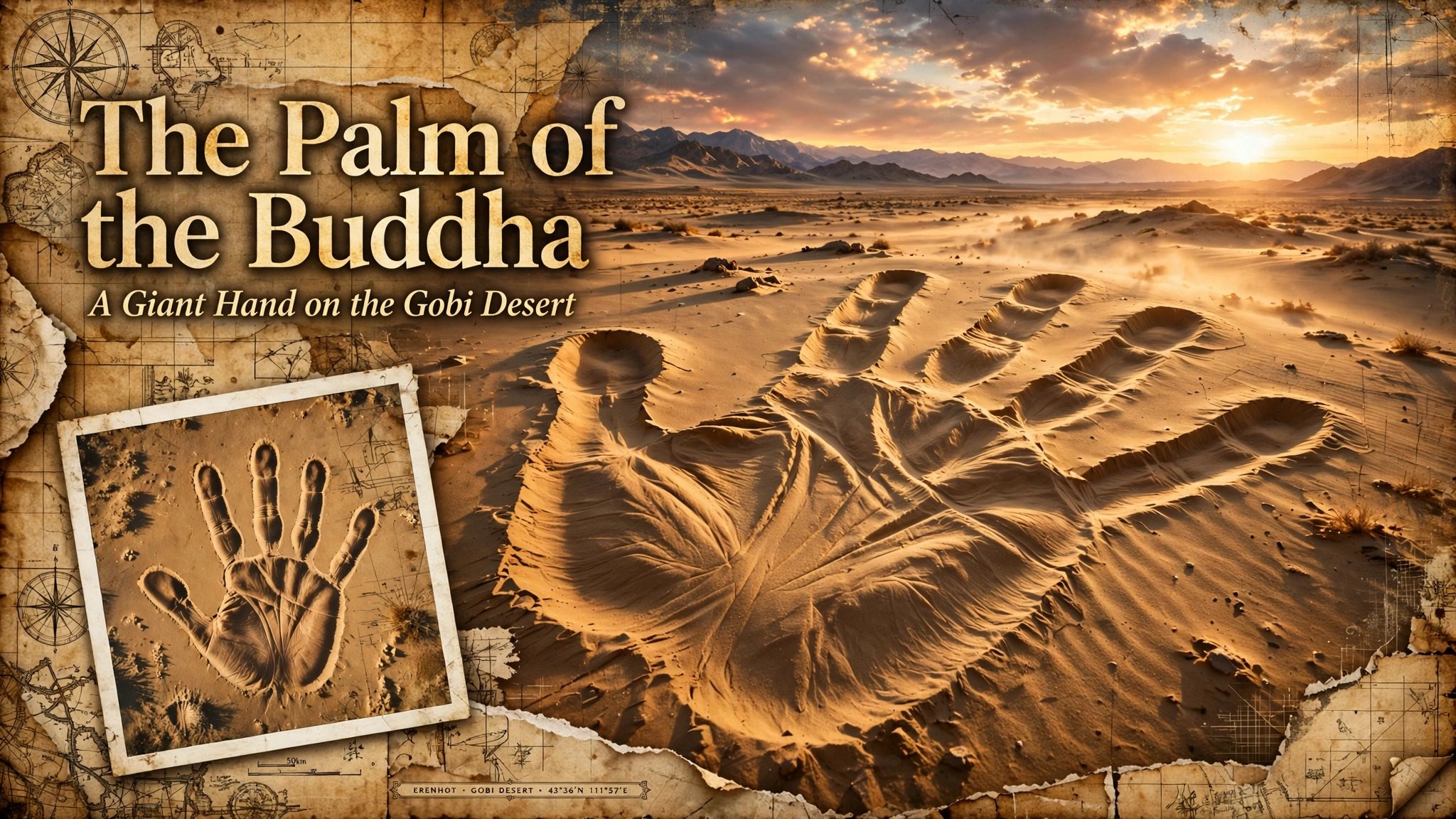
Erenhot, Inner Mongolia, China. In the endless brown wilderness that stretches toward the Mongolian border, there is a place that should, quite literally, contain “nothing.” When the lens of a satellite captures it, what appears is a scene that seems to refuse physical understanding — pressed into the parched surface of the earth, as if some giant being had descended from the sky and planted a hand with all its strength, a colossal “palm” is engraved there.
Its scale is about 40,000 square meters — a giant hand the size of six soccer fields. The raised joints of the fingers, the creases running lengthwise and crosswise over the palm, even the very pressure of fingertips digging into the earth, are rendered in three dimensions. Looked down upon from above, it has a rawness to it, as if the earth itself were raising a groan and trying to push the sky back.
In August 2018, this “hand” was reported to the world through Chinese media. Its true identity is a work of land art: “Buddha’s Palm” (Foshouyin). It is a modern ground drawing built on the outskirts of the city of Erenhot. Earlier accounts called this palm the “palm of a giant,” and recorded its eeriness and its fragility. This time, following that record, we trace the facts that can be confirmed, and the fate of a work vanishing into the wilderness.
But this palm is already beginning to crumble. Only a few years after it was made, the wind and snow of Inner Mongolia are wearing away its outlines, and the palm is slowly returning to sand. A modern ground drawing may not possess the eternity of the ancient ones.
Incidentally, the salt lake of Iren Dabasu nearby is said to take its name from the Mongolian words for “the lake of many-colored salts.” The same echo lingers in the name of the city itself — “Erenhot” (Eren). A palm drawn in many-colored stones on a many-colored land — the name of the city and the ground drawing quietly answer one another.
- Observing the “Palm of the Earth” on Google Maps
- The True Nature of the Palm — A Giant Hand That Appeared on the Grassland in 2018
- Why Erenhot? — Hometown of Dinosaurs and City on the Border
- The Weathering Palm — A Modern Ground Drawing, Vanishing
- Collected Rumors — Whispers of the Palm, Invisible from the Ground
- Our Reading — A Silent Offering to the God Called Technology
- In the Area: Recommended Sights and Activities Around Erenhot
- What to Eat: Food to Enjoy Locally
- Getting There: From Hohhot — The Road to a Border City in the Gobi
- Fragments Assembled
- Sources & Further Reading
Observing the “Palm of the Earth” on Google Maps
Open the satellite view at the observation point carried over from earlier accounts. When you open it, try zooming out a little. In the brown wilderness, the shape of a hand with its fingers spread rises into view. Scattered around it are structures modeled on dinosaur footprints and geometric patterns, and one can see that this whole area is land designed on the premise of “being seen.” How clearly the palm’s outline appears differs with the timing of satellite imagery updates — and that itself tells the story of this ground drawing’s “lifespan.”
One thing to keep in mind here: when we look at this palm as “a single mystery,” we must not cut it off from the context around it. Around the palm spread structures modeled on dinosaurs, and the whole functions as part of one giant tourism project. Before cutting the palm out alone and mystifying it, we first need to know what this land was made for.
The True Nature of the Palm — A Giant Hand That Appeared on the Grassland in 2018
On August 22, 2018, Chinese media reported that a giant “Buddha’s palm” had appeared on the grassland near the city of Erenhot in the Inner Mongolia Autonomous Region. Its area is about 40,000 square meters. It is a work of land art that expresses the creases of the palm and the shadows of the fingers by heaping up the surrounding soil and arranging stones and sand of different colors in layer upon layer. At dusk, when the light comes in at a slant, each crease of the fingers holds a deep shadow, and it is said to create the illusion that the hand might at any moment peel away from the earth and begin to move.
Behind its creation lie the circumstances of the city of Erenhot. A trading hub on the China–Mongolia border and one of the leading sources of dinosaur fossils in Asia, the city nevertheless carried a strong impression of being “a wilderness with nothing in it,” and it needed a draw for tourism. The giant palm, whose full form can be seen only from the sky, was a tourism resource for the age of satellite imagery — a monument for the “god’s-eye view.”
What is interesting is that this palm does not stand alone. Scattered around it are structures modeled on giant dinosaur footprints and several geometric patterns, and the whole area is designed as a park of land art. It is a clever arrangement that stages “the memory of ancient times” and “the mystery of the East” at the same time. And yet its figure, set down alone in the vast desert, floats so far free of the surrounding landscape that it leaves the viewer with an ineradicable sense of “artificial wrongness.” Is it the hand of a Buddha cherishing the earth, or a symbol of the arrogance of human beings seeking to develop a barren land? Opinion is divided.
The method of construction is also interesting. The surrounding soil was heaped up to form the shape of the palm, and stones and sand of different colors were layered over it to create contrast. Especially at dusk, when slanted light casts deep shadows into the creases of the fingers, the palm is said to take on a rawness, as if it might begin to move at any moment. This is a form calculated not for the human being standing on the ground, but for the camera in the sky. The ground drawings of the age of satellite imagery are designed on the premise of the “god’s-eye view.”
In the aerial photographs reported on August 22, 2018, the palm floated white against the contrast of green grassland and brown earth. Aerial shots by a photo agency were distributed around the world, and “the giant hand that appeared in the desert” became a topic of conversation overnight. “Discoveries” in the age of satellite imagery often happen just like this. Someone scrolls a map, someone shares a photograph, and the world is astonished. Buddha’s Palm is a ground drawing that was “discovered” through word of mouth in the digital age.
Why Erenhot? — Hometown of Dinosaurs and City on the Border
Erenhot (Erlian Haote) is a county-level city belonging to the Xilin Gol League of the Inner Mongolia Autonomous Region, and it borders Zamyn-Üüd in Mongolia. It is a key point on the international railway linking China and Mongolia (the Trans-Mongolian Railway), and it is also known as the place where bogies are exchanged, because the track gauge differs between the two countries. It is a city of the border, a city of the railway — and a city of dinosaurs.
The city is also known as a “hometown of dinosaurs.” In the 1920s, international expeditions excavated dinosaur fossils around Iren Dabasu (the Eren Basin) nearby, and since then many dinosaurs have been reported from this land. The city has a dinosaur museum, and in 2006 an arch of two sauropods pressing their necks together — the “Kissing Dinosaurs” — was built spanning the expressway that leads into the city. Its figure, 80 meters across, has become a symbol of the city.
Since the excavations of the 1920s, the area around Iren Dabasu has been known as one of the leading sources of dinosaur fossils in Asia. The city has a dinosaur museum and facilities exhibiting fossils.
An arch of two sauropods built in 2006. A monument spanning 80 meters across the expressway, it has become a symbol of the city.
A key point on the Trans-Mongolian Railway. Because the track gauge differs between China and Mongolia, bogies are exchanged here. It is also a hub of border trade.
Buddha’s Palm is a new landmark set down within that context of the “city of dinosaurs.” The giants of ancient times (the dinosaurs) and the giant of the present day (the palm) — Erenhot is a city that deranges one’s sense of scale.
Dinosaur motifs overflow in every corner of the city. From the design of its streetlights to the ornamentation of its buildings, the dinosaur is this city’s identity. In 2007, still more dinosaur statues were added around the Kissing Dinosaurs arch. Ancient fossils and modern land art — Erenhot is a city that inherits, across the ages, a longing for “enormous things.”
The Weathering Palm — A Modern Ground Drawing, Vanishing
That its true identity has come to light does not mean the eeriness of this coordinate disappears. If anything, knowing the background brings a colder truth into view. The climate of Inner Mongolia is harsh. In summer, temperatures exceed 40°C; in winter, they fall below −30°C. Wind, snow, and dryness are shaving away the palm’s outlines little by little. It is said that within only a few years of its construction, the palm has already begun to melt into the surrounding wilderness.
That the ancient ground drawings of Nazca have kept their form for nearly two thousand years is the fruit of an extremely rainless climate and of human protection. This palm, by contrast, was made “to be seen,” yet it has no mechanism “to be preserved.” Born as a tourism resource and entrusted to natural erosion, it is a fleeting monument.
Zoom in to the maximum and look at the fingertips. What is there may not be exquisite art, but a torrent of sand that nature has already come to reclaim. That a deliberately made “symbol,” once it leaves human management and begins to weather, takes on instead the air of a genuine “cursed ruin” — that paradox lies sunk at the bottom of this coordinate.
What is interesting is that the weathering has begun to give this palm an air of “authenticity.” When it was newly made, it was too artificial, and it floated free of its surroundings. But now, worn by wind and snow and its outlines beginning to collapse, the palm is acquiring something of the dignity of an ancient ruin. The boundaries between intention and chance, between the artificial and the natural, are melting together in the sand.
The ground drawings of Nazca were drawn in the centuries around the turn of the era, and they have kept their form for nearly two thousand years. Buddha’s Palm, by contrast, began to lose its outlines within a few years. Called by the same words, “ground drawing,” their lifespans stand in stark contrast. A ground drawing that never intended eternity cannot obtain it. And yet, within the record of the satellites, the palm goes on living in its form of 2018.
Collected Rumors — Whispers of the Palm, Invisible from the Ground
This place was supposed to have been developed as a tourist site, and yet the reports of those who have actually descended and stood on the ground share a strange common point. Standing on the ground, this “hand” hides its full form. Mounds of earth several meters high, and stones arranged in unnatural ways. It is nearly impossible to recognize that the ground beneath your own feet is “the palm of a giant.” The palm shows its figure only to the eye in the sky.
On online message boards and in urban-legend circles, rumors like these are whispered — though none of them has any scientific backing.
Around the center of the palm, it is said, GPS shows unnatural errors, and smartphones temporarily lose their signal. There is no confirmation of this, and it is most likely due to the state of communications in the wilderness.
When wind blows into the grooves modeled on the creases of the fingers, it is said that a low groaning, or a sound like the chanting of sutras, can be heard. It is thought to be a kind of wind noise, but the reports never cease.
The theory that a far larger, full-body figure was originally planned, but that accidents of unknown cause occurred one after another and the work was halted with “the hand” alone. The very existence of such a plan is unconfirmed.
These are not confirmed facts, but rumors that have circulated. And yet, for us — who can recognize this palm only through the “god’s-eye view” of satellite imagery — such whispers ring with a certain reality. Perhaps the palm is speaking not to the human beings on the ground, but to the eye in the sky.
Our Reading — A Silent Offering to the God Called Technology
Just as the ground drawings of ancient Nazca were drawn toward the gods, this “Buddha’s Palm” is a message cast toward the modern “god called technology” — Google Earth and the reconnaissance satellites.
Ironically, however, this hand has begun to return to sand before it could grasp anything. It is the record of a process in which the arrogant proof of existence that civilization tried to carve into the earth slowly weathers away. It looks less like a prayer for salvation than like the trace of a death cry left behind by a forgotten giant in the moment before its death.
As long as we go on observing this “hand” on digital screens, the hand continues to have its existence defined by the fact of “being seen.” But physical reality draws closer to nothingness with every passing moment. Might this very mismatch be the true nature of the unidentifiable unease that hangs over this coordinate?
Let me add one more way of seeing it. This palm is at once a “Buddha’s hand” and — set beside the footprints of dinosaurs — a “human handprint.” Beside the footprints that the ancient giants left on this earth, modern human beings have left a handprint of their own. Two “traces,” separated by tens of millions of years, stand side by side in the same wilderness — seen that way, this coordinate comes to resemble an exhibition hall of time.
Learning what something is, and the disappearance of the strange impression it gives, are not the same thing. The mystery of fact and the mystery of feeling are different things. The former can be checked against materials. The latter is born within the experience and imagination of the person who sees the shape.
You can stand on top of the palm, but you cannot see the palm. The eye that sees it exists only in the sky. That a ground drawing does not show itself to the human beings on the ground — this twist is what makes the palm of Erenhot more than a mere tourist facility.
In the Area: Recommended Sights and Activities Around Erenhot
Buddha’s Palm itself is a work of land art in the middle of the wilderness, but the city of Erenhot, which serves as the base, has places where dinosaurs and border culture can be experienced safely. For an actual trip, plan around facilities that are open to the public.
A facility where you can view fossil excavation sites and dinosaur skeletal specimens. In an area where Cretaceous strata remain, you can come in touch with the memory of the ancient giants.
An arch of two sauropods built in 2006. A monument spanning 80 meters across the expressway, it is a symbol of the city. Its illumination at night is also said to be worth seeing.
A scenic area where you can view the gate on the China–Mongolia border. Across the border lies Zamyn-Üüd in Mongolia — a landscape unique to a city on the border.
A facility conveying the history of the Trans-Mongolian Railway. You can learn about the culture of a border railway, including the mechanism of bogie exchange.
Tour Buddha’s Palm and the dinosaur park as a set, and you have a journey that visits the giants of ancient times and the giant of the present day in a single day. Travel through the wilderness, however, basically means chartering a car. At the border gate, illumination is sometimes held at night, and it is said to show a different face from the daytime. A day in the city of dinosaurs is made of three times: fossils in the morning, the palm at noon, and the national gate at night.
What to Eat: Food to Enjoy Locally
Inner Mongolia is a land where a nomadic food culture has taken root. In Erenhot, the blessings of the grassland can be tasted in simple forms. It is a flavor rooted in daily life, unlike glamorous court cuisine.
A bold dish of bone-in mutton simply boiled in salted water. It is a traditional dish of the nomads, eaten by taking it in the hand.
A warm drink made by simmering brick tea with cow’s milk or sheep’s milk and seasoning it with salt. It is cherished as a necessity on cold mornings.
Preserved foods full of nomadic wisdom, from dried cheese to yogurt. Try searching for the taste of the land at a canteen in the market.
Because shops’ business conditions, prices, and menus change, we do not list shop names or business hours whose existence cannot be confirmed. It is best to search for the taste of the land at a market canteen. Even if the language does not get through, pointing and smiling will somehow carry you — that is the charm of a border city.
Getting There: From Hohhot — The Road to a Border City in the Gobi
Erenhot is a border city at the northern edge of China. The nearest major airport is in Hohhot, the central city of Inner Mongolia.
From a major international airport in your own country, fly to Hohhot, the air gateway to the Inner Mongolia Autonomous Region. From here, head for Erenhot by train or by a domestic flight.
Board a train from Hohhot bound for Erenhot (about five to seven hours). Through the window spreads a land that changes from grassland into the Gobi. There are also domestic flights to Erenhot Saiwusu International Airport.
Buddha’s Palm lies in the wilderness, away from the city center. Chartering a taxi or renting a four-wheel-drive vehicle is the realistic option. Set the site as your destination.
Once you leave the city, there are stretches where both shops and communications fall away. Be sure to secure plenty of water and fuel before you go.
Even standing on the ground, the whole form of the palm cannot be seen. The observation is completed on Google Maps and Google Earth.
Because the area is close to the Mongolian border, depending on the situation, checkpoints may become stricter, or entry by foreign nationals may be restricted. Always check the latest information before traveling. For drone flights, confirm the local regulations.
In summer, temperatures exceed 40°C; in winter, they fall below −30°C. Visiting in the wrong season can be directly life-threatening. Protection against the cold and the heat, and securing water, are essential.
North from Hohhot, to the border city. From the train window, the Gobi draws closer. At the end of such a journey, the palm waits in a form that only the eye in the sky can see. “The place you can reach” and “the scenery you can see” do not coincide. That gap may be exactly the charm of this coordinate.
Fragments Assembled
The true nature of Buddha’s Palm was neither an ancient mystery nor a paranormal phenomenon. It is a work of modern land art, created in 2018 — a monument for the “god’s-eye view,” born for tourism. That is the answer the investigation arrives at.
But after learning that answer, open the satellite imagery once more. The palm may still appear to be trying to grasp the earth, even now. Including its fragility — the weathering that began within a few years of its creation — this coordinate is beautiful.
The next time you enter this coordinate, will the fingers still number five? A ground drawing promised no eternity — and yet, as long as it is being watched, the palm goes on existing.
Sources & Further Reading
- China Daily — Giant ‘Buddha’s palm’ appears in Inner Mongolia — Report from 2018 (an area of about 40,000 square meters)
- Wikipedia — Erenhot — An overview of the city, its dinosaurs, and its railway
- Trip.com — Erenhot Travel Guide — A travel guide to Erenhot (Buddha’s Palm, the dinosaur geopark)
- Trip.com — Erenhot 3-Day Itinerary — A record of a three-day itinerary in Erenhot