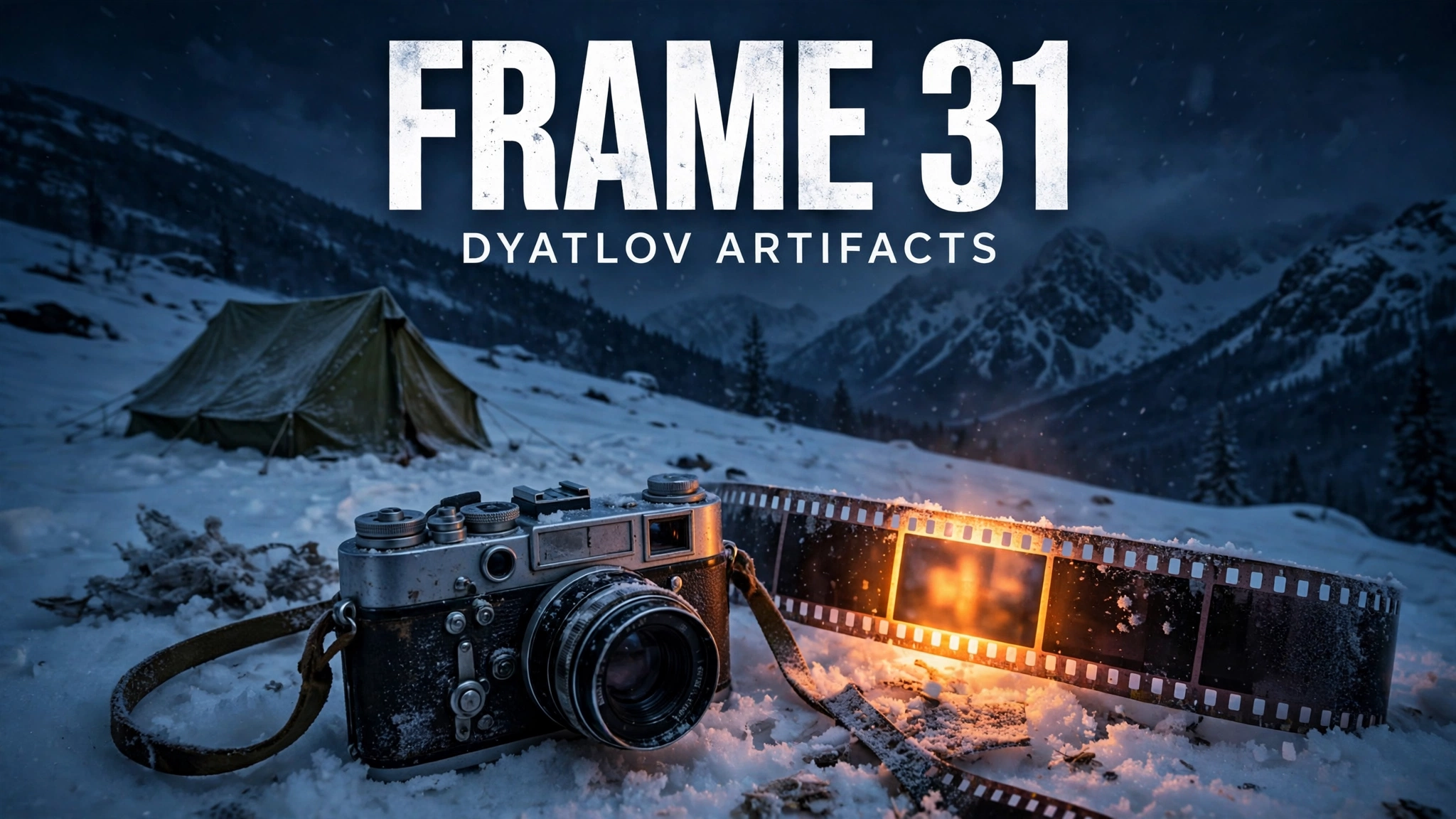
In February 1959, nine young people lost their lives on a snowfield in the Ural Mountains. The outline of the incident is as recorded in the sister article, “The Dyatlov Pass Incident,” but this article approaches the coordinates from a different angle. It follows the belongings they left at the scene. Cameras, diaries, tattoos, a pen and a notebook. For more than 60 years, these silent objects have gone on posing questions as voiceless witnesses.
Because the whole party was lost, the only clues to their final moments became the several cameras and the diaries left at the scene, and the traces carved into their bodies. The further the record is traced, the further the incident slips away from the framework of a natural disaster and changes into an unease that makes the observer shudder. On a snowfield at tens of degrees below zero, what on earth were they trying to capture through the lens? We dig up the fragments from deep inside the digital archive.
- Observing the Final Campsite on Google Maps
- The Mysterious Elder — Semyon Zolotaryov
- Exhumation and DNA Testing — A New Fragment from 2018
- Frame 31 — The Light Caught by the Lens
- Four Cameras and Film That Was Never Developed
- Evening Otorten — Humor on the Snowfield
- The Missing Tenth Companion — Yuri Yudin
- Development as a Second Incident — How the Record Became Public
- Our Reading — The Fate of the Observers
- In the Area: Places of Memory Around Yekaterinburg
- What to Eat: The Food of the Urals and Siberia
- Getting There: Starting from Yekaterinburg — A Journey Tracing the Record
- Fragments Assembled
- Sources & Further Reading
Observing the Final Campsite on Google Maps
Look down on the slope in aerial imagery, and what lies there is a bare, windswept white slope with nothing to block the wind. On February 1, 1959, the party pitched a tent on this slope and photographed one another with their cameras. Many of the photographs that were developed show a cheerful climb, smiles as they frolicked on the snowfield, and the severity of nature. They remain in the archive to this day as happy records that make the tragedy of the incident stand out all the more.
In the photographs, they show not even a shadow of a premonition of death. Their innocence, playing in the snow and smiling toward the camera, strikes the heart. That is exactly why the abnormal frame left at the very end of the film sends a chill down the spine of the viewer.
The Mysterious Elder — Semyon Zolotaryov
The members of the party were centered on students in their twenties, but one person with a very different background was mixed in among them. Semyon Zolotaryov. He was 37 years old at the time. A former soldier who had survived the Second World War, he joined this expedition at the last minute. He was not a student of the Ural Polytechnic Institute, and he is said to have worked as an instructor at a tourist base and in similar roles.
His presence turns this incident from a simple mountain accident into a story carrying something more. First, there are the tattoos left on his body. The autopsy report records the name “Gena (Гена)” on the back of the right hand, a drawing of a beet (a red beet) on the forearm, a five-pointed star, the number “1921,” and a mysterious string of characters, “ДАЕРММУАЗУАЯ,” among other marks. In the Soviet Union of the time, tattoos were seen on soldiers and in certain groups, and they were rare among ordinary citizens. Many of the tattoos were on parts of the body hidden by clothing, and the young people who traveled with him are said not to have known about many of them.
There is more. A camera was found wound around the neck of his body. Testimony also remains that, just before death, he was gripping a pen and a notebook. In the terror of fingers that would no longer move in the extreme cold, what was he trying to write down? The notebook is said to have been blank, but that very obsession tells us he was no ordinary victim — or at least, that is how the story has been passed down.
He was a former soldier born in 1921 and the oldest member of the party, at 37 years of age. He joined the expedition at the last minute. The autopsy report records multiple tattoos (the name “Gena,” a five-pointed star, “1921,” and others). A camera accompanied the body.
Testimony from a member of the search party says he was holding a pen and a notebook. However, the possibility that bodies were mistaken for one another has also been pointed out, and the record contains confusion.
Speculation, based on the number of tattoos and on his background, that he may have been a person with some kind of special past. There is no support for this, and it does not leave the realm of rumor.
The confusion in the record around Zolotaryov is also a miniature of the incident as a whole. Fact, testimony, and rumor become entangled, and the more they are untangled, the more new questions are born. What was captured in his camera? That is the subject of the next chapter.
Exhumation and DNA Testing — A New Fragment from 2018
The mystery around Zolotaryov continues into the present day. In April 2018, his grave was opened and DNA testing was carried out. The trigger was a question that had kept smoldering among family members and researchers: is the body in the grave really Zolotaryov? The number of tattoos and the puzzling background had given birth to speculation that another person had been impersonating him under his name.
The testing was carried out twice. The first round reached no conclusion, and in the second, mitochondrial DNA testing is said to have confirmed a match with relatives. Yet objections to this result also remain. This is not a matter that anyone who is not a specialist in DNA can settle, and debate continues to this day. Even after more than 60 years, the questions around the belongings and the record keep on growing. That is the nature of this incident.
The content of the tattoos recorded in the autopsy report itself has been made public in the English translation archive of the investigation file, and anyone can check it. The name “Gena,” a five-pointed star, the number “1921,” and a mysterious string of characters. What these meant is known only to the man himself. Speculation about the interpretation of the tattoos is plentiful, but there is no established reading. We want to keep this within the bounds of enjoyment as rumor.
Frame 31 — The Light Caught by the Lens
Many of the photographs developed from the several cameras the party carried showed a cheerful climb. Young people frolicking on the snowfield, a commemorative photograph in front of the tent, innocent smiles as they photographed one another. But among them, there is a single frame that gives off a strange glow. In the darkness, blurred and wavering, something like a spherical body of light — the final photograph that earlier accounts called “Frame 31.”
Two readings stand opposed around this photograph. One is the calm view that it is damage to the film or a mistake in development. The other is the view that it is a record of something they witnessed just before death. Offered as material supporting the second view is the testimony from the time: another mountaineering group, in a place not far from this pass, said they had witnessed strange orange spheres of light floating in the northern sky.
Frames 31 and 32 of the camera of Krivonishchenko, by the way, are said to be photographs capturing the final appearance of the party. On the evening of February 1, 1959, the party was beginning the climb over the pass toward Kholat Syakhl. According to the record, sunset that day was at 5:02 p.m. The photographs were taken just before night descended on the mountain. Their figures, equipment in order and walking with energy, show no premonition at all of the tragedy that would occur a few hours later.
And at the end of that film sits that blurred frame of light. A single abnormal frame placed immediately after the happy records. That gap stirs the imagination of the viewer.
Here, though, let us pause. The number “31” itself is open to debate as a strict identification, because the remaining film differed from camera to camera. While frames 31 and 32 of the camera of Krivonishchenko are said to be the last photographs that can be confirmed, they are sometimes discussed under different numbers. The confusion of the numbers itself tells the story of the fragmentation of the record.
Among the photographs developed from the cameras of the party, there is a frame in which something like a blurred body of light appears. Testimony about orange spheres of light from another mountaineering group also remains.
An explanation based on damage to the film, a mistake in development, lens flare, and similar causes. This is difficult for anyone who is not a specialist in photography to settle.
An interpretation of the frame as a record of an unknown phenomenon the party witnessed just before death. Earlier accounts also adopted this reading. This is not fact, and we want to savor it as rumor.
That blurred light, rising into view under the red light of the darkroom. What it was has been left behind on the snowfield together with the film. The only certainty is the fact that this single photograph has gone on capturing the imagination of people for more than 60 years, even now.
Four Cameras and Film That Was Never Developed
The cameras recovered at the scene are said to have been four in number. They belonged to Krivonishchenko, Dyatlov, Zolotaryov, and Slobodin. Six rolls of film are also said to have remained inside the tent. These cameras and rolls of film became valuable clues for reconstructing the final days of the party.
The content of the developed photographs tells the footsteps of the party in detail. A commemorative photograph at the place of departure, a single file moving across the snowfield, figures digging into the snow to pitch the tent, an evening scene just before crossing the pass. Every one is a vivid record with no shadow foretelling the incident. By following the photographs in chronological order, researchers were able to reconstruct the movements of the party almost exactly, it is said. The cameras were the most faithful witnesses the party had.
And yet here, too, there is a blank. The film of the camera wound around the neck of Zolotaryov was badly damaged, and even when it was developed, no readable image could be obtained, it is said. Why was his film alone damaged? Was it chance, or the effect of something? The record speaks no further than that.
On the internet, moreover, a rumor of a fifth camera also circulates. The camera of Thibeaux-Brignolle was not returned to the family because of radioactivity, so the story goes. This is a story set against the background of confusion in the investigation materials, but the support for it is thin, and it does not leave the realm of rumor. The confusion around the number of cameras itself shows how fragmentary the record of this incident is.
The party also left diaries behind. The shared diary was written in the handwriting of several members and conveys their cheerful mood before the incident. The diary of Kolevatov, on the other hand, comes with a tradition that it was taken away or lost, and its whereabouts are also passed down as a mystery. The records that remained, and the records that were lost. Both of them are belongings of this incident.
Evening Otorten — Humor on the Snowfield
Among the belongings of the party, one item is especially human: a handwritten satirical newspaper titled “Evening Otorten (Вечерний Отортэн).” The title is a play on Mount Otorten, the destination. The members took turns writing articles, setting down mishaps and episodes involving their companions in an amusing way. In the middle of a harsh expedition, they had not forgotten how to laugh.
The existence of this newspaper gives warmth to the record of the incident. Before they became victims, they were, without any doubt, a group of young people who were close to one another. They joked with one another, laughed together, and teased one another as they advanced across the snowfield. Because a record of that everyday life exists, the abnormality of the final photograph stands out all the more.
The shared diary is the same. The bright writing of Kolmogorova, the record kept by the members in rotation. What is written there is nothing special. Matters of meals, matters of weather, matters of the plans for tomorrow. But that very lack of anything special tells the size of what was lost. Belongings are not a record of death. They are a record of life.
The Missing Tenth Companion — Yuri Yudin
Soon after the departure, there was a man who turned back because of poor health. Yuri Yudin. On January 28, he left the party for reasons that included a worsening of sciatica, and he alone survived. He later said this: “If God would allow me a single question, I would want to ask what happened to my friends on that day.”
Yudin devoted the rest of his life to uncovering the truth. He was present for the identification of the articles left at the scene, and he went on demanding the release of the investigation materials. Until his death in 2013, he kept carrying the responsibility of the one who survived.
If he had not existed, the record of this incident might have faded away much sooner. Because the one who survived went on asking questions, the file was opened and debate continued. Yudin could be called the tenth recorder of the party. After his death, that role has been quietly passed on to researchers and to the families.
He withdrew on January 28 because of poor health and became the sole survivor. He continued activities aimed at uncovering the truth until his death in 2013.
“If God would allow me a single question, I would want to ask what happened to my friends on that day.” These words symbolize the unfinished nature of the incident.
The existence of Yudin gives a human temperature to this incident. The deaths of the nine were not a statistic. They were the question of a lifetime for one man who had lost his friends.
Development as a Second Incident — How the Record Became Public
The fact that the photographs and diaries of the party, and the investigation file, can be seen in the way they can today is the result of an excavation carried out over a long period of time. The investigation file of 1959 was designated as classified and was not made public for many years. After the collapse of the Soviet Union, part of it was disclosed, and from the 2000s onward, the independent researcher Teodora Hadjiyska published an English translation archive (dyatlovpass.com) of the investigation file, the autopsy reports, and the photographs, so that people around the world became able to come into contact with the primary materials.
In 2019, she visited the site together with an investigation team from the Discovery Channel, and in 2021 she published the book “1079,” written with Igor Pavlov. In 2024, this book received an award in the documentary division of the Russian Detective Award in Russia. The record of the incident has moved, little by little, from the shelves of the state into the hands of private people.
But the fact that the record became public does not mean the mystery was solved. If anything, the more materials there are, the more new questions are born. The confusion of the numbers of the photographs, the damage to the film, the loss of a diary. The release of the record was a second opening act for the incident. What we are looking at now is no more than a record that has passed through processing and dispersal. We want to face the materials with that awareness in mind.
Our Reading — The Fate of the Observers
Earlier accounts gave this article the subtitle “The fate of the observers who vanished on the snowfield of the Urals.” Observers — we think that is an apt name for them. They were fine engineers, they were mountaineers, and they were recorders. They held cameras, they wrote diaries, and they tried to leave their experience behind as data.
Zolotaryov died with a camera wound around his neck, gripping a pen. Dyatlov tried to return to the tent in the extreme cold. These things look like evidence that, to the final moment, they were trying to convey something. Even inside their terror, their reason did not lose the instinct to record.
Ironically, though, the records they left behind became fragmented, were damaged, or were put away on a classified shelf. The records of the observers scattered, as if refusing to be observed. The blurriness of Frame 31 may be a symbol of that. What should have been captured is not captured. What should have remained has not remained. But including even the outline of what did not remain, that is the record they left behind.
When we enlarge the digital map and gaze at that white slope, our line of sight overlaps with theirs, on the far side of the lens. Their diaries, closed while still unfinished, go on posing questions to us, the observers of today, that cannot be answered.
In the Area: Places of Memory Around Yekaterinburg
For a journey that touches the belongings of the incident, the realistic choice is to visit not the snowfield at the scene, but the places where memory is carried on. With Yekaterinburg as a base, tour the places of materials and of memorial.
At Ural Federal University (the former Ural Polytechnic Institute), the school the party attended, there is a memorial mourning the nine. A gathering of remembrance is said to be held there every year on February 2.
A foundation established by the families and friends. It continues activities calling for the release of materials and the uncovering of the truth, and it serves as a point of contact with the record of the incident.
Near the scene at Dyatlov Pass, a memorial to the party has been built. It is a place of prayer visited by those who have joined an expedition.
Not a physical site but a sacred place on the web: an English translation archive (dyatlovpass.com) of the investigation file and the photographs. It is ideal for preparation before a visit.
These places are places of memory rather than tourist spots. When visiting, we want to tour them quietly, without forgetting a feeling of mourning.
What to Eat: The Food of the Urals and Siberia
The food culture of the Urals and Siberia is a culture of preserved food, packed with the wisdom needed to survive a harsh winter. Here are northern flavors that can be tasted in Yekaterinburg.
A traditional dish of Siberia and the north, in which frozen fish is shaved into thin slices and eaten. It is a dish packed with the wisdom of a preserved food culture born of extreme cold.
A Russian savory bun. Fillings include meat, cabbage, potato, and many others, and the taste is a familiar one that can also serve as portable food for a journey.
Berries and mushrooms, the blessings of the forests of the Urals, are indispensable at the table as jam, as pickles, and as ingredients in soup.
Because the business conditions and menus of shops change, we do not list specific shop names or business hours. Check the latest information before visiting.
Getting There: Starting from Yekaterinburg — A Journey Tracing the Record
Many of the belongings of the incident remain in archives and in places of memorial. An expedition to the snowfield at the scene is extremely difficult, as the sister article explained, but a journey tracing the record can be put together starting from Yekaterinburg.
The central city of the Ural region. It is the city from which the party set out, and it is also a center for the carrying on of memory.
A memorial standing at the school the party attended. At this quiet place, where the names of the nine are carved, we first want to offer a silent prayer.
The northern town where the party made its final preparations. Beyond this point stretches a frontier unchanged from 1959.
Approach to the scene requires joining an expedition team led by a professional guide. In winter the approach is by snowmobile, and in summer by four-wheel-drive vehicle and on foot, over several days.
With the cost of a guided expedition, equipment, transport, and local stays combined, a total of several hundred thousand yen or more should probably be expected. Exact prices differ greatly by organizer, so this figure should be understood as an estimate.
Depending on the international situation, advisories or recommendations concerning travel to Russia may have been issued by the foreign ministries of each country. Always check the latest consular information. Winter temperatures reach minus 40 degrees, and sudden changes in the weather lead immediately to danger to life. Never approach without a specialist guide carrying a satellite phone.
Many of the original cameras and diaries are kept in archives, and they are not things that can be seen at the scene. Visit the scene purely as a place of mourning, and keep firmly in mind that taking any belongings away is completely out of the question.
North from Yekaterinburg: half a day by train, several hours by car, and then several days on foot. A journey tracing the record, and a journey standing at the scene, call for a different kind of resolve. Whichever is chosen, we want to keep respect for the nine in mind.
Fragments Assembled
The cameras, diaries, tattoos, pen and notebook left behind by the party. These belongings did not become a key that solved the mystery of the incident. They remained instead as fragments that deepened the mystery. What was the light of Frame 31? What was Zolotaryov trying to write? Where did the diary of Kolevatov disappear to?
They are all questions to which no answer has emerged. But perhaps that is all right. What the party risked their lives to leave behind was not an answer, but the record itself. What we can do is receive that record with care and hand it on to the next generation. A single frame of film, a single line of a diary, a single character of a tattoo. All of them are letters from the snowfield.
The film was damaged, and the notebook remained blank. And yet the will to leave something behind has certainly reached us. Quietly, across more than 60 years, all the way into our hands. The records of the observers, still unfinished, are being handed on to the next observers.
Sources & Further Reading
- Semyon Zolotaryov — DyatlovPass.com — The record of the career and tattoos of Zolotaryov
- Case Files 349-351 (Autopsy Report) — DyatlovPass.com — An English translation of the autopsy report (with a description of the tattoos)
- Dyatlov Pass Photos — All That Is Interesting — An explanation of the cameras and photographs of the party
- Kholat Syakhl — Ermak Vagus — Materials including frames 31 and 32 of the camera of Krivonishchenko
- 31 Days of Horror: The Dyatlov Pass Incident — Brett Talley — A record of the camera and belongings of Zolotaryov
- What Happened on Dyatlov Pass — The Scare Chamber — An organization of the outline of the incident, including Yudin